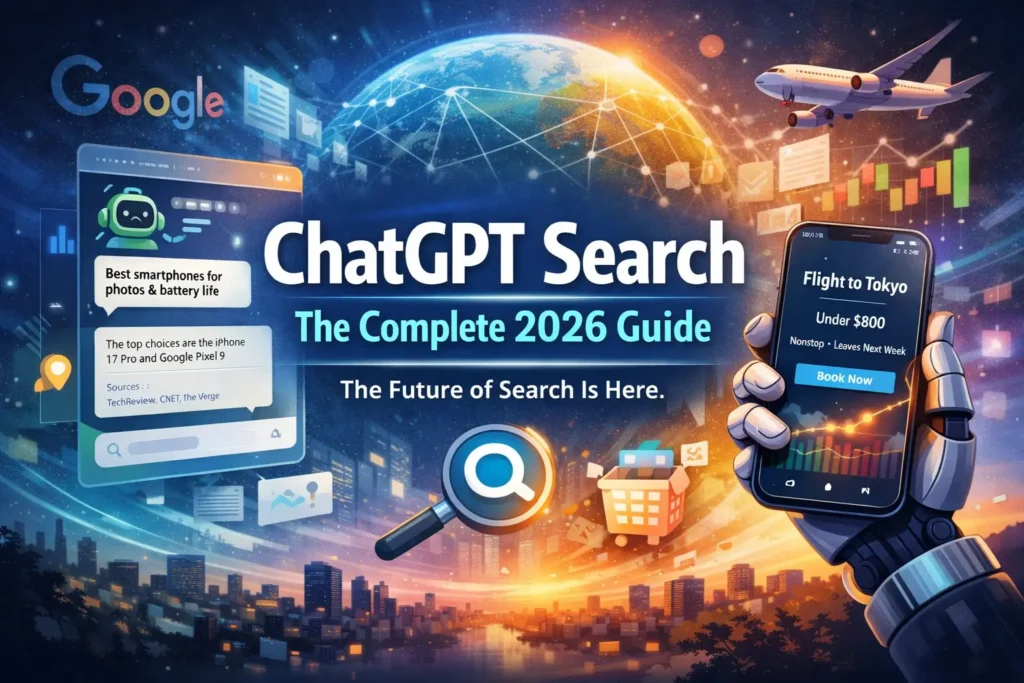
Something remarkable happened in early 2026: for the first time in over two decades, Google’s dominance in search is facing a genuine challenger. ChatGPT Search has captured 17–18% of the global query market—a number that would have seemed impossible just two years ago.
This is not just another search engine competing for scraps. ChatGPT Search represents a fundamental shift in how we find information online. Instead of scrolling through ten blue links, you get direct, conversational answers with sources you can verify.
If you are still using search the old way—typing keywords into Google and clicking through results—you need to understand what is changing and why it matters. This guide explains everything about ChatGPT Search in 2026: how it works, what makes it different, who should use it, and what these changes mean for the future of online search.
What Is ChatGPT Search?
ChatGPT Search combines the conversational power of ChatGPT with real-time access to current web information. Instead of providing a list of links, it synthesizes information from multiple sources and delivers direct answers in natural language.
Simple Explanation: ChatGPT Search is like having a research assistant who reads multiple sources for you, understands your question, and explains the answer in a conversation—not just a list of websites.
Officially launched on October 31, 2024 (originally announced as SearchGPT in July 2024), the service has evolved rapidly. You can explore it directly at OpenAI’s ChatGPT platform. In 2026, it represents OpenAI’s most serious challenge to Google’s search monopoly.
According to market data from January 2, 2026, ChatGPT Search now handles a staggering 17–18% of global queries, while Google’s share has dropped to 78–80%—down from 90% dominance just two years ago.
Just as every new administration inherits and reshapes large structural systems, each major AI platform release builds on—and disrupts—what came before it. ChatGPT Search is no different: it inherited the web’s existing information infrastructure and is now fundamentally reshaping how users interact with it.
How ChatGPT Search Actually Works
Traditional search engines like Google use crawlers that index billions of web pages. When you search, Google matches your keywords to its index and ranks results based on hundreds of factors.
ChatGPT Search works differently:
The Technical Architecture
Step 1: Query Understanding
When you ask a question, ChatGPT uses GPT-5.2 (specifically the “Instant” version for search) to understand what you are really asking—not just what words you typed.
Example: You ask: “Which phone should I buy if I want good photos and battery?”
- Traditional search matches keywords: phone, photos, battery
- ChatGPT understands intent: You want smartphone recommendations prioritizing camera quality and battery life
Step 2: Real-Time Web Retrieval
ChatGPT searches the web through partnerships with Microsoft Bing and direct media partnerships. It accesses current news articles, stock prices and financial data, weather and sports scores, maps and location information, shopping data and reviews, and real-time events and updates.
Step 3: Synthesis and Citation
This is where ChatGPT Search differs most from traditional engines. Instead of showing ten links, it reads multiple sources, extracts relevant information, synthesizes a coherent answer, provides inline citations for every claim, and includes source links in a sidebar.
Step 4: Conversational Follow-Up
Unlike one-shot searches, ChatGPT maintains context. You can ask follow-up questions, refine your search naturally, go deeper into specific aspects, and compare options side-by-side.
Retrieval-Augmented Generation (RAG)
ChatGPT Search uses Retrieval-Augmented Generation (RAG) technology to reduce hallucinations (made-up information). Instead of generating answers from memory alone, it retrieves actual web content, verifies information against sources, generates responses based on retrieved facts, and cites sources for verification. This “Resolution over Retrieval” model marks a fundamental shift from finding websites to getting answers.
Key Features of ChatGPT Search in 2026
The service has evolved significantly since launch. Here are the current capabilities:
Conversational Search Interface
Traditional Search: You type: “best restaurants near me” → Result: List of restaurant websites
ChatGPT Search: You ask: “What are good Italian restaurants within 10 minutes of downtown that take reservations?” → Result: Conversational answer with specific recommendations, price ranges, booking info, and follow-up suggestions
Real-Time Information
ChatGPT Search provides live data for: sports scores and game schedules, real-time weather forecasts, live stock quotes and market data, breaking news stories, concert tickets and local events, and current product prices and reviews. This eliminates the knowledge cutoff problem that plagued earlier AI tools.
Source Attribution and Verification
Every claim includes inline citations linking to source material, a source sidebar showing all references, publisher information, publication dates, and the ability to click through to original content. OpenAI has partnered with major news organizations including the Associated Press, Reuters, Financial Times, and The Atlantic to ensure accuracy and proper attribution.
Visual Search Results
ChatGPT Search displays images relevant to queries, maps for location-based searches, product photos for shopping queries, charts and graphs for data, and video thumbnails when appropriate.
Platform Integration
Available across ChatGPT website, iOS app, Android app, macOS app, Windows app, and can be set as the default search engine in Safari. As of 2026, the experience is consistent across all platforms.
Shopping and Commerce Features
In early 2026, ChatGPT introduced groundbreaking shopping capabilities:
- Shopping Research: ChatGPT asks clarifying questions about budget, needs, and preferences, then searches across the internet for real-time pricing, availability, reviews, and specs.
- Instant Checkout: Through partnerships with Shopify and Etsy, users can now purchase products directly within ChatGPT using the Agentic Commerce Protocol built with Stripe. Over one million U.S. sellers are integrated, including brands like Glossier, SKIMS, Spanx, and Vuori.
This conversational commerce experience even extends to lifestyle purchases. For example, if you’re shopping for organization solutions like a purse holder or handbag storage organizer, ChatGPT Search can now surface top-rated products, compare prices across sellers, and let you purchase without leaving the conversation—a true end-to-end commerce experience.
Who Can Access ChatGPT Search?
Access varies by subscription tier:
Current Availability (2026)
ChatGPT Plus ($20/month): Full access to ChatGPT Search, unlimited searches, priority access during peak times, all latest features
ChatGPT Team ($25–30/user/month): Everything in Plus, team collaboration features, admin controls
ChatGPT Enterprise: Custom pricing, enhanced security, dedicated support
ChatGPT Free: Limited search access, gradually rolling out to all users, may experience usage caps during high demand
ChatGPT Go ($10/month): Launched in 2026 as a middle tier—10× more messages than Free, access to GPT-5.2 Instant, ChatGPT Search included. Ideal for regular users not needing full Plus features.
ChatGPT Search vs Google: The Real Differences
The search wars of 2026 are not about who has more websites indexed. They are about fundamentally different approaches to information retrieval.
Approach to Answering Questions
Google: Shows you where to find answers, provides links to websites, lets you evaluate sources yourself, fast for simple factual queries
ChatGPT Search: Gives you the answer directly, synthesizes multiple sources, explains context and nuances, better for complex multi-part questions
When Google Is Better
Use Google when you need quick factual lookups (business hours, addresses), shopping with many product options, local business discovery, image or video search focused on browsing, or maximum search result variety.
When ChatGPT Search Is Better
Use ChatGPT Search when you need explanations (not just facts), comparison of multiple options, step-by-step guidance, research synthesizing many sources, conversational refinement of queries, or when learning about complex topics.
ChatGPT Search particularly shines when researching deeply layered topics. Take complex policy questions—like why every U.S. president spends more than their predecessor. Rather than clicking through a dozen articles, ChatGPT Search reads them all and delivers a synthesized, conversational answer with citations—ideal for understanding structural, historical, or multi-cause topics.
The “Duopoly of Intent”
Research from January 2026 identified an emerging pattern: users are not choosing one tool over the other. Instead, they use both for different purposes—Google for commercial searches and quick lookups, ChatGPT for learning, research, and decision-making. This “duopoly of intent” suggests the future involves multiple specialized search experiences rather than one dominant player.
How Businesses Can Optimize for ChatGPT Search
If ChatGPT commands 17–18% of search traffic, businesses cannot afford to ignore it. Here is how to ensure your business shows up in ChatGPT results:
Generative Engine Optimization (GEO)
Traditional SEO focused on keywords and backlinks. GEO (Generative Engine Optimization) focuses on what AI trusts: clarity over keyword density, authority over link quantity, structure over content volume, and transparency over marketing speak. GEO is about reshaping your content, data, and brand authority so that when someone asks an AI assistant a question, your business becomes the answer.
Implement Structured Data (Schema Markup)
Schema markup tells AI systems what your content means, not just what it says. Essential schema types include: Organization schema (business details), LocalBusiness schema (location, hours, services), Product schema (prices, availability, reviews), FAQ schema (common questions answered), and Review schema (customer ratings). Structured data is non-negotiable for AI visibility.
Build Authority Signals
ChatGPT evaluates trustworthiness through media mentions from reputable sources, customer reviews across platforms, industry certifications and credentials, expert author bylines, and consistent NAP (Name, Address, Phone) data.
Create Conversational Content
Write how people actually talk and ask questions: answer specific questions clearly, use natural language (not keyword-stuffed text), provide complete and helpful information, include examples and context, and structure content with clear headings.
Conversational content works especially well for lifestyle and fashion brands. For instance, a well-written guide like a comprehensive women’s platform heels style and comfort guide naturally answers the exact questions shoppers ask—making it highly discoverable through AI-powered search engines like ChatGPT Search.
Ensure Real-Time Accuracy
ChatGPT pulls current data, so keep website information updated, maintain accurate pricing and availability, update hours and contact information, refresh content regularly, and monitor and respond to reviews.
Partner with Relevant Platforms
Direct integrations matter: Shopify and Etsy for e-commerce, industry-specific directories, review platforms (Yelp, Google, Trustpilot), news and media outlets, and professional networks.
Beauty and fashion brands especially benefit from this approach. Detailed, authoritative content—such as an in-depth guide to the best tape-in hair extensions—tends to rank well in AI search results because it answers specific user questions with expert-level detail and clear structure.
Privacy and Data Concerns
With any search engine, privacy matters. Here is what you should know about ChatGPT Search:
Data Collection
What ChatGPT Knows: Your search queries, conversation history, follow-up questions, and interaction patterns
What Advertisers See: ChatGPT introduced limited advertising testing in January 2026. Ads use information that stays within ChatGPT. Advertisers never see your chats or personal details—only aggregated data (impressions, clicks). You can dismiss ads and manage personalization, delete ad data with one tap, and there are no ads in sensitive topic chats (health, politics) or for users under 18.
Privacy Controls
Users can delete conversation history, opt out of data being used for training, control memory features, manage ad personalization, and review what information is stored.
Comparison to Google
Google’s business model relies on tracking user behavior across the web for targeted advertising. ChatGPT’s model is primarily subscription-based, though advertising is being tested. For maximum privacy, consider using ChatGPT for sensitive searches, regularly clearing conversation history, and opting out of data training.
The Future of ChatGPT Search
Agentic Search (Coming 2026–2027)
The next evolution moves beyond finding information to taking action. Current: You ask ChatGPT “What flights are available to Tokyo next week?” Future: You say “Book me a flight to Tokyo next week under $800” and ChatGPT handles the entire transaction. Experts predict that the next phase will involve the AI not just finding information, but acting upon it.
Agentic AI search mirrors the kind of structural momentum that makes large systems hard to reverse. Much like the way government spending patterns persist across administrations due to compounding structural forces, AI-powered search is building irreversible momentum—each new capability (real-time data, shopping, agentic tasks) creates deeper user dependency that makes reverting to traditional search increasingly unlikely.
Multi-Modal Search
By end of 2026: point your phone camera at an object and ask questions about it, upload images and get contextual information, use AR glasses with integrated ChatGPT search, and voice-first search becomes standard. Voice capability has improved significantly, with better search responses and more complete answers.
Deeper Personalization
ChatGPT’s Memory feature (expanded in 2026) enables search results tailored to your preferences, context from past searches, understanding of your goals and priorities, and proactive suggestions based on patterns. Free users get lightweight memory, while Plus/Pro users get extended memory across sessions.
Integration with Other Services
ChatGPT is becoming a platform, not just a tool: direct shopping through Shopify/Etsy, calendar and scheduling integration, email and communication tools, file and document handling, and task and project management. ChatGPT is no longer just a chatbot—it’s becoming an end-to-end platform for discovery, research, and commerce.
The end-to-end commerce experience is already visible in everyday purchases. A shopper searching for a purse holder or handbag storage solution can now ask ChatGPT, get personalized recommendations based on closet size, budget, and style—and complete the purchase in the same conversation. This seamless flow is the future of retail discovery.
Competitive Response
Google is not standing still. In January 2026, Google made Gemini 3 the default model for AI Overviews globally. Microsoft continues enhancing Bing with AI features. Brookings Institution analysis suggests the market is evolving toward specialized AI search experiences rather than one-size-fits-all solutions.
Common Questions About ChatGPT Search
Is ChatGPT Search Free?
Limited access is free, with full features available in paid tiers. ChatGPT Go ($10/month) offers a middle ground with 10× more searches than Free.
How Accurate Is ChatGPT Search?
With RAG technology and source citations, accuracy has improved dramatically. However, always verify important information using provided source links.
Can I Trust the Sources?
ChatGPT partners with reputable news organizations and provides clickable citations. You can verify any claim by checking the source sidebar.
Does ChatGPT Search Replace Google?
Not necessarily. Many users employ both for different purposes—Google for quick lookups and shopping, ChatGPT for research and learning.
How Do I Make My Business Show Up?
Implement structured data, build authority signals, create helpful content, maintain accurate information, and consider platform integrations. Read more about Generative Engine Optimization strategies to get started.
What About Privacy?
ChatGPT offers more privacy controls than Google, though it still collects usage data. Review privacy settings and use controls to manage your data.
Will Traditional SEO Die?
No, but it is evolving. GEO (Generative Engine Optimization) complements traditional SEO. Both matter as users employ multiple search methods.
Content that performs well in traditional SEO often does well in GEO too, when it’s structured clearly and answers real questions. A guide like platform heels for women: style and comfort guide demonstrates the principle: focused, helpful, well-organized content earns visibility across both traditional search and AI-powered results.
Conclusion: The Search Revolution Is Here
ChatGPT Search is not a rumor or a prototype anymore. It is a fully functional search engine with 17–18% market share, 700 million weekly active users, and capabilities that fundamentally change how we find information online.
Key Takeaways
- ChatGPT Search launched October 2024, now commands 17–18% of global queries
- Provides conversational answers with source citations instead of link lists
- Uses GPT-5.2 architecture with real-time web access via RAG technology
- Available across all platforms with consistent experience
- Includes shopping and commerce capabilities with Shopify and Etsy integration
- Access tiers: Free (limited) → Go ($10/month) → Plus ($20/month) → Enterprise
- Businesses need GEO strategies alongside traditional SEO
- Not replacing Google but creating a “duopoly of intent”
- Future includes agentic capabilities, multi-modal search, and deeper integrations
What This Means for You
If you search the web: Try both Google and ChatGPT for different needs. Use Google for quick commercial searches, ChatGPT for research and learning.
If you run a business: Implement structured data immediately, build authority signals, and optimize content for conversational AI. The 17–18% of search traffic using ChatGPT will only grow.
If you work in digital marketing: Learn GEO alongside SEO. Test how your business appears in ChatGPT results. Monitor AI search trends closely.
The businesses winning in AI search are those creating genuinely useful, expert content. Whether it’s a detailed review of the best tape-in hair extensions or a comprehensive guide to AI search engines like this one—depth, accuracy, and structure are what AI systems reward.
The shift from “10 blue links” to conversational answers is not coming—it is already here. The question is not whether to adapt, but how quickly you can master this new search paradigm.