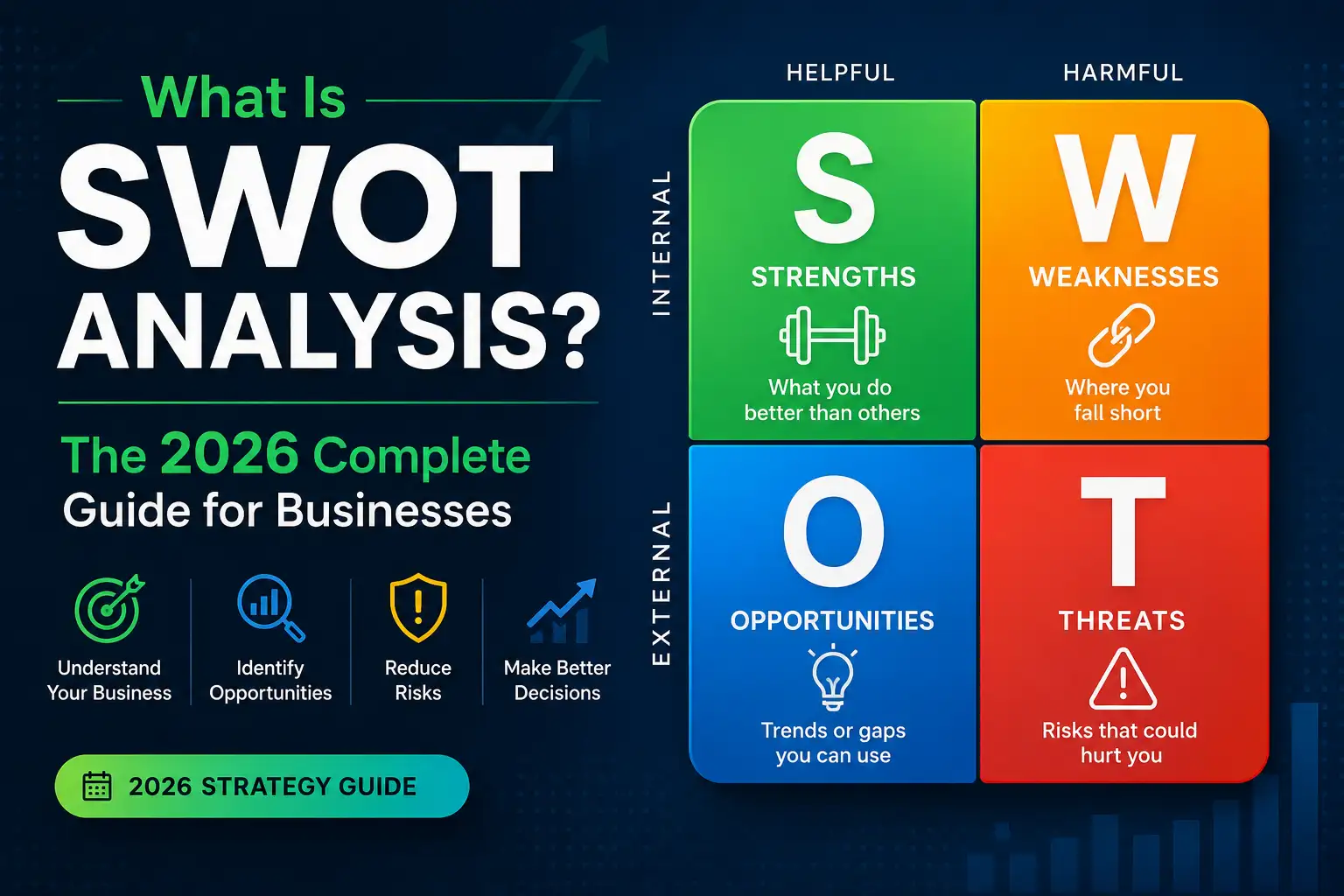
You did a SWOT analysis. You filled in all four boxes. You had a great session with your team.
And then… nothing happened.
That’s the most common problem with SWOT. It tells you what’s true about your business. But it doesn’t tell you what to do next.
That’s exactly where TOWS analysis comes in.
TOWS takes everything your SWOT uncovered and turns it into real, usable strategies. Instead of a list of observations sitting in a folder, you get a clear plan with specific actions for every situation your business faces.
This guide explains what TOWS analysis is, how it works, how it differs from SWOT, and how to build one step by step — with real examples that make the whole process click.
What Is TOWS Analysis?
TOWS is a strategic framework developed by Heinz Weihrich, a management professor, as a practical extension of SWOT analysis. Where SWOT helps you identify your situation, TOWS helps you act on it.
The letters stand for the same four things as SWOT — Threats, Opportunities, Weaknesses, and Strengths. The difference isn’t the words. It’s the direction of thinking.
SWOT asks: What are our strengths, weaknesses, opportunities, and threats?
TOWS asks: How do we combine these factors to create strategies?
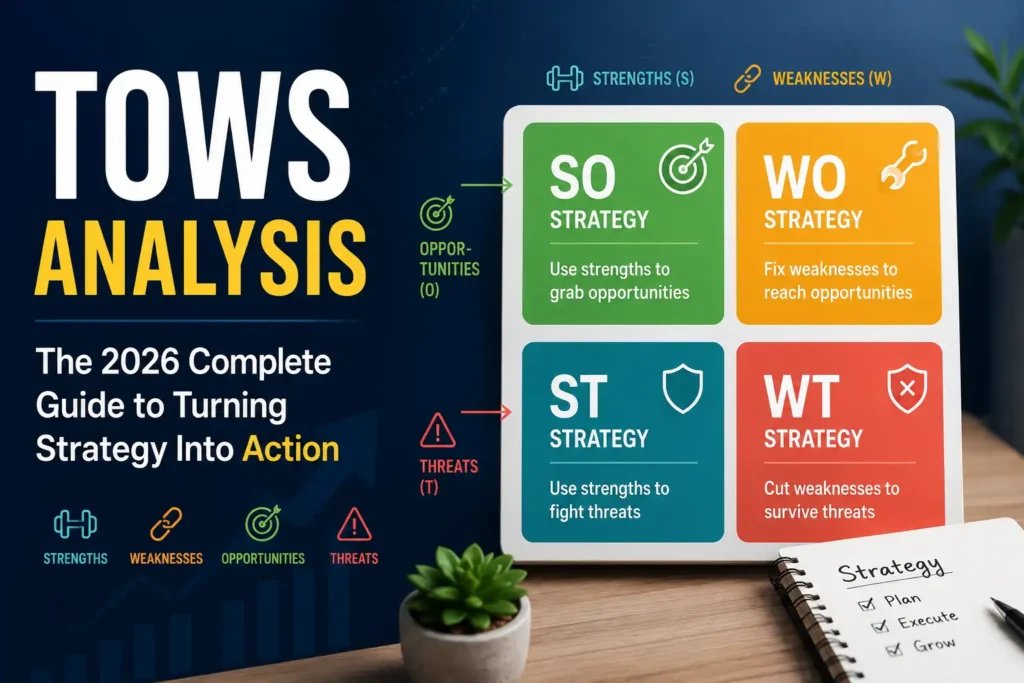
That single shift makes all the difference. Instead of four separate lists, you get a matrix that pairs internal and external factors together to produce four types of strategies.
| Strengths (S) | Weaknesses (W) | |
|---|---|---|
| Opportunities (O) | SO Strategy — Use strengths to grab opportunities | WO Strategy — Fix weaknesses to reach opportunities |
| Threats (T) | ST Strategy — Use strengths to fight threats | WT Strategy — Cut weaknesses to survive threats |
Each box in that grid is a different strategic direction. Together, they cover every situation a business can face.
TOWS vs SWOT: What’s the Actual Difference?
This is the question everyone asks. And it’s a fair one because the two frameworks look almost identical on paper.
Here’s the clearest way to understand it:
SWOT is diagnostic. TOWS is prescriptive.
Think of it like visiting a doctor. SWOT is the blood test and scan — it tells you what’s going on. TOWS is the treatment plan — it tells you what to do about it.
If you’ve already completed a SWOT analysis, you already have everything you need to build a TOWS. You don’t start over. You take those four boxes and use them as inputs for your TOWS matrix.
| Feature | SWOT | TOWS |
|---|---|---|
| Purpose | Diagnose your situation | Build strategies from it |
| Output | Four lists of factors | Four types of actionable strategies |
| Starting point | Internal factors (S and W) | External factors (T and O) |
| When to use | Beginning of planning | After SWOT, before execution |
| Result | Better understanding | Better action plan |
Another key difference is starting direction. SWOT traditionally starts from the inside — you look at your strengths and weaknesses first. TOWS flips that and starts from the outside — it asks you to look at market threats and opportunities first, then consider how your internal factors respond to them.
This outside-in approach is actually more realistic for most businesses in 2026. Markets move fast. Knowing your internal capabilities only matters in the context of what’s happening outside.
The Four TOWS Strategies Explained
Understanding each quadrant in detail makes the framework far easier to apply.
SO Strategies — Grow and Attack
SO stands for Strengths + Opportunities. This is also called the maxi-maxi strategy because you’re maximising both internal strengths and external opportunities at the same time.
These are your most aggressive growth strategies. You use what you’re best at to capture the best opportunities available to you right now.
Ask yourself: Which of our strengths gives us the best shot at capitalizing on this opportunity?
Example: A marketing agency with a strong content team (strength) notices that AI content tools are creating demand for human editing services (opportunity). SO strategy: Launch a premium “AI content editing” service using the existing writing team.
SO strategies are exciting to build because they’re growth-focused. But be careful — many businesses overload this quadrant with wishful thinking. Every SO strategy needs to be backed by a strength that genuinely exists, not one you wish you had.
WO Strategies — Improve and Reach
WO stands for Weaknesses + Opportunities. This is the mini-maxi strategy — you minimize your weaknesses to access opportunities you’re currently not positioned to take.
These strategies focus on closing gaps. An opportunity is sitting there, but something inside your business is stopping you from grabbing it.
Ask yourself: What’s preventing us from taking this opportunity, and how can we fix it?
Example: A local bakery sees rising demand for online orders (opportunity) but has no e-commerce setup (weakness). WO strategy: Partner with a food delivery platform to start selling online without building a custom website.
Notice how the WO strategy doesn’t have to mean fixing everything. It means finding the fastest path to an opportunity, even with limitations. That’s practical strategy.
ST Strategies — Defend and Protect
ST stands for Strengths + Threats. This is the maxi-mini strategy — you use your strongest assets to reduce the damage that threats can cause.
These strategies are defensive but not passive. You’re actively deploying your strengths as shields.
Ask yourself: Which of our strengths can protect us most effectively from this threat?
Example: A software company faces a new competitor offering lower prices (threat) but has a loyal customer base from years of excellent support (strength). ST strategy: Launch a loyalty program and deepen relationships with top clients before the competitor has a chance to poach them.
ST strategies often get underbuilt because businesses focus on growth and forget about protection. In 2026, with markets shifting quickly, a good ST strategy can be the difference between surviving a disruption and being flattened by it.
WT Strategies — Cut and Survive
WT stands for Weaknesses + Threats. This is the mini-mini strategy — you minimize weaknesses to avoid being destroyed by threats. It’s the most defensive quadrant.
These strategies aren’t glamorous. But they’re often the most important ones.
Ask yourself: If this threat hits us while we’re still weak here, what’s the damage — and how do we reduce our exposure?
Example: A retail store faces falling foot traffic (threat) while also having a poor online presence (weakness). WT strategy: Immediately start building a basic e-commerce store and social media presence to reduce total dependence on physical store visits.
WT strategies should be treated urgently. If you see a serious threat aligning with a serious weakness, that’s a red flag that needs action now — not next quarter.
How to Build a TOWS Matrix Step by Step
The process is straightforward when you follow it in order. Most of the work is actually done when you complete your SWOT first.
Step 1 — Complete Your SWOT First
You cannot build a TOWS without SWOT inputs. If you haven’t done this yet, start with a full SWOT analysis before coming back here.
Your SWOT should give you:
- 3 to 5 specific, data-backed strengths
- 3 to 5 honest weaknesses with real evidence
- 3 to 5 external opportunities with market support
- 3 to 5 genuine threats you can’t ignore
Vague inputs produce vague strategies. Before you start TOWS, make sure every point in your SWOT is specific enough to build a strategy from.
Bad strength: “We have a good team.”
Good strength: “Our customer success team has a 91% satisfaction score, which is 14 points above the industry average.”
That second version gives you something to work with. The first gives you nothing.
Step 2 — Set Up Your TOWS Grid
Draw out a 2×2 grid. Label the rows with your key Opportunities and Threats. Label the columns with your key Strengths and Weaknesses.
You don’t have to include every single SWOT factor. Pick the 2 to 3 most significant ones from each category. Quality over quantity here — you want strategies you’ll actually execute, not a list of 40 actions nobody touches.
Step 3 — Fill In Each Quadrant
Work through each box one at a time. In each quadrant, ask the matching question:
- SO: How can we use [strength] to capture [opportunity]?
- WO: How can we fix [weakness] to reach [opportunity]?
- ST: How can we use [strength] to reduce the impact of [threat]?
- WT: How can we reduce [weakness] to avoid being hurt by [threat]?
Try to generate 2 to 4 strategies per quadrant. Some combinations won’t produce anything useful — that’s fine. Move on. The goal is quality strategies, not filling every box.
Step 4 — Prioritize Your Strategies
You’ll end up with 8 to 16 potential strategies. You can’t execute all of them at once.
Use a simple scoring system to prioritize:
| Criteria | Score 1-5 |
|---|---|
| Impact on revenue or growth | __ |
| Ease of implementation | __ |
| Speed to results | __ |
| Resources required (lower = better) | __ |
| Strategic fit with overall goals | __ |
Add up the scores. The highest-scoring strategies go on your 90-day action list. Lower-scoring ones go in the “review later” pile.
Step 5 — Assign Owners and Deadlines
A strategy without an owner is just a wish.
For every strategy you commit to, assign:
- One person who is responsible for leading it
- A clear first action they can take this week
- A 30/60/90-day milestone to measure progress
This turns TOWS from a planning exercise into an execution engine.
Real TOWS Example: Online Fitness Brand
Let’s walk through a complete example. This makes the theory concrete and shows how it plays out in real life.
Company: An online fitness brand selling workout programs and supplements
SWOT Summary:
| Strengths | Weaknesses |
|---|---|
| 85,000 engaged Instagram followers | No email list built |
| Strong brand reputation for results | No physical product retail presence |
| High customer retention (76%) | Limited paid ads experience |
| Opportunities | Threats |
|---|---|
| Growing demand for personalized fitness plans | New well-funded competitors entering market |
| Corporate wellness programs expanding | Rising social media ad costs |
| AI tools reducing content creation costs | Influencer burnout reducing organic reach |
TOWS Matrix:
SO Strategies (Strengths + Opportunities):
- Use the strong Instagram audience to sell personalized fitness plan packages — high-ticket offers to a warm, engaged community
- Partner with 3 to 5 companies for corporate wellness contracts, using customer retention data as proof of results in sales pitches
WO Strategies (Weaknesses + Opportunities):
- Start building an email list immediately by offering a free 7-day meal plan to Instagram followers — this converts social followers into owned audience before reach declines
- Use AI content tools to cut content production time by 40%, freeing budget to test small paid ad campaigns
ST Strategies (Strengths + Threats):
- Before new competitors gain traction, run a “founding member” campaign to lock in loyal customers with annual pricing — high retention rate makes this conversion likely
- Create 4 weeks of evergreen content using AI tools to reduce dependence on frequent manual posting as influencer fatigue rises
WT Strategies (Weaknesses + Threats):
- Build the email list urgently so that if social media reach drops further, there’s a direct channel to customers that doesn’t depend on algorithms
- Test one retail partnership (a local supplement store or gym) to reduce total reliance on online-only sales before costs increase further
Notice how each strategy is specific. You can assign it to someone, start it this week, and measure it next month. That’s what TOWS produces when done right.
Common TOWS Mistakes to Avoid
Most people make the same errors. Knowing them ahead of time saves you a lot of frustration.
Mistake 1: Skipping SWOT and going straight to TOWS
TOWS needs SWOT inputs. If you rush the SWOT or skip it entirely, your TOWS strategies will be built on guesswork. Always do a proper SWOT first.
Mistake 2: Making strategies too vague
“Improve our marketing” is not a TOWS strategy. “Launch a referral program targeting our top 200 customers to generate 50 new leads by Q3” is a TOWS strategy.
The more specific you make each strategy, the more likely it gets executed.
Mistake 3: Filling every quadrant by force
Not every strength pairs with every opportunity. Not every weakness aligns with every threat. If a combination doesn’t produce a useful strategy, leave it blank. Forcing weak strategies just clutters your action plan.
Mistake 4: Building the TOWS alone
Strategic frameworks work better with input from different parts of your business. A sales rep might see a threat your leadership team hasn’t noticed. A customer service rep might know a weakness that never made it into the SWOT.
Get perspectives from across the team. You’ll build better strategies.
Mistake 5: Never updating it
Markets change. Competitors move. New opportunities appear. A TOWS that was accurate in January 2026 might be outdated by July 2026.
Set a quarterly calendar reminder to review and update your TOWS. It should be a living document, not a one-time project.
When Should You Use TOWS Analysis?
TOWS is most useful in specific situations. It’s not a framework you need to run every week — but in these moments, it’s exactly the right tool.
Use TOWS when:
- You’ve completed a SWOT and need to turn it into an action plan
- You’re planning for the next 6 to 12 months
- You’re facing a major new competitor and need to respond strategically
- You’re considering entering a new market or launching a new product
- Your business results have changed significantly and your old strategy feels off
- You’re preparing a strategy presentation for investors or leadership
Don’t use TOWS for:
- Small weekly decisions (it’s a strategic tool, not a daily checklist)
- Situations you don’t have good SWOT data for yet
- Individual projects where a simpler decision-making framework will do
TOWS and Competitive Analysis: Why They Work Together
TOWS doesn’t exist in a vacuum. The threats and opportunities you include in your matrix are only as good as your understanding of the market around you.
That’s why competitive analysis is such a powerful companion to TOWS. When you know exactly what your competitors are doing — where they’re strong, where they’re weak, what gaps they’re leaving — you populate your Threats and Opportunities boxes with far more precision.
Think about it this way. A vague Threat like “competition is increasing” produces a weak strategy. A specific Threat like “Competitor X just cut their price by 20% and is targeting our mid-market segment” produces a sharp, targeted response.
The same applies to opportunities. General awareness that “AI is growing” tells you little. But knowing that your top competitor has no AI-powered features yet — that’s an opportunity you can actually act on.
Running a competitive analysis before your SWOT and TOWS sessions means your inputs are grounded in real market intelligence, not just internal brainstorming. That’s the difference between strategic planning that works and strategic planning that sounds good in a meeting but never changes anything.
TOWS Tools and Resources for 2026
You don’t need expensive software to run a TOWS. But the right tools make it faster and more organized.
Free tools:
- Miro — Excellent for remote teams building TOWS matrices together in real time
- Canva — Clean visual templates for presenting your TOWS to stakeholders
- Google Slides — Simple, shareable, and sufficient for most teams
Paid tools worth considering:
- Cascade Strategy — Connects your TOWS strategies directly to goals and execution tracking
- Lucidchart — Professional matrix and diagram building for more complex strategy sessions
- SWOTPal — AI-powered SWOT and TOWS generation using real company data
For building better inputs:
- SEMrush or Ahrefs — Competitive research for your Threats and Opportunities boxes
- Google Trends — Spot market shifts before they become threats or disappear as opportunities
The tool matters less than the process. Even a whiteboard and sticky notes can produce a great TOWS if the team is engaged and the inputs are specific.
TOWS Quick Reference Table
Use this as a cheat sheet when you’re in the middle of a session.
| Strategy | Inputs Used | Core Question | Goal |
|---|---|---|---|
| SO (Maxi-Maxi) | Strengths + Opportunities | How do we use our best assets to grab the best opportunities? | Grow aggressively |
| WO (Mini-Maxi) | Weaknesses + Opportunities | How do we fix our gaps to reach the opportunities we’re missing? | Improve and reach |
| ST (Maxi-Mini) | Strengths + Threats | How do we use our strengths to reduce the damage from threats? | Defend and protect |
| WT (Mini-Mini) | Weaknesses + Threats | How do we reduce exposure where we’re most vulnerable to threats? | Survive and stabilize |
Key Takeaways
TOWS analysis is the most practical next step after any SWOT session. Here’s what to remember:
- TOWS = SWOT turned into action — same four factors, but used to build specific strategies
- There are four strategy types: SO (grow), WO (improve), ST (defend), WT (survive)
- Always complete SWOT first — TOWS needs those inputs to work
- Make every strategy specific and assignable — vague strategies don’t get executed
- Pair TOWS with competitive analysis to build sharper Threats and Opportunities
- Review quarterly — your TOWS should update as the market changes
- A TOWS matrix isn’t a one-time document — it’s a living strategic tool
The businesses that consistently outperform their competitors aren’t necessarily smarter or better resourced. They’re better at translating insight into action. TOWS is one of the simplest, most practical ways to do exactly that.
Ready to build the inputs for your TOWS? Start with a full SWOT analysis to get your four boxes right — then come back here and turn them into strategies that actually move your business forward.