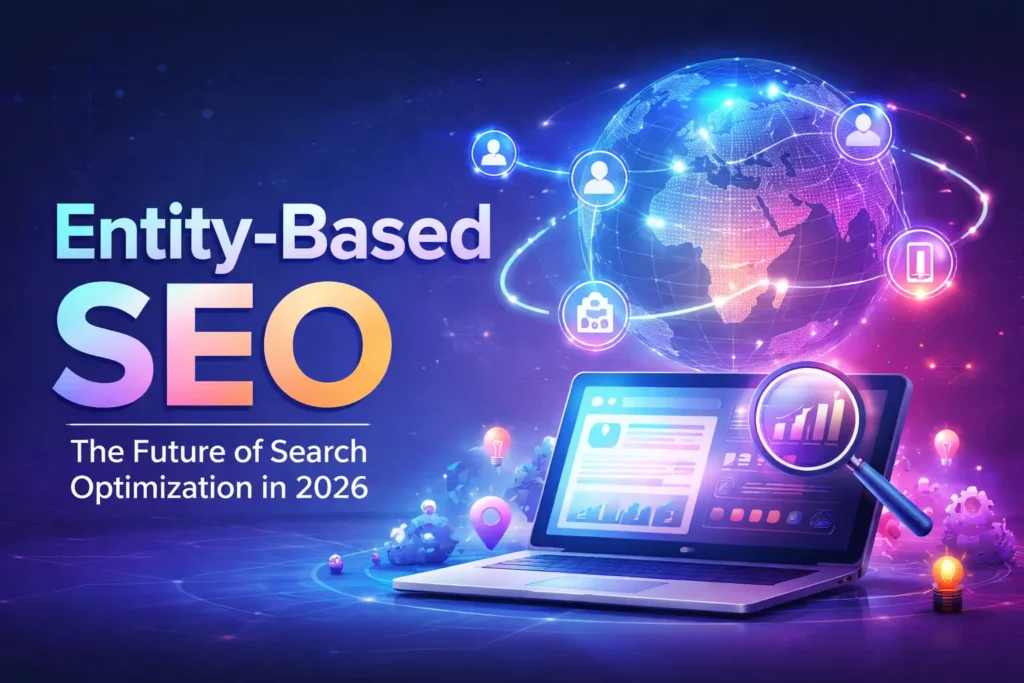
If you still think SEO is about stuffing keywords into blog posts and building backlinks, you are fighting yesterday’s war with yesterday’s weapons. In 2026, ranking on Google is not about keywords anymore. It is about entities.
Google now understands your business, your products, and your expertise as real-world concepts, not just words on a page. This shift changes everything about how you should approach search optimization.
This guide explains what entity-based SEO means, why it matters more than ever in 2026, and how to optimize your content for Google’s Knowledge Graph. Whether you run a small business or manage SEO for clients, understanding entities is now essential for visibility.
What Is Entity-Based SEO?
Entity-based SEO focuses on optimizing for concepts, people, places, and things rather than just keywords. An entity is anything that Google can identify as a unique, well-defined object.
Simple Definition: Entity-based SEO helps search engines understand what your content is about through meaning and relationships, not just word matching.
Think of entities as the building blocks of meaning. When someone searches for “Apple,” Google needs to know if they mean the fruit or the technology company. Entity understanding solves this problem.
Examples of Entities:
- People: Elon Musk, Taylor Swift, your company founder
- Organizations: Google, NASA, your business
- Places: New York City, Eiffel Tower, your store location
- Products: iPhone, Tesla Model 3, your services
- Concepts: Artificial intelligence, democracy, sustainability
Each entity has attributes that define it. For Apple Inc., those attributes include “technology company,” “founded by Steve Jobs,” “makes iPhones,” and “headquartered in Cupertino.”
Understanding how search engine optimization works helps you see why this shift toward entities matters so much.
Why Entity SEO Matters in 2026
The shift from keywords to entities is not gradual anymore. It is here, and it is fundamental to how search works now.
Google’s Knowledge Graph Powers Modern Search
Google launched its Knowledge Graph in 2012 with the purchase of Freebase. Today, it contains over 800 billion facts about billions of entities. This massive database powers almost everything you see in search results.
The Knowledge Graph enables:
- Knowledge Panels (those information boxes on the right side)
- AI Overviews (the AI-generated answers at the top)
- Featured Snippets
- People Also Ask boxes
- Related searches
- Entity carousels
When Google understands your business as an entity in its Knowledge Graph, you become eligible for all these high-visibility features.
AI Search Depends on Entity Recognition
AI systems like ChatGPT, Perplexity, and Google’s AI Overviews do not rank pages the traditional way. They pull information from sources they recognize as authoritative entities.
The Numbers Tell the Story:
- ChatGPT handles over 2.5 billion prompts daily with 800 million weekly active users
- Fewer than 25% of the most-mentioned brands are also the most-sourced
- Visibility now means being cited, referenced, or used as a source by AI
If your brand is not recognized as a clear entity, AI systems skip over your content even if it ranks well in traditional search. This is why entity-based SEO is critical for future-proofing your visibility.
As discussed in our article on the future of marketing with AI, AI-driven search is changing how customers find businesses.
Traditional SEO Is Declining in Effectiveness
Keyword optimization still matters, but it delivers diminishing returns. According to recent industry research:
- 72% of first-page results now use schema markup
- Entity authority determines visibility across hundreds of queries
- Pages without entity clarity struggle in AI-generated results
- Keyword density has almost no impact on modern rankings
The agencies and businesses succeeding in 2026 recognize that keyword optimization alone no longer drives rankings. Entity authority is what matters now.
Entities in SEO vs Traditional Keywords
Let us compare how traditional SEO and entity-based SEO work differently:
Traditional Keyword SEO:
- Focus on matching specific words and phrases
- Optimize for “email marketing software”
- Use exact match keywords in titles and headings
- Build links with anchor text containing target keywords
- Track rankings for individual keyword phrases
The Problem: This approach assumes Google is stupid and can only match words. But Google is smart now.
Entity-Based SEO:
- Focus on defining concepts and relationships
- Become recognized as an authoritative entity about email marketing
- Explain what email marketing is, what problems it solves, and how it works
- Connect to related entities like “marketing automation,” “CRM,” and “lead nurturing”
- Build authority across entire topics, not individual phrases
The Advantage: When Google recognizes you as an entity expert, you rank for hundreds of related queries without targeting each one individually.
What Are Entities in SEO? Understanding the Basics
To master entity SEO, you need to understand how Google identifies and categorizes entities.
Entity Attributes
Every entity has attributes that define it. These attributes help Google understand what the entity is and how it relates to other entities.
Example: A Local Restaurant Entity
- Name: Bella’s Italian Kitchen
- Category: Restaurant, Italian cuisine
- Location: 123 Main St, Portland, OR
- Hours: Monday-Sunday, 11 AM – 10 PM
- Price Range: $$
- Services: Dine-in, takeout, delivery
- Related Entities: Italian food, pasta, pizza, Portland restaurants
- Founder: Isabella Martinez (another entity)
The more clearly you define these attributes, the better Google understands your entity.
Entity Relationships
Entities do not exist in isolation. They connect to other entities through relationships. These connections help Google understand context.
Types of Relationships:
- Is-a: Pizza is a type of Italian food
- Part-of: Marketing automation is part of digital marketing
- Located-in: Your business is located in Portland
- Created-by: iPhone was created by Apple
- Related-to: SEO is related to content marketing
Google uses these relationships to answer complex queries and understand context. Strong, clear relationships make your entity more valuable in the Knowledge Graph.
How to Find Entities for SEO Optimization
Before you can optimize for entities, you need to identify which entities matter for your content. Here are proven methods:
Method 1: Google Search Results Analysis
Search for your target topic and look at what appears:
- What entities show up in Knowledge Panels?
- What topics appear in “People Also Ask”?
- What related searches does Google suggest?
- What entities are mentioned in AI Overviews?
These clues reveal what entities Google associates with your topic.
Method 2: Use Entity SEO Tools
Several tools help identify relevant entities:
InLinks: Analyzes content and suggests related entities with scores showing importance
Google’s NLP API: Shows exactly what entities Google extracts from your content
SEMrush Topic Research: Identifies semantically related topics and entities
Ahrefs Content Explorer: Shows what entities top-ranking content covers
Text Optimizer: Analyzes semantic relevance and entity coverage
These tools reveal entity gaps in your content compared to competitors.
Method 3: Wikipedia and Wikidata Research
Wikipedia is a goldmine for entity research because Google heavily uses it to understand entities.
Steps:
- Search Wikipedia for your main topic
- Note all linked entities in the article
- Check the “See Also” section for related entities
- Look at category tags at the bottom
- Use Wikidata to find Q-IDs (unique entity identifiers)
Wikidata Q-IDs connect your content to globally recognized entities. For example, “Machine Learning” is Q2539 in Wikidata.
Method 4: Analyze Top-Ranking Content
Look at what entities competitors mention:
- What concepts do they explain?
- What products, people, or companies do they reference?
- What related topics do they cover?
- How do they connect different ideas?
Comprehensive entity coverage often explains why certain content ranks well.
Method 5: Google’s Knowledge Graph Search API
For advanced users, Google’s Knowledge Graph Search API lets you query their entity database directly. You can verify if Google recognizes specific entities and see their attributes.
Method 6: Related Entity Gap Analysis
Compare your content’s entity coverage to competitors:
- Extract entities from top-ranking pages
- Extract entities from your content
- Identify which entities you are missing
- Determine which entities are most important
- Add missing entities to strengthen your content
This gap analysis reveals opportunities to improve entity optimization.
Method 7: Customer Research and Language
Listen to how your customers talk about your industry:
- What terms do they use?
- What concepts do they ask about?
- What related topics confuse them?
- What problems are they trying to solve?
Real customer language reveals important entities that connect your business to their needs.
Our guide on how AI is changing marketing shows how businesses use entity research to improve content.
Entity-Based SEO for LLMs: Optimizing for AI Search
Large language models like ChatGPT, Claude, and Google’s Gemini are changing how people find information. Entity-based SEO for LLMs requires a different approach.
Why LLMs Care About Entities
AI systems understand content through entities and their relationships. When you clearly define concepts and show how they connect, AI can:
- Recognize your content as authoritative
- Cite you as a source in generated answers
- Understand context without keyword matching
- Pull accurate information from your content
How to Optimize Content for LLM Citations
Be Explicitly Clear: Define concepts directly. Do not assume AI knows what you mean. For example:
Bad: “Our platform helps with workflows.” Good: “Our workflow automation platform helps marketing teams automatically route leads through email sequences and assign tasks based on predefined triggers.”
Use Structured Definitions: Start sections with clear definitions of what entities are:
“Email marketing is a digital marketing strategy that uses email to communicate with customers, promote products, and build relationships.”
Show Relationships: Explicitly connect related concepts:
“Email marketing automation, a subset of marketing automation, uses software to send targeted emails based on customer behavior and predefined rules.”
Provide Complete Context: Cover all aspects of an entity:
- What it is
- Why it matters
- How it works
- When to use it
- Who uses it
- Where it applies
Use Natural Language: AI understands conversational, clear writing better than keyword-stuffed content.
Google SEO Entities: Technical Implementation
Understanding entities is one thing. Implementing entity optimization is another. Here is how to do it technically:
Step 1: Create Your Entity Map
List all entities your website should represent:
- Your business as an entity
- Your products/services
- Key people (founders, experts, authors)
- Locations you serve
- Core concepts you cover
- Related industries and topics
This entity map becomes your optimization blueprint.
Step 2: Implement Schema Markup
Schema markup is structured data that tells Google exactly what entities exist on your pages.
Essential Schema Types:
Organization Schema: Defines your business entity
- Legal name
- Logo
- Contact information
- Social profiles
- Location
- Founding date
LocalBusiness Schema: For local entities
- Address
- Hours
- Price range
- Services offered
- Areas served
Person Schema: For individuals
- Name
- Job title
- Credentials
- Affiliations
- Expertise areas
Product Schema: For what you sell
- Name
- Description
- Price
- Availability
- Reviews
Article Schema: For content
- Headline
- Author (linked to Person entity)
- Date published
- Featured image
Use @id and sameAs Properties: These connect your entities to known entities in Google’s Knowledge Graph.
Example:
json
{
  "@type": "Organization",
  "@id": "https://yoursite.com/#organization",
  "name": "Your Business Name",
  "sameAs": [
    "https://en.wikipedia.org/wiki/Your_Business",
    "https://www.wikidata.org/wiki/Q12345678",
    "https://www.linkedin.com/company/yourbusiness"
  ]
}
The @id creates a unique identifier. The sameAs properties tell Google this is the same entity mentioned elsewhere.
Step 3: Optimize Internal Linking
Internal links create entity relationships. Link related concepts together:
- Product pages to service pages
- Blog posts about related topics
- Author pages to their articles
- Location pages to service pages
Use descriptive anchor text that identifies the entity: “Learn more about email marketing automation” instead of “click here.”
Step 4: Create Entity-Rich Content
Every page should clearly define its primary entity and related entities:
In the First 100 Words:
- State what the page is about
- Define the main entity
- Mention 2-3 related entities
Throughout the Content:
- Explain entity attributes
- Show relationships to other entities
- Provide comprehensive coverage
- Link to related entity pages
Use Headings Strategically:
- H2 headings should define key entities
- H3 headings should explain entity attributes or relationships
Step 5: Build Entity Authority Through E-E-A-T
Google evaluates entity trustworthiness through E-E-A-T signals:
Experience: Show you have real experience with the topic Expertise: Demonstrate deep knowledge Authoritativeness: Build recognition as the go-to source Trustworthiness: Prove you are reliable and accurate
How to Build E-E-A-T:
- Author content with named experts
- Cite authoritative sources
- Get mentioned by respected publications
- Earn high-quality backlinks
- Build a strong brand presence
- Maintain consistent NAP (Name, Address, Phone) across the web
Learn more about building authority in our article on branding strategies for modern businesses.
Best Entity-Based SEO Tools 2026
The right tools make entity optimization much easier. Here are the top entity SEO tools available in 2026:
Content Optimization Tools
InLinks ($49-$199/month): Specializes in entity-based content optimization. Automatically adds internal links based on entity relationships.
Surfer SEO ($89-$219/month): Includes entity analysis in content editor. Shows semantic term recommendations.
Clearscope ($170-$1200/month): Analyzes top-ranking content for entities and topics. Provides entity coverage scores.
MarketMuse ($149-$1,500/month): AI-powered content intelligence platform. Identifies entity gaps and opportunities.
Schema Markup Tools
Schema Pro ($79-$249/year): WordPress plugin for easy schema implementation. Supports all major schema types.
Rank Math (Free-$59/year): SEO plugin with built-in schema markup. Great for small businesses.
Google’s Structured Data Markup Helper (Free): Official Google tool for creating schema markup.
Schema.org: Reference site for all schema types and properties.
Entity Research Tools
Google’s Natural Language API (Free tier available): Shows exactly what entities Google extracts from text.
Text Optimizer ($29-$199/month): Semantic analysis tool. Reveals entity relationships and importance.
AlsoAsked ($9-$99/month): Shows “People Also Ask” questions. Reveals related entities.
AnswerThePublic (Free-$99/month): Visualizes search questions. Identifies entity relationships.
Entity Monitoring Tools
Google Search Console (Free): Track how Google sees your entities. Monitor Knowledge Panel appearances.
BrightLocal ($29-$249/month): Local entity management. Tracks citations and entity consistency.
Kalicube Pro (Custom pricing): Entity management platform. Monitors Knowledge Panel and brand entity health.
Local Entity SEO: Dominating Local Search
Local businesses face unique entity challenges. Your entity identity affects which searches you appear in.
The Entity Boundary Problem
Your business name and category create an “entity boundary” that determines search eligibility. Recent research from January 2026 shows this dramatically impacts local visibility.
Example: A cafe named “Tropical Sips & Smoothies” with menu items including sandwiches and salads might not appear for “sandwich shop” searches because Google classifies it as a smoothie shop based on the name.
The Fix:
- Choose business names that reflect all major services
- Select primary categories carefully
- Add secondary categories in Google Business Profile
- Build consistent mentions across the web
Building Strong Local Entity Signals
Consistent NAP: Your name, address, and phone must match exactly across:
- Google Business Profile
- Your website
- Social media profiles
- Directory listings
- Citation sites
Rich Google Business Profile: Fill out every field:
- Business description with entity keywords
- Services with detailed descriptions
- Products with categories
- Attributes that define your entity
- Regular posts showing activity
Reviews Mentioning Entities: Encourage customers to mention specific services, products, and features. These mentions help Google understand your full entity scope.
Local Schema Markup: Implement LocalBusiness schema with complete information linking to your Google Business Profile.
Understanding how to build a strong marketing plan helps local businesses coordinate entity building with overall strategy.
Entity SEO Moving from Strings to Things
Google’s 2012 announcement said it best: “Things, not strings.” This phrase captures the entire entity revolution.
What This Shift Means
Before (String-Based):
- Google matched words in queries to words on pages
- “Best Italian restaurant Portland” looked for those exact words
- Rankings based on keyword density and backlinks
- Content optimized for search engines, not humans
After (Entity-Based):
- Google understands “best,” “Italian restaurant,” and “Portland” as separate entities
- It knows Italian restaurant is a type of restaurant
- It knows Portland is a location
- It connects these entities to answer the query
- Rankings based on entity authority and semantic relevance
Practical Implications
Your content must help Google understand entities:
- Define what things are
- Explain how things relate
- Show entity attributes clearly
- Connect entities through context
This approach makes content better for humans too. When you clearly explain concepts and relationships, readers understand better and trust you more.
Entity SEO Strategy: Building Long-Term Authority
Entity optimization is not a one-time task. It requires an ongoing strategy:
Month 1: Foundation
- Audit your current entity presence
- Check if you have a Knowledge Panel
- Verify schema markup implementation
- Create entity map for your business
- Identify entity gaps in content
Month 2-3: Implementation
- Add schema markup to all pages
- Create or update entity-defining content
- Optimize author pages with Person schema
- Build internal link structure connecting entities
- Update Google Business Profile completely
Month 4-6: Authority Building
- Publish comprehensive entity-covering content
- Earn mentions from authoritative sources
- Build quality backlinks to entity pages
- Get featured in industry publications
- Participate in relevant online communities
Month 7-12: Optimization and Expansion
- Monitor entity recognition in Search Console
- Track Knowledge Panel appearances
- Expand entity coverage to related topics
- Create content clusters around core entities
- Measure AI citation frequency
Ongoing: Maintenance
- Keep schema markup updated
- Maintain NAP consistency
- Refresh entity-defining content
- Monitor competitor entity strategies
- Adapt to algorithm changes
Common Entity SEO Mistakes to Avoid
Even experts make these mistakes. Learn from them:
Mistake 1: Generic Schema Markup
Plugin-generated schema often lacks depth. It might have basic Article markup but miss opportunities to:
- Connect authors to Person entities
- Link to organization entities
- Define relationships between entities
- Include all relevant properties
Always customize schema for your specific entities.
Mistake 2: Inconsistent Entity Information
Your business name, address, and details must match everywhere. Even small variations confuse Google’s entity recognition.
Use the exact same format across all platforms. “ABC Corp” and “ABC Corporation” might seem similar to you, but they are different entities to Google.
Mistake 3: Invisible Content in Schema
Google’s guidelines are clear: only mark up content users can see. Marking up hidden content violates guidelines and can result in penalties.
Mistake 4: Ignoring Entity Relationships
Defining entities without showing how they relate misses the point. Google understands entities through relationships.
Always explain:
- How your product relates to the problem it solves
- How your business relates to your industry
- How concepts connect to each other
Mistake 5: Keyword-First Thinking
Adding entity optimization on top of keyword-stuffed content does not work. You need to rethink content from an entity-first perspective.
Focus on meaning and comprehensiveness, not keyword density.
Mistake 6: No Author Entities
Anonymous content has less authority than content by recognized experts. Build author entities with Person schema and author pages.
Mistake 7: Weak Entity Boundaries
Local businesses especially suffer from unclear entity definitions. Be explicit about what you are and what you offer.
The Future of Entity-Based SEO
Where is entity SEO headed? Here are predictions for 2027 and beyond:
More AI-Dependent Search
AI Overviews will dominate more queries. Entity recognition becomes even more critical for AI citations.
Entity Verification
Google may require more verification of entity attributes. Expect stricter requirements for Knowledge Panels and entity recognition.
Cross-Platform Entity Identity
Your entity identity will matter across all platforms – Google, social media, review sites, and AI systems. Consistency becomes paramount.
Deeper Entity Understanding
Google will better understand entity attributes, relationships, and context. Surface-level entity mentions will not be enough.
Entity Reputation Signals
How entities are discussed across the web will affect rankings more. Brand reputation and entity sentiment become ranking factors.
Entity-First Content Tools
More AI tools will help create entity-optimized content automatically. But human expertise in defining entities will still matter.
Conclusion
Entity-based SEO represents a fundamental shift in how search works. In 2026, it is no longer optional. Businesses without clear entity presence face near-invisibility regardless of keyword optimization.
Key Takeaways:
- Entities are concepts, people, places, and things Google recognizes
- Google’s Knowledge Graph contains 800+ billion facts about entities
- AI search depends on entity recognition, not keyword matching
- 72% of first-page results use schema markup
- Entity authority drives rankings across hundreds of queries
- Clear entity definitions help both search engines and humans
The move from strings to things changes everything about optimization. Instead of chasing keywords, build recognition as an authoritative entity in your field.
Start with these steps:
- Create your entity map
- Implement proper schema markup
- Define entities clearly in content
- Build entity relationships through internal linking
- Strengthen E-E-A-T signals
Entity-based SEO aligns with how search actually works now. It makes your content better for users while improving visibility in traditional search and AI-generated results.
The businesses that master entity optimization in 2026 will dominate search visibility for years to come. The question is not whether to adopt entity-based SEO, but how quickly you can implement it.
For more on staying ahead of digital changes, read our articles on AI trends that are changing industries and emerging technologies to watch.
The entity revolution is here. Your visibility depends on how well Google understands your business as a distinct, authoritative entity in its Knowledge Graph.