“Can AI actually write copy that converts, or is it just expensive hype?”
After testing 15 AI copywriting tools over 200+ hours in early 2026, the honest answer is both—if you know which tools do what well. The AI copywriting market reached $3.53 billion in 2026 and projects to hit $7.9 billion by 2033, with 76% of marketers now using AI specifically for copywriting tasks. Yet many businesses waste hundreds monthly on premium tools when $20 ChatGPT Plus subscriptions produce better results with proper prompting.
The challenge isn’t finding AI copywriting tools—it’s separating genuinely useful platforms from glorified chatbot wrappers charging enterprise pricing. Marketing teams struggle with decision paralysis: Jasper claims “conversion-trained AI,” Copy.ai promises “workflow automation,” Anyword advertises “predictive performance scoring,” while Claude and ChatGPT deliver exceptional quality at fraction the cost.
This comprehensive guide reveals exactly which AI copywriting tools excel for content marketing in 2026, comparing Jasper, Copy.ai, Writesonic, ChatGPT, Claude, Anyword, and specialized platforms across output quality, pricing, features, and real-world performance. You will understand which tools justify their cost versus which are expensive repackaging, see actual use cases showing what works where, and learn selection criteria matching tools to specific content marketing needs.
Whether you manage content teams, run campaigns solo, or evaluate marketing technology, this guide transforms confusion into confident tool selection backed by testing data rather than marketing claims.
What Are AI Copywriting Tools? (2026 Reality)
Understanding what these tools actually do versus marketing promises:
AI Copywriting Tool Definition: AI copywriting tools are software applications using large language models (LLMs) and natural language processing (NLP) to generate marketing copy—including ads, emails, blog posts, product descriptions, and social media content—based on user prompts, helping marketers overcome writer’s block, scale content production, and create variations for testing.
What Changed in 2026:
2020-2023: Basic GPT-3 wrappers offering templates with limited customization
2024-2025: Specialized tools adding brand voice training, SEO optimization, and workflow features
2026: Market split between enterprise platforms with full content ecosystems versus sophisticated general LLMs (ChatGPT, Claude) matching quality at lower cost
The Uncomfortable Truth: Every specialized copywriting tool in 2026 uses the same underlying language models (GPT-4, Claude, Gemini) as $20/month chatbots. The premium pricing comes from templates, workflows, integrations, and brand memory—features valuable for agencies managing multiple clients but unnecessary for many solo marketers and small teams.
Core Capabilities:
Text Generation: Creating original copy from prompts or briefs
Brand Voice Learning: Training AI on company tone and style
Template Frameworks: Pre-built structures for ads, emails, landing pages
Multi-Variant Creation: Generating multiple versions for A/B testing
SEO Optimization: Keyword integration and search-friendly formatting
Team Collaboration: Shared workspaces and approval workflows
Learn about how to use AI for content marketing for implementation strategies.
How We Tested AI Copywriting Tools
Methodology ensuring fair comparison:
Testing Criteria (5 Key Areas)
Output Quality: Does copy sound natural and human? Is it compelling and conversion-focused, or generic and robotic?
Ease of Use: How intuitive is the platform? Can non-technical marketers generate quality copy quickly?
Features and Integrations: What templates, frameworks, and third-party connections are included?
Value for Money: Does pricing align with features and quality? Where does ROI break even?
Brand and Context Awareness: Can tools learn company voice and maintain consistency?
Testing Process
Standardized Inputs: Used identical prompts across all tools (product descriptions, blog intros, ad headlines, email sequences)
Blind Comparison: Reviewed outputs side-by-side without branding to eliminate interface bias
Real-World Application: Published test copy in actual campaigns measuring CTR and conversion impact
Editing Requirements: Tracked how much human refinement each tool’s output needed
Team Feedback: Gathered input from content creators, copywriters, and marketing managers
The Goal: Identify which tools deliver genuine value versus which are overpriced AI wrappers.
Best AI Copywriting Tools Compared (2026)
Comprehensive comparison of leading platforms:
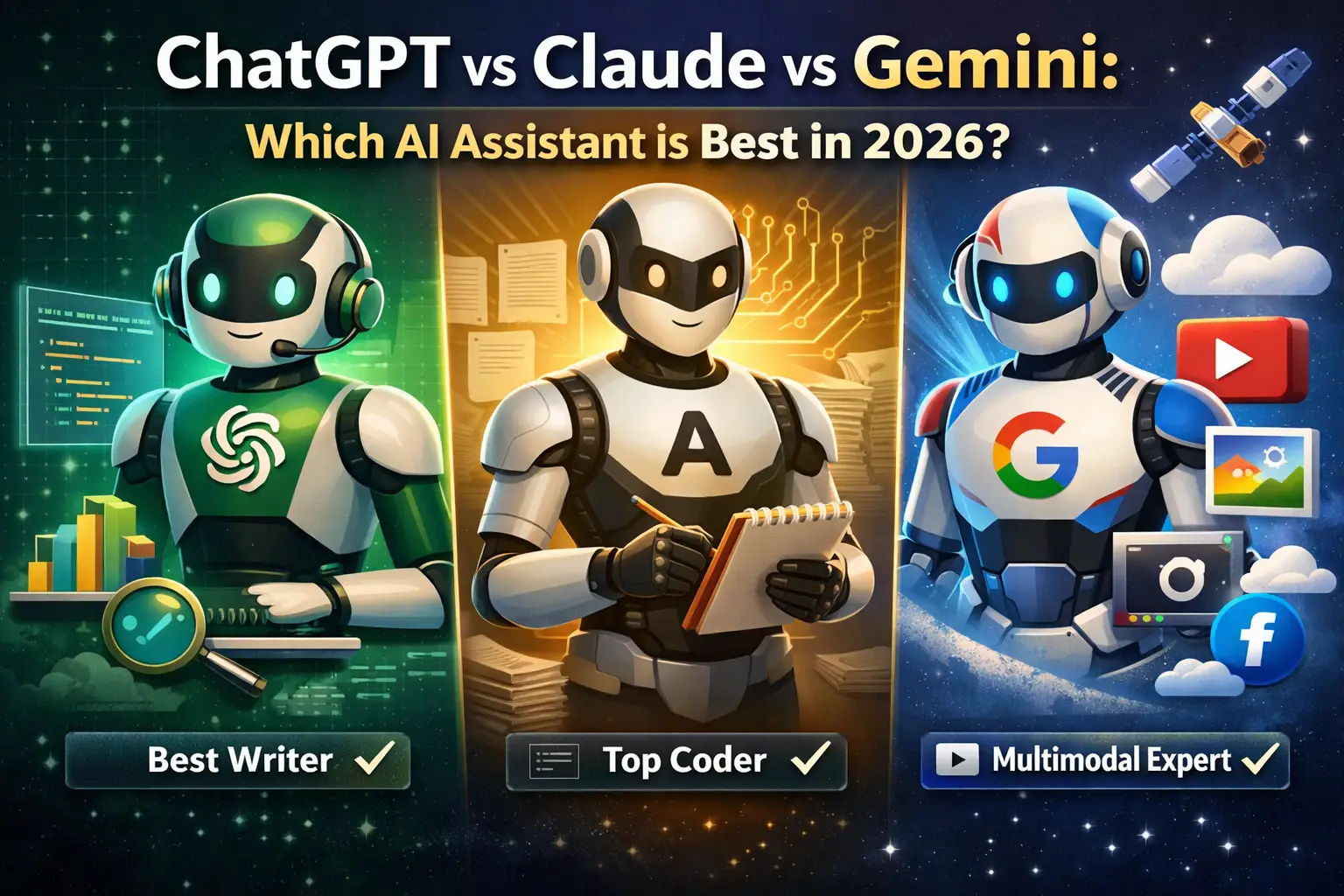
1. ChatGPT Plus (Best Overall Value)
Developer: OpenAI
Pricing: $20/month (Plus), Free tier available
Best For: Versatile copywriting across all content types with exceptional value
Key Features:
- GPT-4 access with advanced reasoning
- Custom GPTs for persistent brand context
- DALL-E image generation integration
- Web browsing for research
- Code Interpreter for data analysis
- Canvas feature for collaborative editing
Strengths:
- Unmatched price-to-quality ratio ($20 vs $49-$99 competitors)
- Most versatile—handles every content type excellently
- Largest community with abundant prompt templates and tutorials
- Can generate 20+ headline variations instantly
- Excellent at brainstorming and ideation
Limitations:
- No built-in brand workspace (recreate context each session unless using Custom GPTs)
- Default outputs tend generic without specific prompting
- Requires learning effective prompt engineering
- No dedicated templates for copywriting frameworks
Real Performance: 86% of marketers in Semrush’s December 2025 survey report ChatGPT as most effective AI marketing tool. A well-crafted ChatGPT prompt often outperforms $99 Jasper subscription with lazy brief.
Verdict: Start here. Only upgrade to specialized tools if you need specific features ChatGPT lacks (brand workspaces, team workflows, predictive scoring).
2. Claude Pro (Best for Long-Form Quality)
Developer: Anthropic
Pricing: $20/month (Pro), Free tier available
Best For: Nuanced, thoughtful long-form content requiring minimal editing
Key Features:
- Claude 4.5 advanced language model
- Superior factual accuracy and reasoning
- Extended context window (200K tokens)
- Attachment support for documents
- Natural, human-like writing tone
Strengths:
- Produces most human-sounding copy in blind tests (80% of marketers prefer for customer-facing content)
- Excellent at maintaining logical flow in long articles
- Strong at technical accuracy and fact-checking
- Less prone to hallucination than competitors
- Natural conversation style for prompting
Limitations:
- No persistent brand workspace (like ChatGPT)
- Fewer third-party integrations than specialized tools
- No built-in templates or frameworks
- Requires recreating context for each session
Real Performance: Marketing teams report 30-40% less editing time on Claude outputs versus other AI tools for blog content and thought leadership articles.
Verdict: Ideal for content marketers prioritizing quality over speed. Best choice for blog posts, white papers, case studies, and content where voice and accuracy matter most.
3. Jasper AI (Best for Enterprise Marketing Teams)
Developer: Jasper.ai
Pricing: $49/month (Creator), $69/month (Pro), Custom (Business)
Best For: Large teams needing brand consistency across multiple projects
Key Features:
- Brand Voice training system
- 90+ copywriting templates
- Surfer SEO integration
- Team collaboration workspace
- Campaign management tools
- Marketing automation workflows
- Multi-language support (30+ languages)
Strengths:
- Most sophisticated brand voice learning (trains on style guides, past content, messaging)
- Excellent team collaboration features
- Surfer SEO integration optimizes content in real-time
- Document editor feels like Google Docs
- Templates for every content type (ads, emails, blogs, social, product descriptions)
- Dedicated customer success for enterprise plans
Limitations:
- Expensive compared to ChatGPT/Claude quality
- Output can feel formulaic without customization
- Steep learning curve for advanced features
- Overkill for solo marketers and small teams
- ROI requires high content volume to justify cost
Real Performance: Marketing agencies managing 5+ client brands report significant time savings. Solo marketers often find $20 ChatGPT Plus produces comparable quality with better prompts.
Verdict: Worth the premium ONLY if you manage multiple brand voices across team members and need strict consistency. Solo marketers should start with ChatGPT/Claude.
4. Copy.ai (Best for Workflow Automation)
Developer: Copy.ai
Pricing: Free tier (2,000 words), $49/month (Pro – unlimited), $1,000+/month (Enterprise workflows)
Best For: Teams needing automated content workflows and GTM processes
Key Features:
- Unlimited word generation (Pro plan)
- 90+ copywriting templates
- Workflow Builder (Enterprise)
- Campaign orchestration
- Multi-channel content planning
- API access for integrations
Strengths:
- Unlimited generation removes word-count anxiety
- Strong short-form copy (ads, landing pages, headlines)
- Workflow automation for complex GTM processes
- Free tier generous for testing (2,000 words/month)
- Fast generation speed
Limitations:
- Platform transformation into “GTM AI” buried simple copywriting features
- Enterprise pricing steep ($1,000/month for Workflow Builder)
- Interface more complex than necessary for basic copywriting
- Core functionality now navigates through enterprise features
- Better for sales teams than pure content marketing
Real Performance: Users report frustration with platform evolution away from simple copywriting toward enterprise sales focus. Many switching to ChatGPT/Claude for cleaner interface.
Verdict: Excellent IF you need workflow automation and can justify enterprise pricing. For straightforward copywriting, ChatGPT Plus at $20 offers better value.
5. Anyword (Best for Performance Prediction)
Developer: Anyword
Pricing: $49/month (Starter), $99/month (Data-Driven), Custom (Business/Enterprise)
Best For: Performance marketers optimizing for conversion metrics
Key Features:
- Predictive Performance Score (82% accuracy)
- Copy Intelligence learning from past campaigns
- Real-time optimization suggestions
- Multi-channel performance tracking
- A/B testing recommendations
- ROI-focused generation
Strengths:
- ONLY tool predicting copy performance before publishing
- Learns from YOUR actual campaign data (not generic datasets)
- Tracks which messaging performs best over time
- Excellent for ad copy and email subject lines
- Performance scores update in real-time as you edit
- Strong at CTR and conversion optimization
Limitations:
- Expensive for what you get ($99/month for meaningful features)
- Performance prediction requires data history (less useful for new brands)
- Narrow focus on conversion copy (less versatile than ChatGPT/Claude)
- Learning curve for understanding scoring system
Real Performance: Marketing teams report 15-25% CTR improvement using Anyword’s predictions versus generic AI copy. ROI justifies cost ONLY if small CTR gains translate to significant revenue.
Verdict: Worth premium pricing for ad-heavy teams where 2% CTR improvement matters financially. Content-focused teams get better value from general LLMs.
6. Writesonic (Best Budget Option)
Developer: Writesonic
Pricing: Free tier, $20/month (Unlimited), Credit-based plans available
Best For: Budget-conscious marketers needing volume content
Key Features:
- Credit-based or unlimited plans
- Multiple AI model access (GPT-4, Claude, etc.)
- SEO optimization tools
- Article Writer for long-form
- Chatsonic for conversational AI
- 24+ language support
Strengths:
- Most affordable unlimited plan ($20/month)
- Flexibility choosing AI models per task
- SEO features built-in
- Decent long-form article generation
- API access for integrations
- Good balance of features and cost
Limitations:
- Output quality slightly below ChatGPT/Claude
- Credit system confusing for some users
- Interface less polished than premium tools
- Templates less sophisticated than Jasper
- Customer support slower than enterprise platforms
Real Performance: Content teams producing 20+ articles monthly find value in unlimited generation. For lower volumes, ChatGPT Plus matches quality at same price.
Verdict: Solid mid-tier option IF you need specific features ChatGPT lacks (SEO tools, templates). Otherwise, ChatGPT Plus delivers comparable quality with better interface.
7. Surfer SEO AI (Best for SEO Content)
Developer: Surfer SEO
Pricing: $89/month (Essential), $129/month (Scale), $219/month (Scale AI)
Best For: SEO-focused content teams prioritizing search rankings
Key Features:
- Content Editor with real-time SEO scoring
- SERP analysis and competitor research
- NLP entity recommendations
- Keyword optimization guidance
- AI article generation (Surfer AI)
- Integration with WordPress
Strengths:
- Reverse-engineers ranking pages for optimization guidance
- Real-time SEO score as you write
- Suggests exact terms, word count, heading structure for rankings
- Surfer AI generates pre-optimized drafts
- Strong at matching search intent
- Excellent for content teams focused on organic traffic
Limitations:
- Expensive ($89-$219/month)
- Narrow focus on SEO (not versatile like ChatGPT)
- Generated content sometimes keyword-stuffed
- Steep learning curve for full feature set
- Overkill if SEO isn’t primary goal
Real Performance: SEO teams report faster path from keyword to publishable draft. Content ranks competitively with minimal SEO editing. ROI depends on organic traffic value.
Verdict: Justified investment IF SEO is core strategy and rankings directly drive revenue. Content teams without SEO focus get better value elsewhere.
Learn about content marketing strategy integrating AI tools effectively.
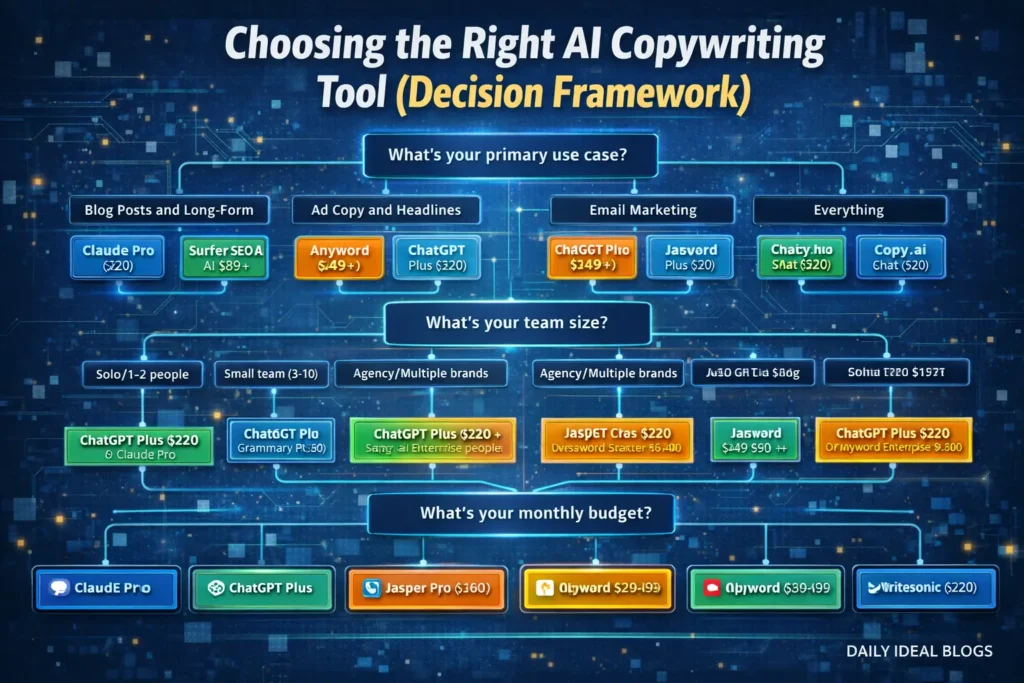
Choosing the Right AI Copywriting Tool (Decision Framework)
Matching tools to specific needs:
Decision Tree
Ask: What’s your primary use case?
Blog Posts and Long-Form: Claude Pro ($20) for quality, Surfer SEO AI ($89+) for rankings Ad Copy and Headlines: Anyword ($49+) for performance prediction, ChatGPT Plus ($20) for versatility Email Marketing: ChatGPT Plus ($20) for sequences, Anyword ($49+) for subject lines Product Descriptions: Jasper ($49+) for brand consistency at scale, ChatGPT ($20) for variety Social Media: Copy.ai ($49) for templates, ChatGPT ($20) for creative variations Everything: ChatGPT Plus ($20) or Claude Pro ($20)
Ask: What’s your team size?
Solo/1-2 people: ChatGPT Plus ($20) or Claude Pro ($20) Small team (3-10): ChatGPT Plus ($20) + Grammarly ($30) for editing Agency/Multiple brands: Jasper ($49-$69) for brand management Enterprise (20+ people): Jasper Business (custom) or Copy.ai Enterprise ($1,000+)
Ask: What’s your monthly budget?
Under $30: ChatGPT Plus ($20) or Claude Pro ($20) $50-100: Jasper Creator ($49), Copy.ai Pro ($49), or Anyword Starter ($49) $100-200: Jasper Pro ($69), Surfer Essential ($89), or Anyword Data-Driven ($99) $200+: Surfer Scale AI ($219), or enterprise custom pricing
Ask: What matters most?
Raw copy quality: Claude Pro ($20) Versatility across tasks: ChatGPT Plus ($20) Brand consistency: Jasper ($49-$69) Conversion optimization: Anyword ($49-$99) SEO rankings: Surfer SEO AI ($89-$219) Budget efficiency: Writesonic ($20) or ChatGPT Plus ($20)
Budget-Conscious Strategy
$14.50/month Total:
- Rytr ($7.50/month) for initial drafts
- Wordtune ($7/month) for polishing and tone adjustment
$20/month Total:
- ChatGPT Plus OR Claude Pro (choose based on content type)
$50/month Total:
- ChatGPT Plus ($20) + Grammarly Pro ($30)
- Covers generation, editing, and quality control
The Honest Recommendation
76% of use cases: Start with ChatGPT Plus ($20/month). Learn effective prompting. Only upgrade if you identify specific limitations.
Enterprise teams: Jasper if managing multiple brand voices across team members.
Performance marketers: Anyword if CTR improvements directly impact revenue.
SEO teams: Surfer SEO AI if organic rankings drive business growth.
Everyone else: Save money. ChatGPT Plus with good prompts outperforms most $49-$99 tools.
Common AI Copywriting Mistakes
Avoid expensive errors:
Mistake 1: Buying Premium Tools Without Testing ChatGPT
The Error: Signing up for $49-$99 tools before trying ChatGPT Plus ($20) with proper prompts.
Why It’s Costly: Most users discover ChatGPT produces equivalent quality after they’ve committed to annual contracts.
The Fix: Test ChatGPT Plus ($20) for one month with structured prompts before considering premium alternatives.
Mistake 2: Publishing AI Copy Without Editing
The Error: Treating AI output as publish-ready content.
Why It Fails: AI copy often lacks brand nuance, contains subtle inaccuracies, and uses generic phrasing readers recognize.
The Fix: Use AI for first drafts. Add human editing for voice, accuracy, specificity, and emotional resonance.
Mistake 3: Lazy Prompting
The Error: Vague inputs like “write a blog post about AI tools.”
Why It Fails: Generic prompts produce generic content regardless of tool quality.
The Fix: Use CART framework—Context (background info), Audience (who you’re writing for), Result (desired outcome), Tone (voice and style).
Example Good Prompt: “Write a 300-word product description for [Product Name], a project management tool for remote teams. Target audience: marketing managers at 10-50 person companies frustrated with scattered communication. Goal: convey how centralized dashboards reduce meeting time. Tone: professional but conversational, benefits-focused.”
Mistake 4: Ignoring Brand Voice Consistency
The Error: Letting different team members use AI without brand guidelines.
Why It Fails: Inconsistent tone and messaging confuse audiences and dilute brand identity.
The Fix: Create brand voice documents. Train AI (Custom GPTs, Jasper Brand Voice) on style guides. Require human review for consistency.
Mistake 5: Over-Reliance Without Strategy
The Error: Using AI to generate content without underlying content strategy, research, or differentiation.
Why It Fails: AI copies patterns from training data. Without strategic direction, you get well-written but undifferentiated content.
The Fix: Start with strategy—audience research, competitive analysis, unique positioning. Use AI to execute, not strategize.
Mistake 6: Choosing Tools Based on Features vs. Needs
The Error: Buying platforms with extensive features you’ll never use.
Why It’s Wasteful: Paying for enterprise collaboration when you work solo, or workflow automation when you need simple copywriting.
The Fix: Identify your 3 core use cases. Choose tools excelling at those specifically rather than “all-in-one” platforms.
Mistake 7: Neglecting Prompt Engineering Learning
The Error: Expecting tools to work perfectly without learning effective prompting.
Why It Limits Results: Prompt quality matters more than tool choice. Well-prompted ChatGPT beats poorly-prompted Jasper.
The Fix: Invest 10 hours learning prompt engineering. ROI is 10x better than upgrading tools.
Learn about AI marketing predictions shaping strategy.
The Future of AI Copywriting (2026-2027)
Where tools are heading:
Multimodal Content Creation: Tools combining text, image, and video generation in unified workflows. Create ad copy, visuals, and video scripts simultaneously.
Deeper Brand Learning: AI systems analyzing not just style guides but customer interactions, sales calls, support tickets for authentic voice matching.
Real-Time Performance Optimization: Copy automatically adjusting based on live campaign data and audience response.
Regulatory Compliance: Built-in checks for industry-specific regulations (healthcare claims, financial advice, legal disclaimers).
Human-AI Collaboration: Interfaces designed for iterative refinement rather than one-shot generation. Writers and AI working together fluidly.
Quality Over Quantity: Market maturing beyond “generate 100 articles” toward “create content that actually converts and builds brand.”
The Constant: Human oversight remains critical. AI handles volume and optimization. Humans provide strategy, emotional intelligence, and brand authenticity.
Conclusion: The Right AI Copywriting Tool for Your Marketing
AI copywriting tools in 2026 range from exceptional values (ChatGPT Plus, Claude Pro at $20/month) to specialized platforms justifying premium pricing for specific needs (Jasper for agencies, Anyword for performance marketing, Surfer for SEO teams). The challenge isn’t finding capable tools—it’s matching capabilities to actual requirements rather than marketing hype.
Key Takeaways:
- AI copywriting market reached $3.53B in 2026, growing to $7.9B by 2033
- 76% of marketers now use AI specifically for copywriting tasks
- 86% report ChatGPT as most effective AI marketing tool (Semrush survey)
- Every specialized tool uses same underlying models (GPT-4, Claude) as $20 chatbots
- Premium pricing justified ONLY for specific features: brand workspaces, team collaboration, predictive scoring, workflow automation
- ChatGPT Plus ($20) and Claude Pro ($20) deliver best price-to-quality ratio for most use cases
- Jasper ($49-$69) worth premium for agencies managing multiple brand voices
- Anyword ($49-$99) justified when small CTR improvements drive significant revenue
- Surfer SEO AI ($89-$219) makes sense when organic rankings are primary growth channel
- Prompt quality matters more than tool choice—well-crafted ChatGPT prompt beats lazy Jasper brief
- AI copy requires human editing for brand nuance, accuracy, and emotional resonance
- Future trends: multimodal creation, deeper brand learning, real-time optimization
What To Do Now:
This Week: Test ChatGPT Plus ($20/month) or Claude Pro ($20/month) with structured prompts using CART framework (Context, Audience, Result, Tone).
This Month: Identify your 3 core copywriting use cases (ads, blogs, emails, etc.). Evaluate if ChatGPT/Claude handle them excellently. Only upgrade if you hit specific limitations.
This Quarter: If managing teams or multiple brands, trial Jasper. If focused on conversion optimization, test Anyword. If SEO-driven, evaluate Surfer. Otherwise, master ChatGPT/Claude prompting.