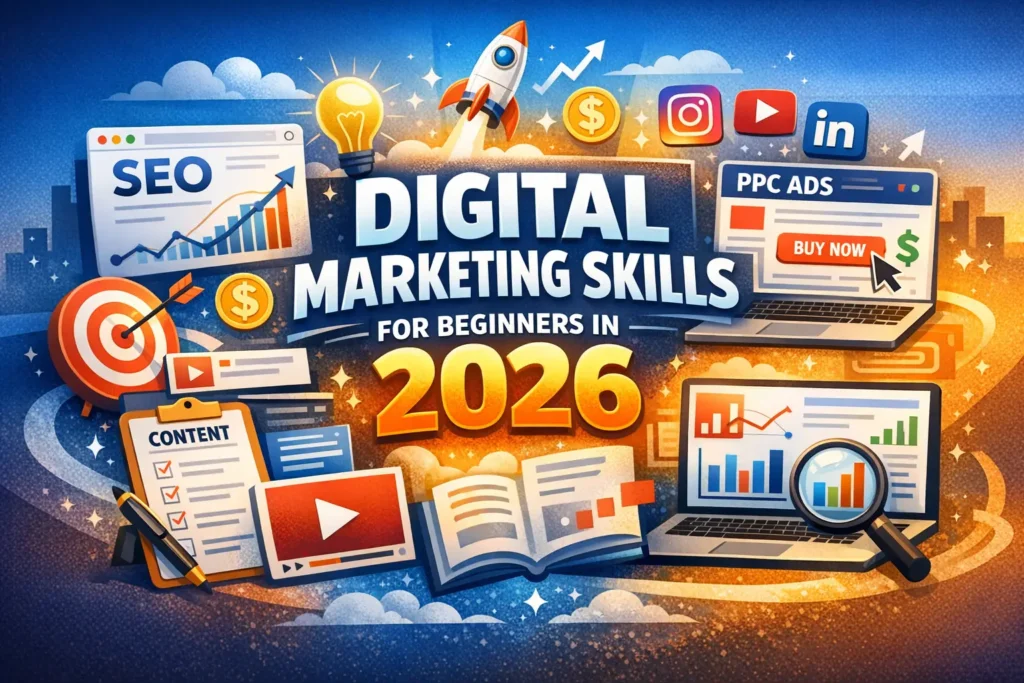
Digital marketing is not just a career—it’s a skill set that opens doors to remote work, freelancing freedom, and unlimited earning potential. Yet 73% of beginners quit within the first six months, not because the field is too difficult, but because they lack a clear roadmap showing which skills to learn and in what order.
According to February 2026 data, the digital marketing field continues its explosive growth with job postings increasing 15% year-over-year. Entry-level salaries average $57,000 annually with experienced professionals earning $80,000-$120,000 or more. The market rewards practical skills over formal degrees—93% of digital marketers report that hands-on platform experience matters more than traditional education.
The challenge for beginners is simple: digital marketing encompasses dozens of specialties from SEO to paid ads to social media management. Trying to learn everything simultaneously leads to overwhelm and abandonment. The successful approach focuses on mastering core foundational skills first, then specializing based on interests and market demand.
This comprehensive guide reveals the best digital marketing skills for beginners in 2026, based on latest job market data, employer requirements, and proven career paths. You will learn which skills to prioritize, how to develop each competency, realistic timelines for proficiency, and strategies for landing your first role.
Whether you are a complete beginner exploring career options, a professional seeking transition, or a student preparing for the job market, this roadmap transforms confusion into clarity and uncertainty into confident action.
Understanding Digital Marketing in 2026
Before diving into specific skills, grasp what digital marketing actually means today:
2026 Definition: Digital marketing is the strategic use of digital channels—search engines, social media, email, websites, mobile apps—to connect brands with customers, drive engagement, build relationships, and generate measurable business results.
What Changed from 2024-2025:
Then: Digital marketing focused primarily on content creation and organic reach Now: Performance marketing dominates with data-driven optimization and AI-powered automation
Then: Generalist roles were common across all digital channels Now: Specialization is rewarded with 25-40% higher salaries for deep expertise
Then: Technical skills alone determined success Now: Strategic thinking combined with execution capabilities separates leaders from followers
Key Insight: Digital marketing in 2026 requires both creative thinking (understanding human psychology and storytelling) and analytical thinking (interpreting data and optimizing performance). The most successful marketers blend both.
Understanding what is marketing provides essential foundation for digital specialization.
Why Digital Marketing Skills Matter in 2026
Current market data reveals why investing time in digital marketing makes sense:
Career Demand: Job postings for digital marketing roles increased 15% year-over-year according to latest analysis. Companies cannot find enough qualified candidates with practical platform experience.
Salary Potential:
- Entry-level: $45,000-$60,000 annually
- Mid-level (2-4 years): $60,000-$85,000
- Senior (5+ years): $85,000-$120,000
- Specialists (PPC, SEO): Often command 20-30% premiums
Career Flexibility:
- Remote work opportunities (60% of roles allow full remote)
- Freelance potential (top freelancers earn 5-6 figures annually)
- Geographic independence (work from anywhere)
- Multiple career paths (agency, in-house, freelance, entrepreneurship)
Low Barrier to Entry: Unlike many high-paying fields requiring advanced degrees, digital marketing rewards demonstrable skills. Build portfolio projects proving competency and bypass traditional education requirements.
Future-Proof: As long as businesses need customers and people use the internet, digital marketing remains essential. The channels evolve but fundamental principles endure.
Learn about AI marketing predictions shaping 2026 for future context.
The 12 Essential Digital Marketing Skills for Beginners
Based on February 2026 job market analysis and employer requirements:
Skill 1: Search Engine Optimization (SEO)
What It Is: The practice of optimizing websites and content to rank higher in organic search results, driving free, targeted traffic from search engines.
Why It Matters: SEO drives the highest ROI among B2B marketing channels with 748% return. It’s the foundation of digital visibility—if customers can’t find you in search, you don’t exist to them.
Core SEO Components:
On-Page SEO:
- Keyword research and strategic targeting
- Title tags and meta descriptions
- Header structure (H1, H2, H3)
- Content optimization for search intent
- Internal linking strategy
Technical SEO:
- Site speed optimization
- Mobile responsiveness
- XML sitemaps
- Structured data (schema markup)
- Core Web Vitals
Off-Page SEO:
- Link building strategies
- Brand mentions and citations
- Domain authority development
Tools to Master:
- Google Search Console (free, essential)
- Google Analytics 4 (free, essential)
- Ahrefs or SEMrush (professional keyword research)
- Screaming Frog (technical audits)
Learning Timeline: 2-3 months for fundamentals, 6-12 months for proficiency, continuous learning for expertise.
Practice Project: Build a niche blog or website, optimize 10-15 articles for target keywords, track rankings and traffic growth over 3-6 months.
Learn about entity-based SEO optimization for advanced strategies.
Skill 2: Content Marketing and Copywriting
What It Is: Creating valuable, relevant content that attracts audiences, builds trust, and drives profitable customer action through strategic storytelling.
Why It Matters: Content marketing is the #1 ROI-generating channel according to 93% of digital marketers. Well-written campaigns can double conversions without changing design or targeting.
Essential Components:
Writing Skills:
- Understanding tone, voice, and audience psychology
- Structural flow and readability
- Call-to-action placement
- Headline and hook creation
- Storytelling fundamentals
Content Types:
- Blog posts and articles
- Email campaigns
- Social media posts
- Landing pages
- Video scripts
- Ad copy
Strategic Elements:
- Content calendaring
- SEO integration
- Audience research
- Performance tracking
- Repurposing strategies
2026 Evolution: AI tools like ChatGPT and Claude assist with drafting, but human creativity, strategic thinking, and brand voice remain irreplaceable. The skill is learning AI-augmented workflows where technology handles initial drafts while humans provide strategic direction and refinement.
Learning Timeline: 1-2 months for basics, 3-6 months for solid competency, years for mastery.
Practice Project: Start a personal blog publishing weekly for 3 months. Write 20+ pieces covering one topic deeply. Track engagement metrics.
Skill 3: Social Media Marketing
What It Is: Building brand presence, engaging audiences, and driving business results through strategic use of social platforms like Instagram, Facebook, LinkedIn, TikTok, and YouTube.
Why It Matters: Social media is where brands interact with audiences daily. Effective social media marketing builds community, drives awareness, and converts followers into customers.
Platform-Specific Skills:
Instagram:
- Visual storytelling
- Reels and Stories creation
- Hashtag strategy
- Influencer collaboration
LinkedIn:
- Professional content creation
- B2B lead generation
- Thought leadership building
- Employee advocacy
TikTok:
- Short-form video production
- Trend participation
- Algorithm understanding
- Authentic brand personality
Facebook:
- Community management
- Groups strategy
- Meta Ads integration
Core Competencies:
- Content calendaring and scheduling
- Audience segmentation
- Engagement planning and community management
- Algorithm behavior understanding
- Brand storytelling consistency
- Analytics interpretation
- Crisis management
Tools to Master:
- Platform native schedulers
- Hootsuite or Buffer (scheduling)
- Canva (design)
- CapCut or InShot (video editing)
- Platform analytics dashboards
2026 Focus: Social media has become more performance-driven. Companies expect measurement of engagement quality, cost per result, and retention value—not just vanity metrics like follower counts.
Learning Timeline: 1-2 months for platform basics, 3-4 months for strategic competency.
Practice Project: Manage one platform consistently for 90 days. Post daily, engage actively, track growth and engagement metrics. Document what works.
Skill 4: Paid Advertising (PPC)
What It Is: Planning, launching, and optimizing paid campaigns across Google Ads, Meta Ads (Facebook/Instagram), LinkedIn Ads, and other platforms to drive targeted traffic and conversions.
Why It Matters: Paid advertising is the highest-value digital marketing skill. Businesses spend billions annually on paid channels and desperately need specialists who can deliver positive ROI.
Core PPC Skills:
Strategy:
- Campaign structure and organization
- Audience targeting and segmentation
- Bidding strategies
- Budget allocation
- Landing page alignment
Execution:
- Ad copywriting
- Creative development
- Keyword selection (search ads)
- Interest targeting (social ads)
- A/B testing frameworks
Optimization:
- Performance analysis
- Cost per click (CPC) reduction
- Conversion rate optimization
- Quality score improvement
- Attribution modeling
Platform Competencies:
Google Ads:
- Search campaigns
- Display advertising
- Shopping ads (e-commerce)
- YouTube advertising
Meta Ads:
- Facebook and Instagram campaigns
- Audience network
- Pixel implementation
- Catalog integration
LinkedIn Ads:
- Sponsored content
- B2B targeting
- Lead generation campaigns
Tools to Master:
- Google Ads platform
- Meta Ads Manager
- Google Analytics (conversion tracking)
- Google Tag Manager
- Ad testing tools
Entry Salary Impact: PPC specialists often start 20-30% higher than general digital marketers due to direct revenue impact. Top freelancers charge $1,000-$5,000+ per client monthly.
Learning Timeline: 2-3 months for platform fundamentals, 4-6 months for campaign management competency, continuous learning for optimization mastery.
Practice Project: Run small test campaigns ($5-$10 daily budget) for 30 days. Track metrics, optimize daily, document learnings. Build case study showing results.
Learn about content marketing strategy that integrates paid promotion.
Skill 5: Data Analytics and Measurement
What It Is: Collecting, interpreting, and acting on data to understand campaign performance, audience behavior, and business impact.
Why It Matters: Data analytics distinguishes real performance from speculation. Analytics is the center of digital marketing skills—businesses depend on metrics to allocate budgets and plan strategies.
Essential Analytics Competencies:
Tools:
- Google Analytics 4 (GA4)
- Google Tag Manager
- Google Search Console
- CRM systems (HubSpot, Salesforce)
- Heatmap tools (Hotjar, Crazy Egg)
Metrics Understanding:
- Traffic sources and attribution
- Conversion tracking and funnels
- User behavior patterns
- Customer journey mapping
- ROI calculation
Reporting:
- Dashboard creation
- Stakeholder communication
- Insight identification
- Recommendation development
2026 Expectation: Companies seek candidates capable of tying marketing activities to financial results. Present findings with clarity and data-driven evidence showing business impact.
Common Beginner Mistake: Many learn SEO and ads but go blank when asked to analyze data and create reports. Analytics is non-negotiable for career advancement.
Learning Timeline: 1-2 months for tool familiarity, 3-4 months for analysis competency.
Practice Project: Track personal website or campaign for 90 days. Create monthly reports summarizing performance, insights, and recommendations.
Skill 6: Email Marketing
What It Is: Building subscriber lists, designing email campaigns, and automating communication flows to nurture leads, drive engagement, and generate sales.
Why It Matters: Email continues delivering the highest ROI among digital channels when executed well—$36-42 returned per dollar spent. Critical for customer retention, lead nurturing, and remarketing.
Core Email Skills:
List Building:
- Lead magnet creation
- Sign-up form optimization
- Segmentation strategy
- Compliance (GDPR, CAN-SPAM)
Campaign Creation:
- Subject line writing
- Email copywriting
- Design and layout
- CTA optimization
- Mobile responsiveness
Automation:
- Welcome sequences
- Abandoned cart recovery
- Lead nurturing workflows
- Re-engagement campaigns
- Behavioral triggers
Performance:
- Open rate optimization
- Click-through rate improvement
- Conversion tracking
- A/B testing
- Deliverability management
Tools to Master:
- Mailchimp (beginner-friendly)
- ConvertKit (creator-focused)
- ActiveCampaign (automation-focused)
- HubSpot (enterprise)
Learning Timeline: 1-2 months for platform basics, 2-3 months for campaign competency.
Practice Project: Build email list to 100+ subscribers, create 5-email welcome sequence, track engagement metrics.
Skill 7: Marketing Automation
What It Is: Using software to automate repetitive marketing tasks like email sequences, social media posting, lead scoring, and customer segmentation.
Why It Matters: Automation enables personalization at scale. AI and automation tools allow marketers to manage sophisticated multi-channel campaigns without proportional resource increases.
Automation Applications:
Email:
- Drip campaigns
- Behavioral triggers
- Personalization at individual level
Social Media:
- Scheduled posting
- Content queuing
- Cross-platform publishing
Lead Management:
- Lead scoring
- Nurture workflows
- CRM integration
Tools to Master:
- HubSpot Marketing Hub
- ActiveCampaign
- Zapier (workflow automation)
- Hootsuite (social scheduling)
2026 AI Integration: Marketing automation increasingly incorporates AI for predictive analytics, content personalization, and performance optimization. Understanding AI-augmented workflows is becoming essential.
Learning Timeline: 1-2 months for tool basics, 2-4 months for workflow design.
Practice Project: Build automated welcome sequence with email, social follow-up, and lead scoring. Document workflow and results.
Skill 8: Conversion Rate Optimization (CRO)
What It Is: Systematically improving website and landing page performance to increase the percentage of visitors who complete desired actions.
Why It Matters: Doubling conversion rate has the same business impact as doubling traffic—but often costs far less. CRO maximizes ROI from existing marketing investments.
CRO Fundamentals:
Research:
- User behavior analysis
- Heatmap interpretation
- Session recordings
- User surveys and feedback
Testing:
- A/B testing methodology
- Multivariate testing
- Statistical significance
- Test prioritization
Optimization:
- Landing page design
- Copy and messaging
- Call-to-action placement
- Form optimization
- Trust signals and social proof
Tools to Master:
- Google Optimize (free A/B testing)
- Hotjar (heatmaps and recordings)
- Crazy Egg (visualization)
- Unbounce (landing pages)
Learning Timeline: 2-3 months for methodology understanding, 4-6 months for proficiency.
Practice Project: Run 5 A/B tests on landing page or website. Document hypotheses, results, and learnings.
Skill 9: Basic Graphic Design and Visual Content
What It Is: Creating visually appealing marketing materials including social media graphics, ads, email headers, and website images.
Why It Matters: While larger teams have dedicated designers, small businesses and agencies expect marketers to handle everyday visual tasks. Basic design skills create independence and faster execution.
Essential Design Competencies:
Principles:
- Layout and composition
- Color theory basics
- Typography fundamentals
- Visual hierarchy
- Brand consistency
Tools:
- Canva (beginner-friendly)
- Adobe Express (easy templates)
- Figma (professional design)
- Adobe Photoshop basics
Applications:
- Social media graphics
- Email headers
- Ad creatives
- Blog post images
- Presentation slides
2026 AI Assistance: AI image generation tools (DALL-E, Midjourney) accelerate visual content creation but require human direction for brand-appropriate output.
Learning Timeline: 1 month for tool basics, 2-3 months for design competency.
Practice Project: Create 30-day social media content calendar with all graphics designed yourself.
Skill 10: Video Marketing and Production
What It Is: Creating, editing, and optimizing video content for platforms like YouTube, TikTok, Instagram Reels, and LinkedIn.
Why It Matters: Over 90% of businesses use video as marketing tool. Short-form video delivers highest ROI among content formats according to 2026 data.
Video Skills:
Production:
- Smartphone filming techniques
- Lighting and audio basics
- Scripting and storyboarding
- On-camera presence
Editing:
- CapCut or InShot (mobile)
- DaVinci Resolve (desktop, free)
- Adobe Premiere basics
- Transitions and effects
Platform Optimization:
- YouTube SEO
- TikTok algorithm understanding
- Instagram Reels strategy
- Thumbnail creation
- Caption writing
Learning Timeline: 1-2 months for basic video creation, 3-4 months for platform-specific strategy.
Practice Project: Create and publish 20 short-form videos across 30 days. Track engagement patterns.
Skill 11: Marketing Strategy and Planning
What It Is: Developing comprehensive marketing plans that align campaigns with business objectives, target audiences, and available resources.
Why It Matters: Execution without strategy wastes resources. Strategic thinking separates senior marketers earning $100K+ from junior executors.
Strategic Competencies:
Planning:
- Goal setting (SMART framework)
- Audience research and persona development
- Competitor analysis
- Channel selection
- Budget allocation
Execution:
- Campaign brief development
- Timeline creation
- Team coordination
- Resource management
Measurement:
- KPI identification
- Success metrics definition
- Performance tracking
- ROI calculation
Learning Timeline: Developed through experience over 1-2 years of execution.
Practice Project: Create complete marketing plan for hypothetical business. Include situation analysis, strategy, tactics, and measurement framework.
Learn about competitive analysis for strategic planning.
Skill 12: AI Tools and Platforms
What It Is: Leveraging artificial intelligence tools to enhance marketing efficiency, personalization, and performance.
Why It Matters: AI doesn’t replace marketers—it amplifies human capabilities. Marketers who integrate AI effectively work faster, produce more, and deliver better results than those who don’t.
AI Applications in Marketing:
Content Creation:
- ChatGPT and Claude for drafting
- Jasper for marketing copy
- Copy.ai for variations
Design:
- DALL-E and Midjourney for images
- Canva AI features
Research:
- Perplexity for market research
- Google AI Mode for trend analysis
Analytics:
- Predictive analytics platforms
- AI-powered insights
Automation:
- Chatbots for customer service
- AI email personalization
Critical Understanding: AI is amplifier, not replacement. Human creativity and strategy still drive success. The skill is directing AI effectively rather than relying on it blindly.
Learning Timeline: 1-2 months for tool familiarity, ongoing learning for advanced applications.
Practice Project: Create content series using AI for drafting, then refine with human editing. Compare AI-assisted vs. purely manual workflows.
Learn about how to use AI for content marketing for detailed implementation.
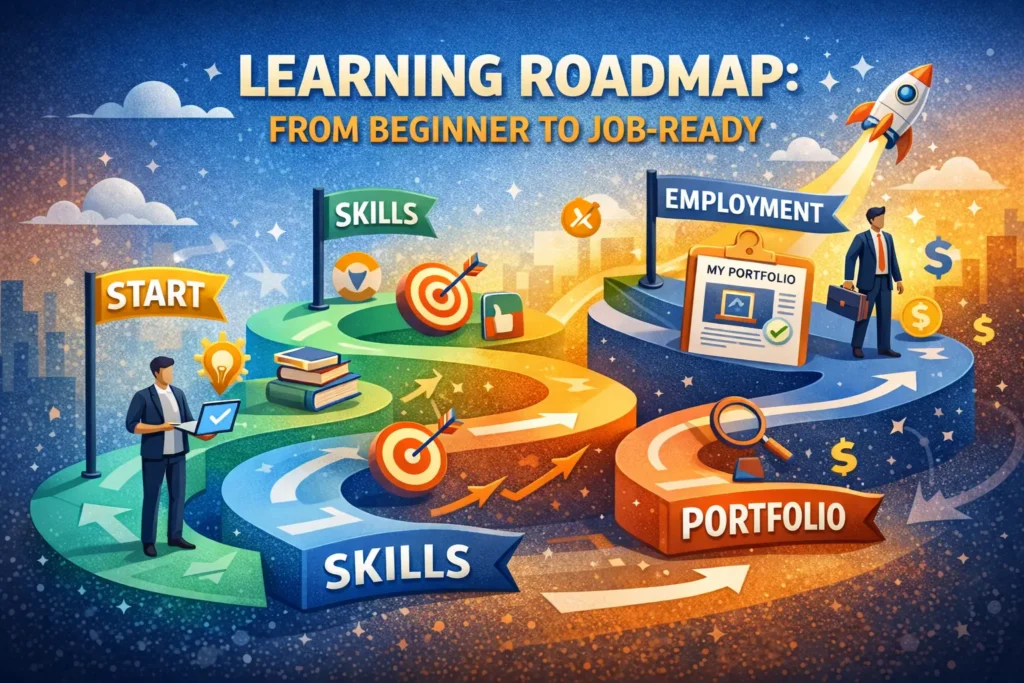
Learning Roadmap: From Beginner to Job-Ready
Realistic timeline for skill development:
Months 1-2: Foundations
Focus: Marketing fundamentals and first platform
Activities:
- Study marketing basics and consumer psychology
- Choose first skill focus (recommend SEO or social media)
- Complete beginner course
- Build first practice project
- Start personal brand (LinkedIn, portfolio site)
Goal: Understand digital marketing landscape and gain initial platform experience.
Months 3-4: Depth in Primary Skill
Focus: Mastering chosen specialty
Activities:
- Advanced training in primary skill
- Complete 2-3 substantial projects
- Document results and learnings
- Begin second skill (recommend pairing SEO with content, or social with paid ads)
Goal: Develop job-ready competency in one area.
Months 5-6: Breadth and Portfolio
Focus: Complementary skills and proof of work
Activities:
- Learn second skill to proficiency
- Build comprehensive portfolio
- Create case studies from projects
- Network on LinkedIn and Twitter
- Apply for internships or freelance projects
Goal: Demonstrate multi-skill capability and real-world results.
Months 7-12: Specialization and Employment
Focus: Deep expertise and career launch
Activities:
- Specialize in highest-value skill
- Pursue certifications (Google, Meta, HubSpot)
- Land first paid role (internship, freelance, entry-level)
- Build professional network
- Continuous learning and skill refinement
Goal: Secure employment and begin professional growth trajectory.
Common Beginner Mistakes to Avoid
Learn from widespread errors:
Mistake 1: Trying to Learn Everything Simultaneously
The Error: Attempting to master SEO, PPC, social media, email, and analytics all at once.
Why It Fails: Diluted focus prevents depth in any area. Employers want specialists with demonstrable skills, not generalists with surface knowledge.
The Fix: Master one skill first. Build portfolio proving competency. Add complementary skills strategically.
Mistake 2: Theory Without Practice
The Error: Watching courses and reading articles without building actual projects.
Why It Fails: Knowledge without application doesn’t create hireable skills. Employers want proven ability, not theoretical understanding.
The Fix: Build projects for every skill learned. Document results. Create portfolio showcasing work.
Mistake 3: Jumping Straight to Paid Ads
The Error: Starting with PPC before understanding marketing fundamentals or testing with own money.
Why It Fails: Paid advertising requires strategic foundation. Running ads without understanding customer psychology, messaging, and metrics wastes money.
The Fix: Learn SEO and content marketing first. Understand audience research. Then approach paid advertising with strategic foundation.
Mistake 4: Ignoring Data and Analytics
The Error: Focusing only on creative execution while avoiding data analysis.
Why It Fails: Cannot demonstrate ROI or optimize performance without measurement. Career advancement requires analytical capability.
The Fix: Learn Google Analytics early. Track every project. Build comfort with numbers and reporting.
Mistake 5: Not Building Personal Brand
The Error: Learning skills privately without documenting journey or building professional presence.
Why It Fails: When ready to apply for jobs, no one knows you exist or what you can do.
The Fix: Share learnings on LinkedIn. Build portfolio website. Document project results. Network actively.
Mistake 6: Following Strategies Without Learning Fundamentals
The Error: Replicating tactics seen online without understanding underlying principles.
Why It Fails: Tactics change constantly. Fundamentals endure. Copy-paste approaches fail when market conditions shift.
The Fix: Study consumer psychology, marketing principles, and strategic thinking alongside tactical skills.
Mistake 7: Expecting Instant Results
The Error: Giving up after 1-2 months when mastery doesn’t materialize.
Why It Fails: Skill development requires consistent effort over months. Digital marketing proficiency takes 6-12 months minimum.
The Fix: Set realistic expectations. Commit to 6-12 month learning journey. Celebrate small wins along the way.
How to Land Your First Digital Marketing Job
Strategies that work in 2026:
Build Portfolio First
Before Applying: Create 3-5 substantial projects demonstrating capability. Document process, results, and learnings. Make projects visible online.
Portfolio Examples:
- Personal blog ranking for target keywords
- Social media account grown from 0 to 1,000 followers
- Email campaign with documented open/click rates
- PPC campaign case study (even $50 budget)
- Website redesign with improved conversions
Leverage Certifications Strategically
Valuable Certifications:
- Google Analytics Certification (free)
- Google Ads Certification (free)
- HubSpot Certifications (free)
- Meta Blueprint Certification (free)
- Hootsuite Social Marketing Certification
Important: Certifications supplement portfolio, they don’t replace it. Employers want proof of practical skills, not just course completion.
Network Actively
Platforms:
- LinkedIn (share insights, engage with industry content)
- Twitter (follow marketers, participate in discussions)
- Marketing Slack communities
- Local marketing meetups
Strategy: Provide value before asking for anything. Help others, share learnings, build genuine relationships.
Start with Internships or Freelance
Benefits:
- Gain real-world experience
- Build professional portfolio
- Earn while learning
- Make connections
- Test career fit
Where to Find Opportunities:
- Upwork and Fiverr (freelance)
- Local businesses (offer services)
- Digital marketing agencies (internships)
- Startups (often hire eager learners)
Optimize Job Applications
Resume:
- Lead with results, not responsibilities
- Quantify achievements (“Increased traffic 150%”)
- Highlight relevant certifications
- Include portfolio link prominently
Cover Letter:
- Demonstrate understanding of company’s marketing challenges
- Show specific ideas for improvement
- Highlight relevant project experience
- Express genuine enthusiasm
The Future of Digital Marketing Skills
Where the field is heading:
AI Integration Will Be Table Stakes: By 2027, AI-augmented workflows will be expected, not impressive. The skill isn’t using AI—it’s directing it strategically while maintaining human creativity and judgment.
Specialization Premium Increases: Generalists face downward salary pressure while specialists command premiums. Deep expertise in SEO, PPC, or analytics pays 25-40% more than general skills.
Performance Focus Intensifies: Vanity metrics (followers, impressions) matter less. Revenue attribution, customer acquisition cost, and ROI become central evaluation criteria.
First-Party Data Becomes Critical: With third-party cookies disappearing, marketers who understand first-party data collection, management, and activation gain significant advantage.
Video and Visual Content Dominate: Short-form video continues explosive growth. Marketers comfortable on camera and with video editing enjoy expanded opportunities.
Conclusion: Your Digital Marketing Journey Starts Now
Digital marketing offers remarkable career potential for those willing to invest time developing practical skills. The field rewards execution over education, results over credentials, and continuous learning over static expertise.
Key Takeaways:
- Digital marketing job postings increased 15% year-over-year in 2026
- Entry-level salaries average $57,000 with clear path to $80,000-$120,000+
- 93% of employers value hands-on platform experience over formal degrees
- SEO, paid advertising, and data analytics are highest-value beginner skills
- AI tools amplify human capabilities but don’t replace strategic thinking
- Portfolio projects proving competency matter more than certifications
- Specialization pays 25-40% premiums over generalist positions
- Most beginners quit due to lack of clear roadmap, not difficulty
- 3-6 months of focused learning builds job-ready competency
- Continuous learning is essential as platforms and strategies evolve
What To Do Now:
This Week: Choose your first skill focus (SEO recommended for beginners). Sign up for free Google Analytics account. Start learning fundamentals.
This Month: Complete beginner course in chosen skill. Start first practice project. Set up LinkedIn profile and begin sharing learning journey.
Next 90 Days: Build 2-3 portfolio projects demonstrating competency. Document results. Apply for first internship or freelance opportunity.
The Bottom Line:
Digital marketing success doesn’t require genius, expensive degrees, or insider connections. It requires focused skill development, practical project experience, and persistent execution. The tools are free, the resources are abundant, and the opportunities are real.
The question is not whether digital marketing offers viable career path. The question is whether you will commit to the focused learning required to capture that opportunity.
For related career guidance, read our articles on how to choose the right career path and marketing for business growth.
Start your digital marketing journey today. Your future career awaits.