In 2026, conversational AI becomes the default interface. Agentic AI moves from hype to operational reality. Zero-click experiences dominate search. And nearly half of all marketing content gets created with AI assistance.
Yet according to HubSpot’s State of Marketing report, 71% of consumers believe AI makes it impossible to know what is true. This is the paradox defining marketing in 2026: AI tools are table stakes for efficiency, but authenticity is the ultimate differentiator.
Welcome to the inflection point. After years of experimentation, AI marketing transitions from “interesting capability” to “competitive requirement.” The question is no longer whether to adopt AI—it is how to deploy it strategically while maintaining human connection.
This comprehensive guide presents 15 major AI marketing predictions shaping 2026, backed by research from Google, Forrester, Gartner, Kantar, and dozens of industry analysts. You will understand what is changing, why it matters, and exactly how to prepare your marketing strategy for the AI-powered reality already here.
Whether you lead marketing strategy, manage campaigns, or run an agency, these predictions determine who thrives and who struggles in the year ahead.
The State of AI Marketing: February 2026 Reality Check
Let’s establish the baseline with current data:
AI Adoption:
- 73% of marketers already use AI-powered tools
- 84% of marketing leaders plan to increase AI investment
- Nearly 50% of all marketing content created with AI assistance
- Average marketer uses 3.2 AI tools regularly
- 61% say AI improves their productivity
Business Impact:
- Companies using AI see 3x higher customer engagement
- AI-powered personalization increases conversion rates by 15-30%
- Marketing teams report 40% time savings on content creation
- Lead quality improves 25% with AI scoring
- 67% say AI helps them work faster and smarter
Consumer Sentiment:
- 71% believe AI makes truth unknowable
- 55% trust human-generated content more than AI
- 63% less likely to engage with AI-generated visuals
- 88% want brands to disclose AI usage
- 76% prefer authentic over polished content
Investment Trends:
- $107.5 billion global AI marketing spending in 2026
- 29% annual growth through 2030
- Search and social advertising absorbing most AI investment
- Conversational AI platforms seeing fastest adoption
- Agentic AI moving from pilot to production
Understanding how AI is changing marketing provides essential context for these predictions.
15 AI Marketing Predictions for 2026
Based on extensive research and expert analysis:
Prediction 1: Conversational AI Becomes Default Interface
What’s Happening: Conversational AI evolves from answering simple questions to taking independent action—researching, comparing, and purchasing on behalf of users.
The Data: According to industry forecasts, conversational AI platforms will handle 30% of all customer service interactions by end of 2026. Google predicts consumer AI will become indispensable agent actively advising and executing purchases.
What This Means: Traditional marketing funnels break. Customers may never visit your website. AI agents evaluate your offering against competitors in milliseconds, presenting only “winners” to humans.
Your Response:
- Optimize for AI recommendation engines, not just search engines
- Provide structured data AI can easily parse
- Build relationships with AI platforms
- Ensure pricing and product info are always current
- Create comparison content positioning you favorably
Timeline: Already happening, accelerates Q2-Q4 2026
Prediction 2: Zero-Click Experiences Dominate Search
What’s Happening: Majority of online journeys end without clicks. AI provides answers directly in search results, chat interfaces, and voice assistants.
The Data: Rand Fishkin projects zero-click experiences will become the majority of searches in 2026. Google processes over 5 trillion searches annually, yet organic clicks decline rapidly.
What This Means: Traffic as primary success metric becomes obsolete. Brand visibility, citations, and influence matter more than visits.
Your Response:
- Optimize for featured snippets and knowledge panels
- Build authority AI systems trust and cite
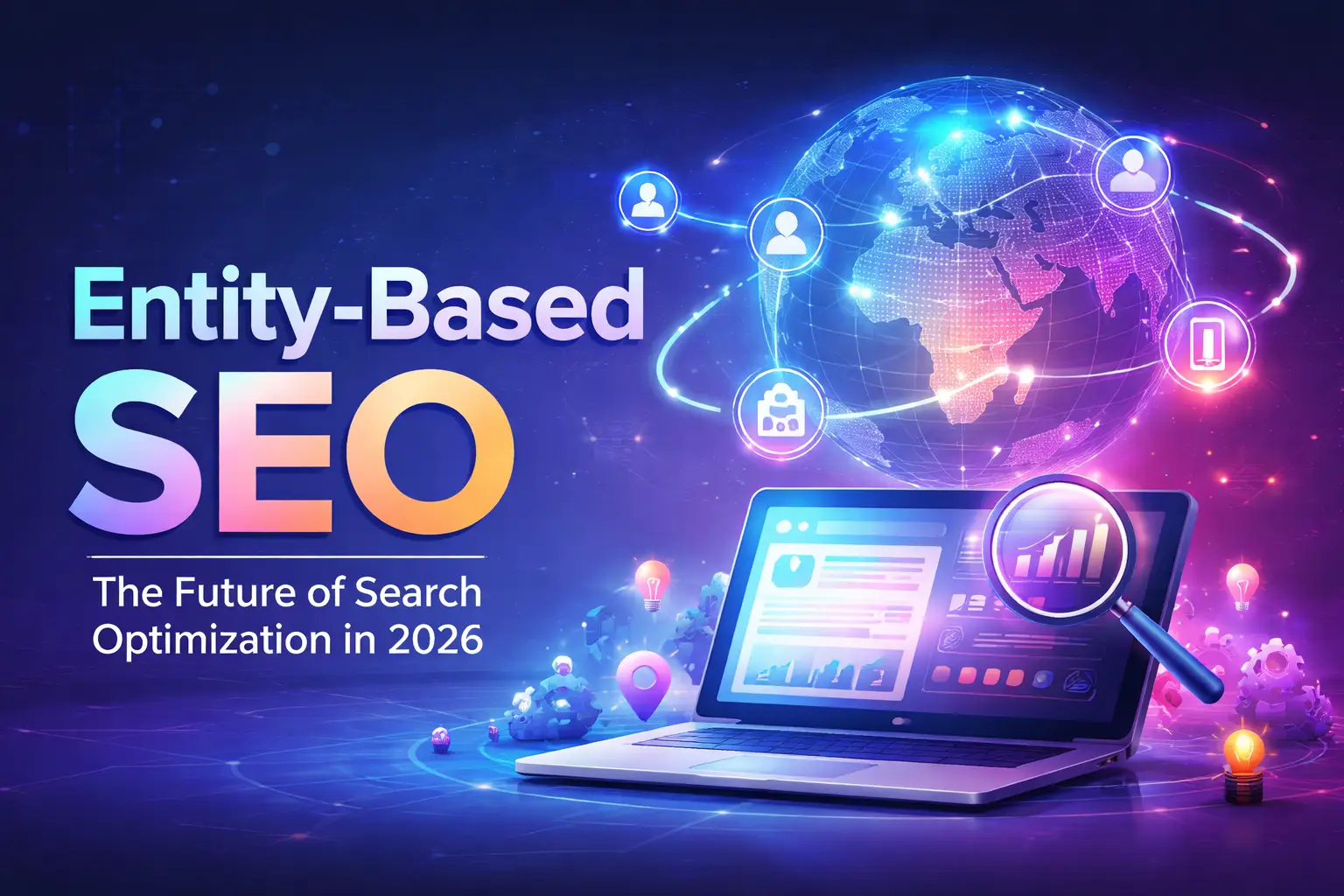
- Focus on entity-based SEO
- Create comprehensive content AI references
- Measure brand mentions and citations, not just traffic
Timeline: Already majority of searches, solidifies throughout 2026
Learn about entity-based SEO optimization for zero-click strategy.
Prediction 3: Agentic AI Goes Mainstream
What’s Happening: AI agents that reason, plan, and act autonomously enter everyday marketing operations.
The Data: By 2028, 33% of enterprise software will include agentic AI according to Gartner. 81% of business leaders say agents will be integrated into strategy within 12-18 months.
What This Means: AI does not just assist marketers—it executes campaigns, adjusts budgets, personalizes content, and optimizes performance continuously without human intervention for routine tasks.
Examples:
- Autonomous A/B testing that creates variants, runs tests, and implements winners
- Budget allocation AI that shifts spending hourly based on performance
- Content generation agents that produce, publish, and promote
- Email personalization at individual level across millions
Your Response:
- Start with narrow use cases (one workflow)
- Establish clear boundaries and human oversight
- Measure impact rigorously
- Scale gradually as confidence builds
- Maintain human strategic direction
Timeline: Early adopters implementing Q1-Q2 2026, mainstream by Q4
Prediction 4: Hyper-Personalization at Scale
What’s Happening: Every customer experiences unique content, offers, and journeys tailored to their specific context, behavior, and predicted needs.
The Data: According to Forrester, businesses using AI-driven personalization see 15-30% increase in conversion rates. 80% of consumers more likely to purchase when brands offer personalized experiences.
What This Means: Generic campaigns die. One-size-fits-all messaging fails. AI enables personalization previously impossible at scale.
Applications:
- Website content adapting to visitor profile in real-time
- Email campaigns with unique content per recipient
- Ad creative customized to individual viewer
- Product recommendations based on predicted needs
- Pricing and offers optimized per customer
Your Response:
- Consolidate customer data into unified profiles
- Implement AI personalization platform
- Start with email and website personalization
- Test impact on conversion and lifetime value
- Respect privacy and provide transparency
Timeline: Technology ready now, adoption accelerates through 2026
Prediction 5: Voice and Visual Search Transformation
What’s Happening: Text search declines as voice commands and image-based searches become primary discovery methods.
The Data: Industry analysts project 50% of searches will be voice or visual by end of 2026. Smart speakers in 35% of U.S. homes. Visual search queries growing 300% year-over-year.
What This Means: Optimization strategies designed for text fail for voice and visual. Natural language and visual recognition require different approaches.
Your Response:
- Optimize for conversational queries (“where can I buy…” not “buy shoes”)
- Add schema markup for rich results
- High-quality images with descriptive alt text
- FAQ content matching spoken questions
- Local SEO for “near me” voice searches
Timeline: Already significant, becomes dominant throughout 2026
Prediction 6: AI-Powered Video Creation Goes Mainstream
What’s Happening: AI video generation tools become accessible and affordable enough for every marketer.
The Data: AI-generated video content already possible at fraction of traditional cost. Tools like Sora demonstrate text-to-video capabilities. Marketers report 60% time savings using AI video tools.
What This Means: Video creation barrier disappears. Every company can produce professional video content without studios, actors, or extensive budgets.
Applications:
- Product demos generated from descriptions
- Personalized video messages at scale
- Social media content creation automated
- A/B testing video variants
- Multilingual video without reshooting
Your Response:
- Experiment with AI video tools now
- Maintain authentic voice even with AI generation
- Use AI for efficiency, humans for creativity
- Test audience response to AI vs. traditional video
- Combine AI-generated with human-created content
Timeline: Tools available Q1 2026, mainstream adoption Q2-Q4
Prediction 7: Predictive Analytics Becomes Standard
What’s Happening: AI predicts customer behavior, campaign performance, and market trends with increasing accuracy.
The Data: Marketing teams using predictive AI report 25% improvement in lead quality and 20% increase in conversion rates. Churn prediction accuracy now exceeds 85%.
What This Means: Reactive marketing dies. Proactive, predictive strategies based on AI forecasts replace intuition-based decisions.
Applications:
- Churn prediction triggering retention campaigns
- Lead scoring identifying highest-value prospects
- Demand forecasting optimizing inventory and promotions
- Lifetime value prediction guiding acquisition spending
- Campaign performance prediction before launch
Your Response:
- Implement predictive lead scoring immediately
- Use churn prediction for proactive retention
- Test predictions against actual outcomes
- Refine models with your specific data
- Combine predictions with human judgment
Timeline: Available now, becomes standard practice through 2026
Prediction 8: Content Creation Shifts to AI Assistance
What’s Happening: Nearly 50% of marketing content created with AI assistance by end of 2026.
The Data: 60% of marketers already use AI weekly for content creation. 70% say it helps productivity. Yet 63% of consumers less likely to engage with purely AI-generated visuals.
What This Means: AI becomes creative partner, not replacement. Marketers using AI for efficiency while maintaining human creativity and authenticity win.
Best Practices:
- AI for first drafts, humans for final creativity
- AI for ideation and variations, humans for strategy
- AI for scale, humans for brand voice
- AI for repetitive tasks, humans for novel thinking
- Always disclose significant AI usage
Your Response:
- Adopt AI writing assistants for drafts
- Use AI image generation for concepts
- Maintain human editorial oversight
- Develop clear AI usage policies
- Measure audience response to AI-assisted content
Timeline: Already widespread, becomes majority practice by Q3 2026
Learn about AI’s impact on social media content creation.
Prediction 9: Privacy-First Marketing with AI
What’s Happening: Cookie deprecation and privacy regulations force AI-powered alternatives for targeting and measurement.
The Data: Third-party cookies disappearing across browsers. GDPR, CCPA, and emerging regulations restrict data usage. Yet personalization expectations remain high.
What This Means: AI enables privacy-compliant personalization through contextual targeting, first-party data analysis, and predictive modeling without invasive tracking.
Solutions:
- Contextual AI analyzing page content for relevant ads
- First-party data platforms building rich customer profiles
- Predictive modeling inferring preferences from limited data
- Privacy-preserving AI techniques like federated learning
- Consent management integrated with personalization
Your Response:
- Build first-party data collection strategies
- Implement contextual targeting AI
- Respect privacy while maintaining relevance
- Transparent communication about data usage
- Invest in consent management platforms
Timeline: Urgent now, critical throughout 2026
Prediction 10: AI Democratizes Advanced Analytics
What’s Happening: Natural language interfaces make advanced analytics accessible to non-technical marketers.
The Data: According to analyst predictions, 40% of enterprise analytics platforms will include natural language query by end of 2026. AI assistants answer marketing questions in plain English.
What This Means: Data analysis skills gap closes. Every marketer can ask questions and get insights without SQL, Python, or data science expertise.
Examples:
- “Show me conversion rate by channel last quarter”
- “What caused the traffic spike on Tuesday?”
- “Predict next month’s lead volume”
- “Which segments have highest lifetime value?”
Your Response:
- Adopt analytics platforms with AI assistants
- Encourage data-driven decision making across team
- Reduce dependence on dedicated analysts for routine questions
- Invest in data quality for better AI insights
- Maintain strategic thinking even with easy analysis
Timeline: Early tools available Q1 2026, widespread by year-end
Prediction 11: Multichannel Attribution Solved by AI
What’s Happening: AI finally cracks attribution problem, accurately crediting touchpoints across complex customer journeys.
The Data: Traditional attribution models oversimplify reality. AI analyzes millions of journey combinations, assigning accurate credit to each touchpoint based on actual influence.
What This Means: Budget allocation becomes data-driven, not political. Teams understand what actually drives conversions across all channels.
Your Response:
- Implement AI-powered attribution platform
- Question existing budget allocations
- Test AI recommendations against current strategy
- Accept complexity rather than forcing simple models
- Use insights to optimize channel mix
Timeline: Advanced tools available now, mainstream adoption Q2-Q4 2026
Prediction 12: Real-Time Marketing Optimization
What’s Happening: AI adjusts campaigns in real-time—creative, targeting, bidding, messaging—responding to performance continuously.
The Data: Marketers using AI optimization report 35% improvement in ROAS. Real-time adjustments outperform scheduled optimizations significantly.
What This Means: “Set and forget” campaigns die. Continuous optimization becomes baseline expectation.
Applications:
- Ad bidding adjusted every auction
- Creative variants rotated based on performance
- Audience segments refined hourly
- Budget shifts between channels automatically
- Email send times optimized per recipient
Your Response:
- Enable automated bidding on ad platforms
- Use AI creative optimization tools
- Set clear boundaries for AI decision-making
- Monitor AI decisions for alignment with strategy
- Gradually expand AI autonomy as trust builds
Timeline: Already available on major platforms, adoption accelerates 2026
Prediction 13: Influencer Marketing Gets AI Enhancement
What’s Happening: AI identifies optimal influencer partners, predicts campaign performance, and detects fake followers.
The Data: 94% of marketers say influencer marketing outperforms traditional ads. AI reduces influencer fraud by 90% and improves ROI prediction accuracy.
What This Means: Influencer selection becomes data-driven. Fake engagement gets exposed. ROI prediction improves dramatically.
AI Applications:
- Audience analysis matching influencers to target customers
- Engagement authenticity verification
- Performance prediction before campaign launch
- Content analysis for brand alignment
- Fraud detection identifying fake followers
Your Response:
- Use AI tools for influencer discovery
- Verify engagement authenticity before partnerships
- Demand performance predictions from agencies
- Test smaller campaigns before major investment
- Focus on authentic engagement over follower counts
Timeline: Tools available now, widespread adoption through 2026
Prediction 14: Email Marketing Gets Radical Personalization
What’s Happening: AI generates unique email content for each recipient based on behavior, preferences, and predicted needs.
The Data: Personalized emails drive 6x higher transaction rates. AI-powered email personalization shows 25-40% improvement over traditional segmentation.
What This Means: Batch-and-blast email dies. Every recipient gets customized content, subject line, send time, and offers.
Personalization Layers:
- Subject lines optimized per recipient
- Content blocks tailored to interests
- Product recommendations based on predictions
- Send time optimized for individual behavior
- Offers matched to value sensitivity
Your Response:
- Implement AI email personalization platform
- Start with send time optimization
- Progress to dynamic content blocks
- Test individual vs. segment personalization
- Measure impact on engagement and revenue
Timeline: Available now, becomes standard by Q4 2026
Prediction 15: Brand + Performance Integration
What’s Happening: False choice between brand building and performance marketing dies. AI enables simultaneous optimization of both.
The Data: According to Google’s 2026 predictions: “Retire ‘brand or performance.’ It’s about brand and performance. If you aren’t building full-funnel engine where brand fuels sales and sales build brand, you’re driving with hand brake on.”
What This Means: Siloed brand and performance teams merge. AI measures long-term brand impact alongside short-term conversions.
Your Response:
- Measure brand metrics alongside conversion metrics
- Optimize campaigns for both awareness and action
- Use AI to understand brand-performance relationship
- Stop fighting internal brand vs. performance battles
- Build integrated strategies from the start
Timeline: Philosophy shift ongoing, AI tools enabling it throughout 2026
Learn about content marketing strategy integrating brand and performance.
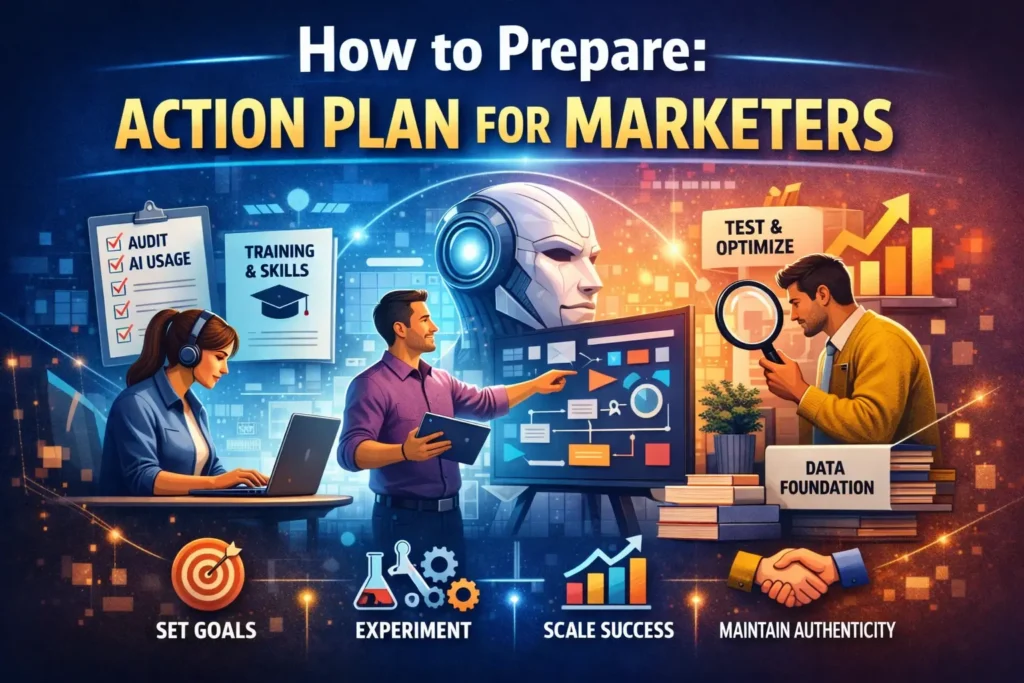
How to Prepare: Action Plan for Marketers
Turn predictions into preparation:
Immediate Actions (Next 30 Days)
Audit Current AI Usage:
- List all AI tools your team uses
- Identify gaps in capabilities
- Document what’s working and what isn’t
- Survey team on AI needs and concerns
Establish AI Governance:
- Create clear policies on AI usage
- Define disclosure requirements
- Set quality standards for AI content
- Determine human oversight requirements
Quick Wins:
- Enable AI-powered ad bidding
- Implement predictive lead scoring
- Use AI for email send time optimization
- Adopt AI writing assistants for drafts
Short-Term (90 Days)
Build Foundation:
- Consolidate customer data
- Implement AI analytics platform
- Test conversational AI for customer service
- Launch AI-powered personalization pilots
Skill Development:
- Train team on AI tools
- Establish best practices
- Share success stories
- Address concerns and resistance
Experimentation:
- Test AI video creation
- Try AI image generation
- Pilot agentic workflows
- Measure results rigorously
Medium-Term (6-12 Months)
Scale What Works:
- Expand successful pilots
- Integrate AI across workflows
- Automate repetitive tasks
- Optimize AI investments
Strategic Shifts:
- Optimize for zero-click experiences
- Build AI-friendly content
- Develop voice search strategy
- Implement privacy-first personalization
Competitive Positioning:
- Monitor competitor AI adoption
- Identify AI-enabled opportunities
- Build distinctive AI applications
- Maintain authentic brand voice
Long-Term (12+ Months)
Transformation:
- AI-native marketing operating model
- Agentic systems handling routine work
- Humans focused on strategy and creativity
- Continuous AI innovation
Measurement Evolution:
- New metrics for AI era
- Attribution across complex journeys
- Brand and performance integration
- ROI on AI investments
Common Mistakes to Avoid
Learn from early adopters’ errors:
Mistake 1: Adopting AI Without Strategy
Random tool adoption wastes money and creates chaos. Start with problems, not solutions.
Mistake 2: Assuming AI Means No Humans
AI is tool, not replacement. Human strategy, creativity, and oversight remain essential.
Mistake 3: Ignoring Privacy and Ethics
Cutting corners on privacy or ethics creates backlash and regulatory problems.
Mistake 4: Chasing Every AI Trend
Focus on AI applications that solve real problems for your business, not just what’s trendy.
Mistake 5: Neglecting Data Quality
AI is only as good as data it trains on. Garbage in, garbage out.
Mistake 6: Over-Relying on AI-Generated Content
Consumers push back against purely AI content. Use AI for efficiency, humans for authenticity.
Mistake 7: Not Disclosing AI Usage
Transparency builds trust. Hidden AI usage destroys it.
Conclusion: The AI Marketing Inflection Point
2026 is not about whether AI transforms marketing—it already has. This year determines who uses AI strategically versus who gets overwhelmed by it.
Key Takeaways:
- Conversational AI becomes default interface for customer interactions
- Zero-click experiences dominate, making traditional traffic metrics obsolete
- Agentic AI moves from hype to operational reality
- 50% of content created with AI assistance by year-end
- Hyper-personalization at scale becomes baseline expectation
- 71% believe AI makes truth unknowable (authenticity differentiates)
- 73% already use AI tools regularly
- $107.5 billion global AI marketing investment in 2026
- Privacy-first approaches required as cookies die
- Brand + performance integration replaces false choice
What To Do Now:
This Month: Audit AI usage, establish governance, implement quick wins
Next 90 Days: Build data foundation, train team, test new capabilities
This Year: Scale successful pilots, shift strategies, maintain authenticity
AI is table stakes for efficiency. Authenticity is the differentiator for connection. The brands winning in 2026 master both.
Technology changes fast. Human psychology changes slow. Use AI to work faster and smarter, but never forget you are marketing to humans who crave authentic connection.
The future belongs to marketers who see AI as creative partner amplifying human judgment—not replacement eliminating it.
The AI revolution in marketing is here. The question is whether you will shape it or be shaped by it.