Software development changed more in the last two years than in the previous two decades. If you are a developer, you already feel it. If you manage developers, the data proves it. And if you are building software products, you cannot ignore it anymore.
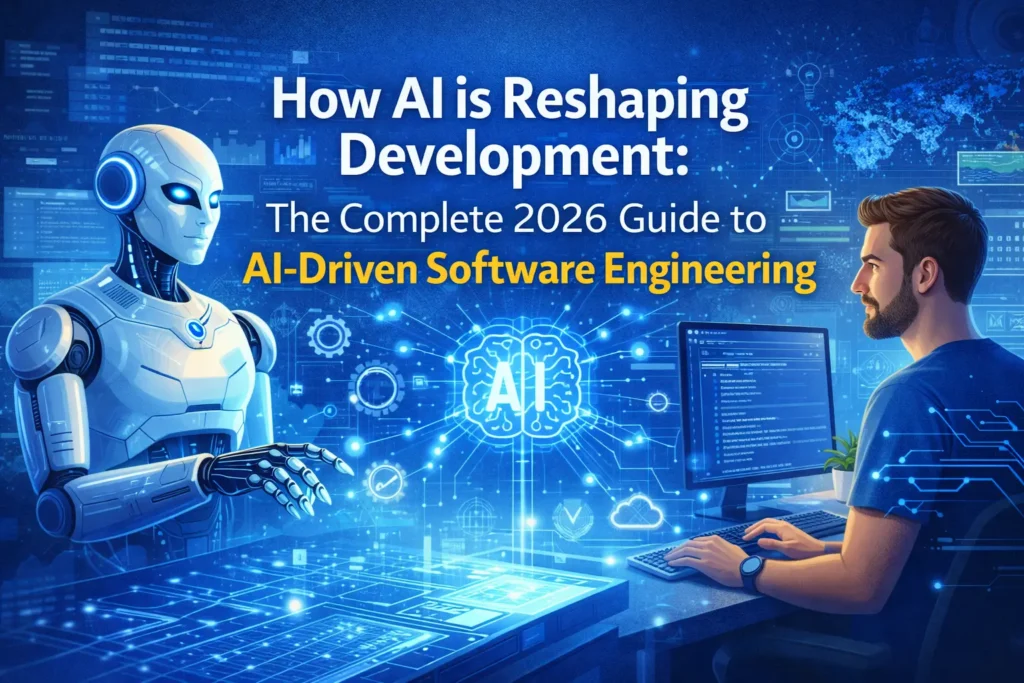
In February 2026, artificial intelligence is not just assisting developers—it is fundamentally transforming every stage of the software development lifecycle. From writing code to testing, deployment, and maintenance, AI has become the primary force reshaping how software gets built.
This guide explores exactly how AI is changing development work, what the latest data reveals about productivity and challenges, and what these changes mean for developers, teams, and businesses in 2026 and beyond.
The State of AI in Software Development: 2026 by the Numbers
Let’s start with the facts. These numbers tell the real story of AI’s impact on development:
Adoption Rates:
- 85% of developers use AI tools frequently in daily tasks (JetBrains 2025 State of Developer Ecosystem)
- 84% are using or planning to use AI in workflows (Stack Overflow Developer Survey)
- 41% of all code written in 2025 is AI-generated
- By 2028, 90% of enterprise developers will use AI coding assistants (Gartner)
Industry Growth:
- Software development service market: $499.25 billion in 2025
- Projected to reach $571.7 billion in 2026
- Expected to hit $1.935 trillion by 2035
- Custom software development: 22.5% CAGR through 2030
Job Creation, Not Elimination:
- 55% of companies using AI report new job creation
- 63% added up to 25 new roles
- 65% of developers expect their role to be redefined in 2026
- Focus shifts from coding to architecture, integration, and AI-enabled decision-making
These numbers reveal a clear pattern: AI is not replacing developers. It is transforming what development means.
Understanding how AI is changing marketing shows similar patterns across other knowledge work professions.
How AI is Reshaping the Software Development Lifecycle
AI impacts every phase of the traditional Software Development Lifecycle (SDLC). Let’s examine each stage:
Planning and Requirements
Traditional Approach:
- Product managers write requirement documents
- Stakeholders review and revise
- Developers interpret requirements
- Back-and-forth clarification cycles
AI-Enhanced Approach in 2026:
- AI analyzes user research data and identifies patterns
- Natural language processing extracts requirements from meetings
- AI generates user stories automatically from product visions
- Predictive analytics forecast feature impact
Impact: Requirements gathering that once took weeks now takes days. AI identifies inconsistencies and gaps humans miss.
Design and Architecture
Traditional Approach:
- Architects design system components manually
- Technical decisions based on past experience
- Architecture documentation created by hand
AI-Enhanced Approach in 2026:
- AI suggests optimal architecture patterns based on requirements
- Automated generation of system diagrams
- AI recommends technology stacks based on project constraints
- Continuous architectural validation during development
Impact: Architecture decisions backed by data from thousands of similar projects, not just individual experience.
Development and Coding
This is where AI makes the most visible impact. In 2026, the development phase looks radically different:
Code Generation:
- AI writes significant portions of boilerplate code
- Natural language descriptions convert to working code
- Legacy code automatically refactored and modernized
- AI suggests optimizations in real-time
Vibe Coding Emerges: Named Collins Dictionary’s Word of the Year 2025, “vibe coding” describes developers describing what they want in natural language and letting AI generate the implementation.
As Steven Webb, Capgemini’s UK CTO, explains: “Vibe coding, already crowned Collins’ Word of the Year for 2025, will take off in earnest, fundamentally reshaping software delivery pipelines.”
Developer Experience Changes:
- Junior developers become productive in weeks instead of months
- Experienced developers focus on complex problem-solving
- Context switching between tasks increases significantly
- Cognitive density of work rises as routine tasks disappear
According to World Economic Forum research from January 2026, one engineer leveled up from junior to near-senior JavaScript skills in just two months using AI—a process that would traditionally take years.
Testing and Quality Assurance
AI transforms testing from a bottleneck into an accelerator:
AI-Powered Testing:
- Automated test case generation from code changes
- Predictive bug detection before code reaches production
- Intelligent test prioritization based on risk analysis
- Self-healing tests that adapt to UI changes
- Performance testing at scale
Quality Control Shift: According to recent industry analysis, as AI code generation becomes routine, development teams shift focus from rapid coding to quality control. This represents a fundamental change in how teams spend their time.
Deployment and DevOps
DevOps is evolving into AI-Ops:
AI-Driven DevOps Features:
- Predictive deployment risk assessment
- Automated rollback when issues detected
- Intelligent resource allocation and scaling
- Root cause analysis in seconds, not hours
- Self-healing systems that recover from failures automatically
As highlighted in The AI Journal’s February 2026 analysis: “In 2026, AI-driven DevOps systems detect integration risks before they occur, identify root causes instantly, automate code rollbacks, optimize cloud spending, and manage deployment pipelines without manual oversight.”
Maintenance and Monitoring
Post-deployment, AI provides continuous intelligence:
Intelligent Monitoring:
- Anomaly detection in system behavior
- Predictive maintenance alerts
- Automated incident response
- Performance optimization recommendations
- User experience monitoring with AI insights
Learn more about maintaining systems in our guide on how technology is changing businesses.
The Rise of Agentic AI in Development
The biggest shift in early 2026 is the move from AI assistants to AI agents.
What Are AI Agents?
AI agents are autonomous systems that can:
- Execute complex tasks independently
- Collaborate with other AI agents
- Self-correct and optimize their performance
- Handle end-to-end workflows without human intervention
How Agents Change Development
Traditional AI Tools (2023-2025):
- Developer asks: “Write a function to sort this array”
- AI generates code
- Developer reviews and integrates
Agentic AI (2026):
- Developer sets goal: “Build a customer dashboard with real-time analytics”
- AI agent breaks down requirements
- Generates code across multiple files
- Creates tests automatically
- Identifies and fixes integration issues
- Deploys to staging environment
- Reports back with documentation
As noted in recent BM Magazine research: “In 2026, AI is moving toward agentic systems that can independently execute tasks, collaborate with other agents, and optimize their own performance. These agents are capable of generating production-quality code, debugging applications, orchestrating cloud resources, and monitoring system behavior.”
Real-World Agentic Systems
Apple Xcode 26.3: Released in February 2026, this update integrates Claude Agent and OpenAI’s Codex directly into the IDE, allowing developers to leverage advanced reasoning capabilities within their workflow.
Multi-Agent Collaboration: Multiple AI agents now work together—one agent handles frontend, another backend, a third manages databases, and a fourth handles deployment.
The Productivity Paradox: Faster but Not Always Better
Here is where things get complicated. AI makes developers faster, but does it make them more productive?
The Data on Speed
What’s Getting Faster:
- Individual coding speed increases significantly
- Code volume generated multiplies
- Time to first prototype decreases dramatically
- Feature implementation accelerates
What’s Getting Slower:
- Code review takes longer
- Debugging AI-generated code is more complex
- Integration issues multiply
- Testing requirements expand
As BayTech Consulting’s comprehensive February 2026 analysis reveals: “By 2026, the question ‘Does AI increase productivity?’ will likely be viewed as too simplistic to be useful. The data confirms that AI increases output volume and individual speed. However, without a corresponding evolution in workflows, testing protocols, and management strategies, this speed creates friction.”
The Hidden Costs
Context Switching: AWS research shows teams switching between too many contexts (now exacerbated by rapid AI task generation) deliver 40% less work and double their defect rate.
Cognitive Density: Developers spend less time on easy tasks (which provide mental breaks) and more time on hard debugging, architectural review, and complex problem-solving.
Code Quality Concerns: AI tools trained on historical repositories may lack real-time CVE awareness and can suggest vulnerable libraries.
What Actually Improves Productivity
According to industry data from February 2026:
Winners:
- Organizations that build robust verification systems
- Teams that implement AI-assisted code review
- Companies that invest in developer experience
- Businesses that focus on filtering and quality, not just speed
Losers:
- Companies chasing AI for its own sake
- Teams generating code without proper review processes
- Organizations ignoring developer satisfaction metrics
- Businesses optimizing for speed over reliability
AI-Native Development: The New Standard
Just as “cloud-native” defined the last decade, “AI-native” defines software development in 2026.
What Makes Software AI-Native?
Core Characteristics:
- AI integrated from the ground up, not bolted on
- Continuous learning built into the system
- Real-time inference pipelines
- Multi-model orchestration
- Rigorous model lifecycle management
According to BM Magazine’s February 2026 report: “Just as cloud-native design transformed development a decade ago, AI-native architecture is now the new gold standard. These applications incorporate continuous learning, real-time inference pipelines, multi-model orchestration, and rigorous model lifecycle management.”
Building AI-Native Applications
Architecture Requirements:
- Modular AI components that can be updated independently
- Observability into AI decision-making
- Fail-safe mechanisms when AI confidence is low
- Human-in-the-loop for critical decisions
- Continuous model monitoring and retraining
The Governance Challenge
As AI systems deploy in high-stakes domains (finance, healthcare, hiring), organizations face new requirements:
Governance Imperatives:
- Traceability from inputs to outputs
- Clear provenance of training data
- Predictable behavior for high-impact decisions
- Explainability of AI recommendations
- Compliance with emerging regulations
As The AI Journal notes: “In 2026, that question is evolving into a more demanding one: whether AI behavior can be explained, validated, and governed.”
The Developer’s Evolving Role
Developers are not becoming obsolete. They are becoming something different.
From Code Writers to AI Orchestrators
Old Role (Pre-2024):
- Write code from scratch
- Debug syntax errors
- Implement algorithms manually
- Optimize performance through trial and error
New Role (2026):
- Define intent and requirements clearly
- Guide AI agents toward solutions
- Verify and validate AI-generated code
- Design system architecture
- Make complex decisions AI cannot handle
- Ensure security and compliance
As World Economic Forum research from January 2026 states: “The role of the software developer is transitioning from ‘writer of syntax’ to ‘architect of intent’ and ‘verifier of logic’.”
Skills That Matter More Than Ever
Rising in Importance:
- System design and architecture
- Problem decomposition
- AI prompt engineering
- Code review and quality assessment
- Security awareness
- Understanding of AI limitations
- Cross-functional communication
- Product thinking
Declining in Importance:
- Writing boilerplate code
- Memorizing syntax
- Routine debugging
- Manual testing
- Documentation writing (AI handles this)
Continuous Learning Becomes Essential
65% of developers worry about falling behind without continuous learning. The response has been clear:
Learning Approaches:
- Fast, practical, collaborative self-directed learning
- Hands-on experimentation
- Online tutorials
- Weekly dedicated learning time
- Building with new technologies immediately
As World Economic Forum notes: “Developers reversed that logic. As AI reshapes their work, they’re turning to fast, practical, collaborative self-directed learning, and 65% worry about falling behind without it.”
33% of developers rank GenAI and AI/ML as their top learning priorities for 2026.
Our guide on how to choose the right career path discusses the importance of adaptability in modern tech careers.
Major Challenges and Risks
AI in development is not without problems. Here are the real concerns facing teams in 2026:
Security and Supply Chain Risks
The Problem:
- AI coding tools may suggest vulnerable dependencies
- Single compromised component can cascade across thousands of enterprises
- AI lacks real-time CVE awareness
- Increased supply chain complexity
As noted in IT Pro’s January 2026 analysis: “With AI expanding software supply chain volume and complexity, similar incidents become more likely and severe, as a single compromised component could cascade across thousands of enterprises.”
Trust and Verification
Developer Concerns:
- 48% prefer to “stay hands-on” when using AI in core tasks
- Trust lags behind adoption
- Black-box AI decision-making creates uncertainty
- Difficulty attributing bugs to human or AI origin
Team Dynamics and Burnout
New Stressors:
- Developers feel like “janitors” for AI-generated code
- Increased cognitive load from complex problem-solving
- Pressure to maintain AI-level speed
- Lack of mental breaks from routine tasks
Quality Control at Scale
The Volume Problem:
- More code means more to review
- Faster generation does not equal faster validation
- Testing requirements expand exponentially
- Integration complexity multiplies
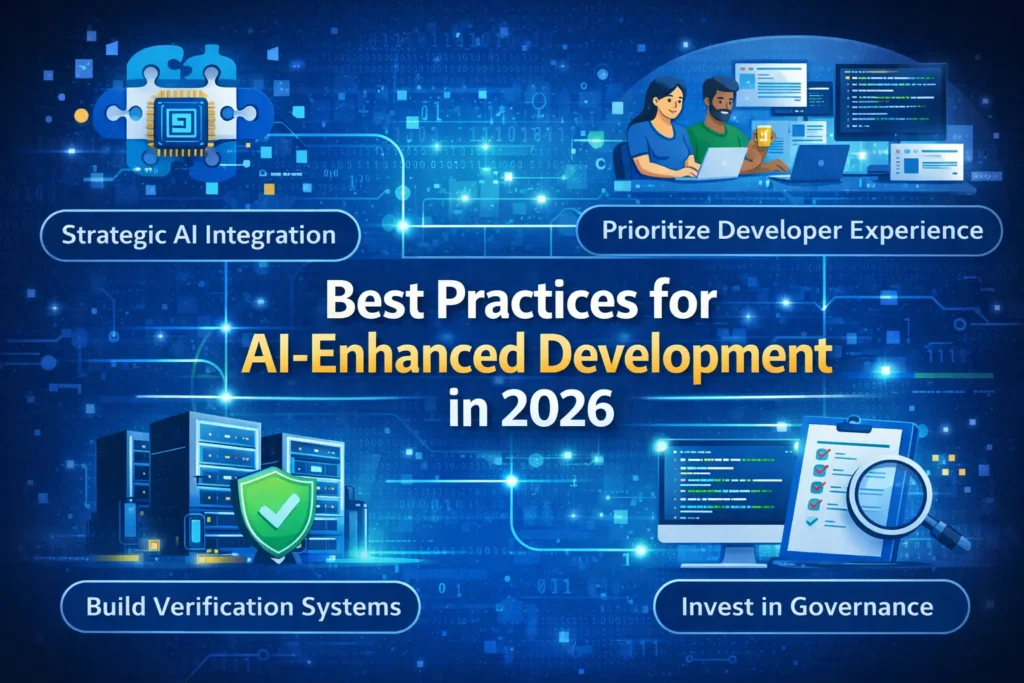
Best Practices for AI-Enhanced Development in 2026
Based on analysis from leading organizations, here is how to succeed with AI in development:
1. Strategic AI Integration
Don’t:
- Chase AI for its own sake
- Implement every new AI tool
- Assume AI always improves outcomes
Do:
- Identify specific pain points
- Measure impact before scaling
- Ensure data readiness
- Chart clear paths from prototype to production
2. Prioritize Developer Experience
The Math: Half of developers lose 10+ hours weekly to organizational overhead. For a 500-person development team, that equals $8 million lost annually.
Solutions:
- Reduce organizational friction
- Consolidate tools thoughtfully
- Improve documentation
- Streamline communication channels
3. Focus on Quality Over Speed
Framework:
- Use AI for acceleration
- Implement robust review processes
- Invest in automated quality checks
- Track defect rates closely
- Monitor developer satisfaction
4. Build Verification Systems
As BayTech Consulting emphasizes: “The winners of this era will not be the companies that generate the most code. They will be the companies that build the best filtering and verification systems.”
Components:
- Automated security scanning
- AI-assisted code review
- Comprehensive testing frameworks
- Production monitoring and alerting
- Incident response automation
5. Invest in Governance
Requirements:
- Clear AI use policies
- Model version control
- Decision auditability
- Data provenance tracking
- Regular compliance audits
Learn about branding strategies for modern businesses to understand how governance builds trust.
The Future Beyond 2026
Where is AI-driven development heading? Here are predictions based on current trajectories:
Fully Autonomous Development Teams
Within 3-5 years, some organizations may operate development teams where AI agents outnumber humans. Humans will focus on strategy, architecture, and business alignment while AI handles implementation.
Natural Language Programming
Programming languages may become optional. Developers will describe what they want in plain English (or any language), and AI will generate appropriate implementation.
Self-Improving Systems
Software will continuously improve itself based on usage patterns, performance data, and user feedback without human intervention for routine enhancements.
Hyper-Personalized Applications
Every user will experience custom versions of applications, with UI, features, and behavior adapting in real-time to individual preferences and needs.
Democratization of Development
The barrier to building software will drop dramatically. Domain experts without coding backgrounds will create sophisticated applications using AI assistance.
Conclusion: Adapting to the AI-Driven Future
AI has fundamentally reshaped software development. The numbers are clear, the trends are undeniable, and the transformation is accelerating.
Key Takeaways:
- 85% of developers already use AI tools daily
- 41% of code written in 2025 is AI-generated
- Development roles are evolving, not disappearing
- 55% of companies using AI created new jobs
- Speed increases but requires new quality processes
- Governance and verification matter more than generation
- Continuous learning is now essential, not optional
- Software development market reaching $571.7 billion in 2026
What This Means for You:
If you are a developer: Embrace AI tools but focus on skills AI cannot replicate—architecture, system design, problem decomposition, and business thinking. Invest time in continuous learning. Your role is becoming more strategic and more valuable.
If you manage developers: Reduce organizational friction, provide modern tools, measure quality not just velocity, and support continuous learning. Build verification systems, not just generation capabilities.
If you build software products: Integrate AI strategically based on specific problems, not hype. Focus on shipping reliable, maintainable, secure software. The winners will be those who balance AI acceleration with robust quality processes.
The transformation is here. The question is not whether AI will reshape development—it already has. The question is how quickly you will adapt to this new reality.
The future of development is being written right now. Make sure you are part of writing it.