Forex trading in 2026 is not the same market it was even two years ago. Algorithms move faster, central banks are more aggressive, and retail traders now have access to tools that were once only available to institutional desks. If you are still running the same approach you used in 2022, you are already behind.
This guide covers everything a serious trader needs in 2026 — from the foundations of how currency markets work, to proven strategies, risk management rules, AI automation tools, and the daily habits that separate profitable traders from those who blow their accounts. We have also linked to expert resources throughout, including the team at GregForex.com who specialise in tested Expert Advisors and automated trading tools for retail traders.
But here is something most trading guides miss — great traders are not just good at reading charts. They are financially disciplined, personally organised, and consistently intentional across every area of their life. We will connect those dots throughout this guide.
What Is Forex Trading and How Does It Work?
Forex, short for Foreign Exchange, is the global market where one currency is bought while another is simultaneously sold. It is the largest and most liquid financial market on Earth, with over 7.5 trillion dollars traded every single day. Unlike stock markets, it has no central exchange — it runs as a decentralised global network of banks, institutions, brokers, and retail traders, 24 hours a day, five days a week.
Every trade involves a currency pair. EUR/USD means you are trading the Euro against the US Dollar. GBP/JPY means the British Pound against the Japanese Yen. When you buy a pair, you are betting the first currency will rise against the second. When you sell, you are betting the opposite.
Why the Dollar Matters More Than Any Other Currency
The US Dollar is involved in over 80% of all Forex transactions worldwide. This means that understanding American economic policy, government spending cycles, and Federal Reserve decisions is not optional for any serious trader — it is core knowledge.
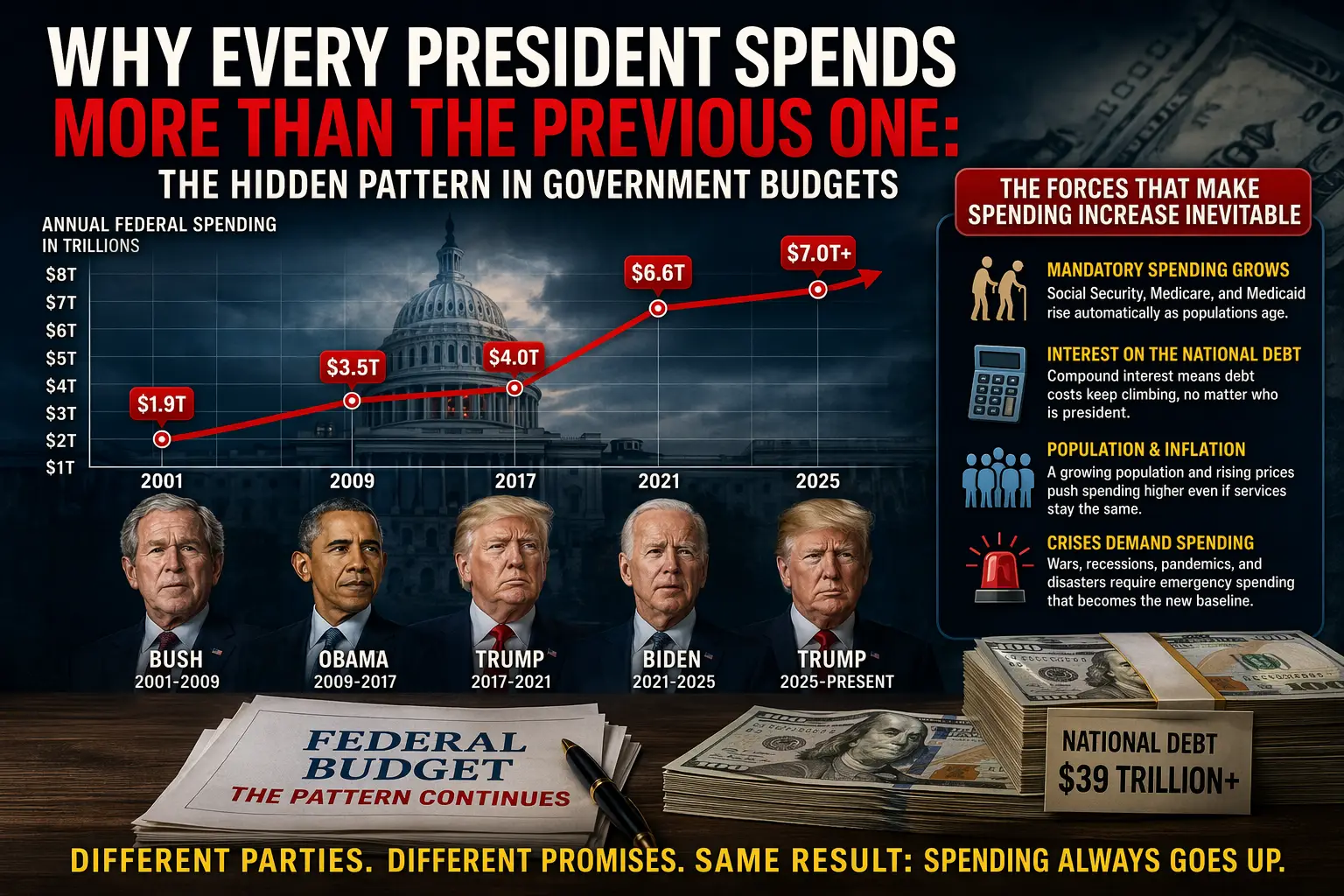
A deep understanding of how government fiscal policy drives currency strength is one of the most underrated edges in retail trading. If you want to understand why the Dollar moves the way it does, reading about why every president spends more than the previous one gives you genuinely useful context — not just interesting trivia. Government debt cycles, deficit spending, and monetary policy responses are all direct drivers of USD movement in the Forex market.
Why 2026 Is a Different Market
Before you apply any strategy, you need to understand the environment you are trading in. The 2026 Forex market has four defining characteristics that every trader must account for:
AI and Algorithms Dominate Volume
Over 70% of daily Forex volume is now executed by algorithmic and AI-powered systems. This means price reacts faster to news, patterns get exploited the moment they form, and purely emotional human decision-making is at a structural disadvantage. The best response is not to fight this — it is to use automation yourself.
Central Bank Volatility Is at Historic Levels
Rate decisions from the US Federal Reserve, the European Central Bank, and the Bank of Japan are creating 100 to 300 pip moves in minutes during 2026. If you are trading major pairs without tracking central bank calendars and policy shifts, you are operating with a serious blind spot.
Retail Participation Has Exploded
Retail trader participation has grown by over 40% since 2022. This increases liquidity, but it also means more competition at obvious technical levels. You need to be more patient, more selective, and more disciplined than the crowd to stay consistently profitable.
Automation Is Now Accessible to Everyone
Expert Advisors and automated trading systems are no longer reserved for hedge funds. Platforms like GregForex.com have made professionally built, backtested EAs available to retail traders for under ten dollars — making serious automation realistic even on a small account.
Key Forex Terms Every Trader Must Know
These terms appear in every strategy, every platform, and every broker interface you will ever use. Master them completely before anything else.
Pip
The smallest standard price movement in a currency pair. For most major pairs, one pip equals 0.0001. Your profits and losses are counted in pips.
Spread
The difference between the buy price and the sell price. This is your broker’s primary fee on every trade. Tighter spreads mean lower costs per trade.
Leverage
Borrowed capital that multiplies your position size. At 1:100 leverage, $100 controls a $10,000 trade. Leverage amplifies both gains and losses — it is a tool, not a shortcut.
Lot Size
Standard lot equals 100,000 units. Mini lot equals 10,000 units. Micro lot equals 1,000 units. Always begin with micro lots while learning and building confidence.
Stop Loss
A pre-set instruction that closes your trade automatically if the market moves against you by a set amount. Never open a trade without one. Not sometimes — never.
Take Profit
A pre-set instruction that closes your trade automatically when your profit target is reached. Removes the temptation to hold too long out of greed.
Drawdown
The decline in your account from its peak to its lowest point over a period. A critical measure of how risky any strategy or trading period has been.
Top Forex Trading Strategies for 2026
There is no single best strategy. The best one is the strategy you understand completely, trust fully, and can execute without hesitation — especially when it is in a temporary losing streak. Here are the five approaches delivering results in current 2026 market conditions:
1. Trend Following
The simplest and most reliable approach for new traders. Identify whether the market is making higher highs and higher lows (uptrend) or lower highs and lower lows (downtrend) on the Daily or H4 chart. Use the 50 EMA and 200 EMA to confirm direction. When price is above both, only look for buys. When below both, only look for sells. Wait for a pullback to a key level, then enter in the trend direction.
Best for: Beginners and intermediate traders building their first consistent system.
2. Price Action Trading
The approach used by most professional institutional traders. It removes all lagging indicators and reads the market purely through candlestick patterns, support and resistance zones, and chart structure. Key patterns to study include pin bars, engulfing candles, inside bars, and order blocks. Most reliable on H4 and Daily charts where short-term noise is filtered out.
Best for: Intermediate to advanced traders who want clean charts and deep market reading skills.
3. Scalping
Scalping means taking many small, fast trades — typically lasting one to fifteen minutes — targeting five to twenty pips per trade. It requires tight spreads, fast execution, and complete emotional discipline. The London and New York session overlap from 1:00 PM to 5:00 PM GMT is the optimal window. Manual scalping is mentally exhausting long-term, which is why many serious scalpers automate it. The MT5 Expert Advisor collection at GregForex.com includes several scalping systems built precisely for high-frequency execution across this session.
Best for: Advanced traders, or beginners who want to automate a fast-paced strategy without the emotional toll.
4. News and Fundamental Trading
Major economic releases — Non-Farm Payrolls, CPI data, and central bank rate decisions — regularly move pairs by 50 to 300 pips within minutes of release. In 2026, with active central bank policy shifts, these events offer some of the clearest high-probability setups available. Always check the economic calendar before opening any position, and never hold unprotected trades through high-impact releases.
Best for: Traders who follow global economics and want to trade around defined, predictable catalysts.
5. Swing Trading
Holding positions for two to seven days and targeting moves of 50 to 300 pips. You analyse the Daily or H4 chart, identify a strong level or pattern, enter with a wider stop loss, and let the trade breathe toward a larger take profit. Swing trading is consistently recommended as the best starting strategy for beginners — it gives you time to think, minimises emotional pressure, and only requires 30 to 45 minutes of analysis per day.
Best for: Beginners and anyone who cannot monitor charts throughout the trading day.
Risk Management: The Skill That Actually Keeps You in the Game
You can have the most accurate entries in the world and still lose everything without proper risk management. Most professional traders will tell you directly — how you manage losses matters more than how you pick entries. These rules are non-negotiable:
Risk Only 1 to 2 Percent Per Trade
Never put more than one to two percent of your account at risk on any single trade. At this level, you can absorb 30 consecutive losses and still have meaningful capital to continue. This is not conservative — it is the mathematical foundation of trading longevity.
Always Use a Minimum 1:2 Risk-to-Reward Ratio
Your profit target must always be at least double your potential loss. At a 1:2 ratio, you only need to win four out of ten trades to be profitable overall. This is the single most important number in your trading plan.
Set a Hard Daily Loss Limit
Decide before you start each day that if you lose three to five percent of your account, you stop trading immediately. No exceptions, no overrides. The worst trading decisions are always made while chasing losses. A hard daily limit protects you from yourself on your worst days.
Use Leverage Conservatively
Most professional retail traders use an effective leverage of no more than 1:10, regardless of what their broker offers. High leverage is responsible for the majority of retail account failures. Use it as a precise tool, not a shortcut to bigger profits.
Understand Correlated Pairs
EUR/USD and GBP/USD move in the same direction the vast majority of the time. Buying both simultaneously is not two separate trades — it is doubling your exposure to a single market move. Know your correlations before building multi-pair positions.
AI and Automation: No Longer Optional in 2026
In 2026, automation has moved from a competitive advantage to a near necessity for serious retail traders. Here is how to use it intelligently:
Expert Advisors Explained
Expert Advisors are automated programmes that run inside MetaTrader 4 or MT5. They analyse price, execute trades, manage stop losses, and close positions based on pre-programmed rules — without emotion, hesitation, or fatigue. They never revenge-trade, never miss a setup because you were asleep, and never panic during a spike. For traders who cannot monitor markets continuously, a well-tested EA is transformative. GregForex.com offers a tested collection of EAs across multiple strategies — scalping, trend following, grid systems, and Gold specialists — many available for under ten dollars. Their structured Forex courses also help traders understand the strategy logic behind the automation they run.
AI Analysis Tools
Beyond EAs, AI-powered tools in 2026 can scan dozens of pairs across multiple timeframes simultaneously, flag high-probability setups, and integrate live news sentiment into charting platforms. Even manual traders who use AI for scanning and news impact analysis hold a meaningful edge over those relying purely on instinct.
The Trader Mindset: Discipline Across Your Whole Life
This is where most trading guides stop — at the charts. But the traders who genuinely last and grow are not just technically skilled. They are financially disciplined, personally organised, and intentional across every area of their life. Your habits outside the terminal directly shape how you perform inside it.
Personal Organisation as a Trading Edge
Traders who take care of their space, their possessions, and their daily routines tend to trade with the same deliberateness. Something as practical as having a proper purse holder and handbag storage system sounds unrelated to trading — but it is not. It reflects the same mindset: protect what you have invested in, stay organised, and avoid the chaos that leads to poor decisions. Disorganisation in life tends to show up as impulsiveness in trading.
Confidence and Intentional Self-Presentation
Successful traders are deliberate about how they show up — not just on charts, but in life. Confidence is built through intentional choices and following through on standards you set for yourself. Whether that is choosing quality platform heels with purpose rather than impulse, or selecting the right trading setup for your strategy rather than the flashiest one — the mindset is the same. Deliberate over reactive. Quality over novelty. Standards over impulse.
Research Before Committing Money
One of the most consistent habits among profitable traders is deep research before any commitment. They do not buy an EA because it looks good on a sales page — they research it, test it on demo, and verify the backtest. Apply the same thinking to every purchase. A guide like the best tape-in hair extensions is built around exactly this habit — researching quality, understanding what works for your specific situation, and not rushing a decision you will regret. That is core trading discipline applied to daily life.
Consumer Trends and Market Awareness
Broader awareness of what is trending in culture and consumer behaviour gives you a more complete picture of economic sentiment. Style trends, discretionary spending patterns, and what people are prioritising as purchases are all signals of where consumer confidence sits. Something like the guide to hexagonal sunglasses is also a window into discretionary spending confidence — when fashion experimentation is high, consumer confidence tends to be following. Traders who read the full picture, not just price charts, develop sharper macroeconomic instincts.
10 Pro Tips for Forex Trading in 2026
1. Demo Trade for Three Months Minimum
Consistent profitability on demo — not just comfort — is your benchmark before going live. If you cannot make money without risk, you will not make money with it.
2. Keep a Trading Journal on Every Trade
Log your entry reason, exit reason, emotional state, and outcome for every single trade. After 50 entries, patterns in your behaviour become impossible to ignore. This is the most underused improvement tool available.
3. Specialise in Two or Three Pairs Only
Deep expertise in EUR/USD, GBP/USD, or XAU/USD beats surface awareness of twenty pairs. Learn how your pairs behave, how they react to news, and what their typical daily ranges look like across sessions.
4. Never Add to a Losing Trade
Averaging down — adding more to a position moving against you — is one of the most account-destroying habits in retail trading. If the trade is wrong, close it or let the stop loss do its job. Never compound a mistake.
5. Check the Economic Calendar Every Morning
Know exactly what high-impact news is due before placing any trade. One NFP report or Fed speech can invalidate any technical setup in under sixty seconds. Use Forex Factory or Investing.com every single morning without exception.
6. Focus on the London and New York Overlap
The window from 1:00 PM to 5:00 PM GMT offers the highest volume, tightest spreads, and the biggest moves of any session. If your schedule limits trading time, prioritise this window above all others.
7. Always Analyse Top-Down
Start with the Weekly chart, then Daily, then H4, then your entry timeframe. A 5-minute setup running against a strong Daily trend has very low probability. Always know the bigger picture before entering.
8. Automate Sessions You Cannot Monitor
Use a tested EA to capture opportunities during sessions or overnight moves you cannot watch manually. The affordable Expert Advisors at GregForex.com make this practical even on a small account.
9. Reduce Size After a Winning Streak
Overconfidence after a run of profitable trades destroys accounts just as reliably as fear. After a strong period, deliberately reduce your position size for the next few trades. Discipline over momentum, always.
10. Never Stop Learning
The market evolves every year. Strategies from 2022 need updating for 2026. Read widely, take structured courses, and stay current. The traders who keep growing are the ones who never assume they already know enough.
Common Mistakes to Avoid in 2026
Trading Without a Stop Loss
Even once. A single unprotected trade during a news spike or flash crash can wipe a significant portion of your account. A stop loss is mandatory on every position, without exception.
Misusing High Leverage
Just because your broker offers 1:500 leverage does not mean you should use it. High leverage is the leading cause of retail account failure. Use it sparingly and deliberately, always within a calculated risk framework.
Revenge Trading
The impulse to immediately re-enter with a larger position after a losing trade is one of the most destructive patterns in all of retail Forex. Losses are a normal cost of doing business. Take the loss, step back, and return with a clear head.
Strategy Hopping
Every solid strategy has losing streaks — that is a mathematical reality of any trading system. Abandoning a strategy after five consecutive losses and chasing the next system keeps traders permanently stuck. Commit to any strategy for at least 50 to 100 trades before forming a real judgement on it.
Overtrading
Three to five high-quality trades per week will outperform fifty low-quality ones. Patience and selectivity are genuine competitive advantages in Forex. More trades almost never equals more profit.
Your Daily Trading Checklist for 2026
Every Morning
- Check the economic calendar — what high-impact news is due today?
- Review the Daily and H4 charts — what is the current trend on your pairs?
- Mark key support and resistance levels for the session ahead
- Confirm which session you are trading and whether it overlaps
Before Every Trade
- Is this trade aligned with the higher timeframe trend direction?
- Have I set both a stop loss and a take profit before entering?
- Is my risk within one to two percent of my current account?
- Is my risk-to-reward ratio at least 1:2?
- Is there any scheduled news in the next hour that could spike the pair?
End of Day Review
- Log every trade in your journal with full notes
- What went well today and what did not?
- Did you follow your rules? If you broke them, understand exactly why
- What will you adjust or improve for tomorrow?
Final Thoughts
Forex trading in 2026 rewards discipline, continuous learning, and adaptability above everything else. The market is more accessible than it has ever been — but also more competitive. The traders who win consistently are the ones who treat their entire financial life with the same seriousness they bring to their charts.
Build your strategy. Protect your capital with proper risk management. Be intentional in every area of life, not just at your trading terminal. And when you are ready to let automation do the heavy lifting on your execution, explore the Expert Advisor tools that make it possible.
For tested, affordable Expert Advisors across MT4 and MT5 — covering scalping, trend following, grid systems, and Gold strategies — the GregForex.com store is one of the most accessible and well-organised resources available for retail traders at any level. Whether you are automating your first strategy or building a multi-system portfolio, start there.