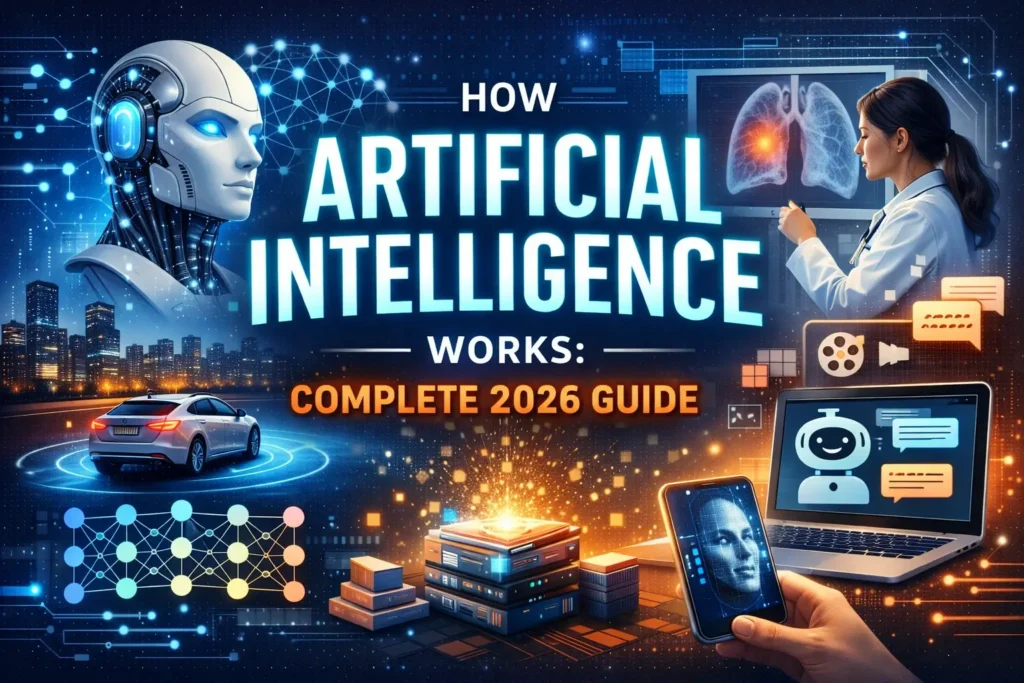
You ask ChatGPT to write an email. Your phone unlocks by recognizing your face. Netflix recommends shows you actually want to watch. Self-driving cars navigate busy streets. Doctors use AI to detect cancer earlier than human eyes can see.
All of this is artificial intelligence working behind the scenes. But how does it actually work? What makes AI different from regular computer programs? And why does it sometimes feel like magic?
According to Stanford researchers, 2026 marks the moment AI confronts its actual utility—moving from evangelism to evaluation. After years of rapid expansion and billion-dollar bets, the coming year demands rigorous proof that AI delivers on its promises. This is no longer about what AI could do theoretically. It is about what it does practically.
This comprehensive guide explains how artificial intelligence works in simple terms anyone can understand—no technical background required. You will learn the core concepts, see real examples, understand different AI types, and grasp why AI matters heading into 2026 and beyond.
Whether you are a business owner, student, professional, or simply curious about technology, this guide provides clarity on the AI systems shaping your daily life.
What Is Artificial Intelligence? (Simple Definition)
Let’s start with the basics:
Artificial Intelligence (AI) is computer systems designed to perform tasks that normally require human intelligence—such as recognizing speech, making decisions, translating languages, or identifying patterns.
Even Simpler: AI means making computers smart enough to do things that we think require human thinking.
What Makes AI Different: Regular computer programs follow exact instructions step-by-step. If you want them to do something different, a programmer must rewrite them.
AI systems can learn and improve on their own over time. They do not need new programming for every situation—they adapt based on experience and data.
Real-World Example: When you learned to ride a bicycle, you did not receive a manual for every situation you might face. You learned through practice and experience. AI learns similarly, though the mechanics differ.
Understanding the benefits of artificial intelligence provides context for why these capabilities matter.
The Three Main Types of AI (2026 Classification)
Not all AI is created equal. Understanding different types clarifies what AI can and cannot do:
Type 1: Narrow AI (Artificial Narrow Intelligence)
What It Is: AI designed for specific tasks. This is all AI that exists in 2026.
Examples:
- Email spam filters
- Voice assistants (Siri, Alexa)
- Recommendation systems (Netflix, Amazon)
- Self-driving cars
- Medical diagnosis tools
- Language translation
Characteristics:
- Excellent at one specific job
- Cannot transfer knowledge to different tasks
- All current AI falls into this category
Real-World Impact: Narrow AI powers virtually every AI application you use today. When your phone recognizes your face, that is narrow AI. When Google translates text, that is narrow AI working.
Type 2: General AI (Artificial General Intelligence – AGI)
What It Would Be: AI with human-level intelligence across all domains—able to learn any task a human can learn.
Current Status: Does not exist yet. Many experts debate whether and when it will exist.
Predictions: Some researchers think AGI could emerge within 10-20 years. Others believe it is decades or centuries away. Still others question whether it is possible at all.
Why It Matters: AGI represents a major milestone because it would match human cognitive flexibility. Current AI excels at specific tasks but cannot generalize learning the way humans do.
Type 3: Super AI (Artificial Super Intelligence – ASI)
What It Would Be: AI that surpasses human intelligence in all domains—creativity, problem-solving, emotional intelligence, everything.
Current Status: Pure speculation. Does not exist. May never exist.
Significance: This is the “science fiction” level AI—systems more intelligent than humanity’s greatest minds combined. Currently theoretical, not practical.
2026 Reality: All discussion about ASI remains hypothetical. We are working with Narrow AI exclusively.
How AI Actually Works: The Core Concepts
Now the practical explanation:
Concept 1: Machine Learning (The Foundation)
What It Means: Instead of programming specific instructions, we give AI systems examples and let them find patterns themselves.
Simple Analogy: Think of teaching a child to recognize dogs:
- You do not give them a rule book defining dogs
- You show them many pictures of dogs
- They learn what features dogs typically have
- Eventually they can identify new dogs they have never seen
Machine learning works similarly. The AI “learns” from examples rather than following explicit rules.
Three Types of Machine Learning:
1. Supervised Learning:
- AI learns from labeled examples
- Like a student with an answer key
- Example: Show AI 10,000 images labeled “cat” or “dog”—it learns to distinguish them
2. Unsupervised Learning:
- AI finds patterns in data without labels
- Like organizing items without being told categories
- Example: AI groups customers by behavior without predefined categories
3. Reinforcement Learning:
- AI learns by trial and error with rewards and penalties
- Like training a dog with treats
- Example: AI learns to play chess by playing millions of games and learning from wins/losses
Learn about machine learning vs AI differences for deeper understanding.
Concept 2: Neural Networks (Inspired by Brains)
What They Are: Computer systems loosely inspired by how human brain cells (neurons) connect and communicate.
How They Work:
- Made of layers of artificial “neurons”
- Each connection has a strength (called a weight)
- AI adjusts these weights during learning
- Eventually the network recognizes patterns
Simple Visualization: Imagine a team of people passing information:
- First layer notices basic features (edges, colors)
- Middle layers combine features (shapes, textures)
- Final layer makes decisions (this is a cat!)
Real Application: When you upload a photo and Facebook suggests tagging friends, neural networks analyze facial features through millions of connections to identify people.
Concept 3: Deep Learning (Many-Layered Networks)
What It Is: Neural networks with many hidden layers—”deep” refers to layer depth, not complexity of understanding.
Why It Revolutionized AI: Deep learning can automatically discover features that matter. Traditional programming required humans to specify what to look for. Deep learning finds relevant patterns independently.
Breakthrough Example: In 2012, researchers showed how deep learning could recognize objects in pictures by analyzing millions of examples. This ImageNet moment demonstrated AI could “see” in ways previously thought impossible.
Current Power: Deep learning drives:
- Voice recognition
- Image understanding
- Language translation
- Self-driving vehicles
- Medical diagnosis
Concept 4: Large Language Models (LLMs)
What They Are: AI systems trained on massive amounts of text to understand and generate human-like language.
How They Work:
- Trained on billions of text examples from books, websites, articles
- Learn patterns in how language works
- Predict what words come next in sequence
- Generate coherent text based on prompts
Famous Examples:
- ChatGPT (OpenAI)
- Gemini (Google)
- Claude (Anthropic)
- GPT-4 and beyond
Key Insight: LLMs do not truly “understand” like humans. They excel at predicting patterns in language based on training data. This enables impressive capabilities but also limitations.
2026 Evolution: According to IBM research, 2026 sees shift from individual LLMs to orchestrated systems. You are not talking to a single model—you are interacting with software systems combining models, tools, and workflows.
Concept 5: Training (How AI Learns)
The Process:
- Data Collection: Gather large amounts of examples
- Initial Setup: Create network structure with random weights
- Feed Examples: Show AI training data repeatedly
- Measure Error: Calculate how wrong predictions are
- Adjust Weights: Change connections to improve accuracy
- Repeat: Continue until performance reaches acceptable level
Why Lots of Data Matters: More examples generally create better AI. This is why companies invest heavily in data collection. Quality and quantity both matter.
Time and Computing: Training advanced AI requires massive computational power. ChatGPT-4 training reportedly cost over $100 million in computing resources.
Concept 6: Inference (When AI Works)
What It Means: After training completes, AI uses learned patterns to make predictions on new data. This is called inference.
Example:
- Training: AI sees millions of email examples labeled spam/not-spam
- Inference: AI evaluates YOUR new email and decides if it is spam
Key Difference: Training happens once (or occasionally). Inference happens constantly—every time you use AI.
Real Examples: How AI Works in Practice
Let’s examine specific applications:
Example 1: Email Spam Filter
How It Works:
- Trained on millions of emails labeled spam/legitimate
- Learns patterns: certain words, sender patterns, link types
- When new email arrives, AI analyzes features
- Calculates probability of spam
- Filters high-probability spam to junk folder
Why It Improves: Continuously learns from your actions (marking spam/not-spam), adapting to new spam tactics.
Example 2: Voice Assistants (Siri, Alexa)
How It Works:
- Speech Recognition: Converts voice to text using neural networks trained on millions of speech samples
- Natural Language Understanding: Interprets what you mean (not just literal words)
- Action Processing: Determines what you want done
- Response Generation: Creates appropriate answer
- Text-to-Speech: Converts response back to spoken words
Multiple AI Systems: One voice interaction involves multiple specialized AI models working together.
Example 3: Self-Driving Cars
How It Works:
- Sensors: Cameras, radar, lidar collect environment data
- Perception: AI identifies objects (cars, pedestrians, signs, lanes)
- Prediction: AI forecasts what other vehicles/people will do
- Planning: AI determines safest path forward
- Control: AI adjusts steering, acceleration, braking
Learning Approach: Combination of supervised learning (from human drivers) and reinforcement learning (simulated practice).
2026 Status: According to recent analysis, autonomous vehicles already operate 24/7 in many major U.S. and Chinese cities safely, with expansion continuing.
Example 4: Medical Diagnosis
How It Works:
- AI trained on millions of medical images (X-rays, MRIs, scans)
- Learns patterns associated with diseases
- When analyzing new patient scan, identifies concerning patterns
- Highlights areas needing doctor attention
- Provides probability scores for various conditions
Human-AI Collaboration: AI assists doctors but does not replace them. Doctors make final decisions with AI insights.
Example 5: Recommendation Systems
How It Works:
- Tracks your behavior (watches, clicks, purchases, ratings)
- Finds patterns in preferences
- Identifies similar users or items
- Predicts what you might enjoy
- Surfaces recommendations
Continuous Adaptation: Every interaction provides new data, refining recommendations constantly.
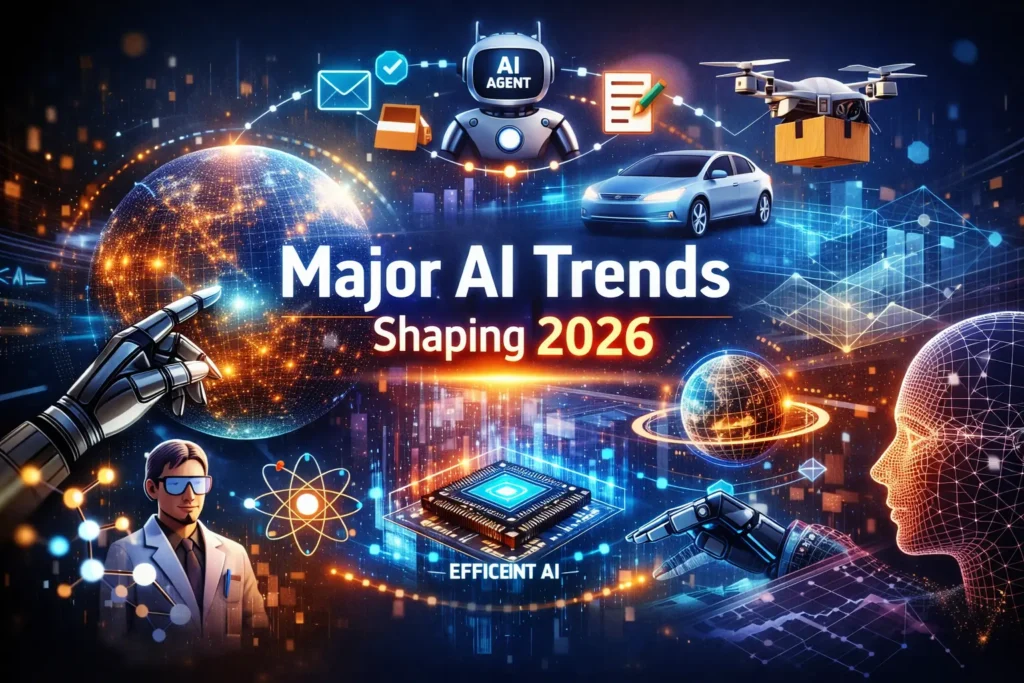
Major AI Trends Shaping 2026
Based on expert analysis from Microsoft, IBM, Stanford, and industry leaders:
Trend 1: From Individual AI to Orchestrated Systems
What’s Changing: 2026 shifts from isolated AI tools to integrated systems that coordinate workflows, connect data across departments, and move projects from idea to completion.
Impact: AI becomes team collaborator rather than individual assistant. Entire workflows get automated, not just discrete tasks.
Trend 2: Agentic AI Goes Mainstream
What It Means: AI agents that autonomously execute multi-step tasks, self-verify work, and operate with minimal human oversight.
Example: Instead of asking AI to draft email, you tell it “handle customer complaint about late delivery”—agent investigates issue, drafts response, coordinates with logistics, and follows up independently.
2026 Breakthrough: Self-verification capabilities solve the error accumulation problem that previously limited agent reliability.
Trend 3: World Models Enable Spatial Understanding
What They Are: AI systems that learn how things move and interact in 3D spaces—not just language patterns.
Why It Matters: Current LLMs predict words. World models understand physics, spatial relationships, and how actions create effects. This enables better planning and decision-making.
Applications:
- Robotics with better environmental understanding
- Better video generation
- Improved physical AI
- Enhanced simulation capabilities
Trend 4: Smaller, More Efficient Models
What’s Changing: Instead of always bigger models, 2026 sees focus on efficient models that run on modest hardware.
Benefit: AI becomes accessible without requiring massive data centers. Edge devices, phones, and local systems run powerful AI.
Trend 5: Repository Intelligence for Software
What It Means: AI that understands not just code lines but relationships, history, and context across entire software repositories.
Impact: According to GitHub data, development activity increased 23% year-over-year with AI assistance. Repository intelligence makes that collaboration even more effective.
Trend 6: AI as Research Partner
What’s Happening: AI moves beyond searching papers or calculations to generating hypotheses, managing experiments, and conducting collaborative research.
Example: Google’s “AI co-scientist” technology helps discover novel knowledge instead of just examining existing literature, accelerating climate modeling, molecular dynamics, and materials design.
Trend 7: Integration Over Innovation
Key Insight: According to industry analysis, 2026 competition is not about AI models themselves (those become commoditized) but about systems—how well you orchestrate models, tools, and workflows.
What This Means: Success comes from integrating AI effectively into real work, not from having most advanced model.
Learn about AI trends changing industries for broader context.
Limitations: What AI Cannot Do
Honest assessment of current capabilities:
Limitation 1: No True Understanding
AI recognizes patterns but does not “understand” meaning the way humans do. It predicts based on training data without genuine comprehension.
Limitation 2: Requires Lots of Data
AI needs massive examples to learn. Humans can learn from few instances. This creates challenges for rare situations.
Limitation 3: Narrow Specialization
AI trained for one task cannot transfer knowledge to different domains. You cannot use email spam filter to drive cars.
Limitation 4: Brittle to Unexpected Input
Small changes outside training data can confuse AI dramatically. Humans handle novel situations better.
Limitation 5: Cannot Explain Reasoning
Many AI systems are “black boxes”—they produce answers but cannot explain why. This creates trust and accountability challenges.
Limitation 6: Bias in Training Data
AI learns biases present in training data. If training examples reflect societal biases, AI perpetuates them.
Limitation 7: No Common Sense
AI lacks basic common sense reasoning humans develop through living in the world. This causes surprising errors.
How to Prepare for AI Future
Practical advice for individuals and organizations:
For Individuals:
Learn AI Literacy: Understand basics of how AI works, what it can/cannot do, and how to work with it effectively.
Develop Complementary Skills: Focus on uniquely human capabilities—creativity, emotional intelligence, ethical reasoning, strategic thinking.
Experiment Hands-On: Use AI tools regularly. Practical experience builds understanding better than theory alone.
Stay Adaptable: AI evolves rapidly. Continuous learning becomes essential, not optional.
Cultivate Human Edge: As Stanford researchers note, success does not require coding expertise—it requires understanding what AI can and cannot do while cultivating uniquely human elements beyond computer capabilities.
For Organizations:
Start With Problems, Not Technology: Identify specific business challenges before selecting AI solutions.
Invest in Data Quality: AI is only as good as training data. Clean, relevant data creates better outcomes.
Establish Governance: Create clear policies on AI usage, ethical guidelines, and oversight mechanisms.
Focus on Integration: Success comes from how AI fits into workflows, not just from technology itself.
Measure Real Impact: Track business outcomes, not just technical metrics.
Learn about AI marketing predictions for strategic planning.
Conclusion: AI as Tool, Humans as Guide
Artificial intelligence works by learning patterns from data, using neural networks to make predictions, and improving through experience. It powers email filters, voice assistants, recommendation systems, medical diagnosis, self-driving cars, and countless other applications.
Key Takeaways:
- AI learns from examples rather than following explicit rules
- Machine learning, neural networks, and deep learning are foundation
- All current AI is narrow (specialized for specific tasks)
- 2026 sees shift from individual tools to orchestrated systems
- Agentic AI executes multi-step workflows autonomously
- World models add spatial understanding beyond language
- AI has real limitations—no true understanding, requires massive data, narrow specialization
- Success comes from human-AI collaboration, not replacement
The Path Forward:
According to Microsoft’s chief product officer for AI experiences, 2026 marks “new era for alliances between technology and people.” The future is not about replacing humans but amplifying them.
Organizations designing for people to learn and work alongside AI get the best of both worlds—teams tackling bigger creative challenges and delivering results faster.
For individuals, success means not competing with AI but learning how to work alongside it. As experts emphasize, “the coming year belongs to those who elevate the human role, not eliminate it.”
AI is powerful tool. But tools require human wisdom, creativity, and judgment to use effectively. Understanding how AI works enables you to leverage it strategically while maintaining critical human oversight.
The AI revolution is here. The question is not whether it transforms your industry—it already is. The question is whether you understand it well enough to navigate that transformation successfully.