In 2026, technology touches 3.5 billion lives every single day. A generative AI tool reached 50 million users in two months—something that took the telephone 50 years. According to Deloitte’s Tech Trends 2026, knowledge half-life in AI has shrunk to months from years.
Yet despite this unprecedented pace, 71% of people still believe technology makes the world a better place, up from 69% in 2025 according to Bosch’s Tech Compass 2026 surveying 11,000 people across seven countries.
This tension—between breathtaking technological acceleration and enduring human optimism—defines society in 2026. Technology is no longer something we use occasionally. It is the infrastructure of modern life, influencing our relationships, health, work, learning, and even how we think.
This comprehensive guide examines technology’s profound impact on society in 2026. You will understand both transformative benefits and serious challenges, see what data reveals about our technological present, and learn what experts predict for our collective future.
Whether you manage technology implementation, study societal trends, or simply navigate this digital world, understanding technology’s societal impact is essential.
The Current State: Technology in Numbers (2026)
Let’s establish the baseline with current data:
Adoption and Access:
- 5.52 billion internet users globally (67% of world population)
- 5.08 billion social media users (61.8% of population)
- 800 million weekly users for leading AI tool (10% of planet)
- 71% believe technology makes world better (Bosch Tech Compass 2026)
- 75% believe line between human and technology will blur (VML Future 100)
Economic Impact:
- $4 trillion global spending on digital transformation by 2027
- $5.5 trillion potential losses from IT skills shortages by 2026
- 90% of organizations facing IT talent crisis
- 87% facing skill gaps already or within five years
Social Dynamics:
- 1 in 6 people worldwide affected by loneliness epidemic
- Social isolation increases death risk by 32% (comparable to smoking)
- 43% of adults 60+ report loneliness
- 71% believe AI makes it impossible to know what’s true
Pace of Change:
- Telephone: 50 years to reach 50 million users
- Internet: 7 years to 50 million users
- Leading AI tool: 2 months to 50 million users
- Knowledge half-life in AI: months (was years)
Understanding how technology is changing businesses provides context for these societal shifts.
Positive Impacts of Technology on Society
Let’s examine documented benefits technology brings to human civilization:
1. Enhanced Communication and Global Connectivity
Technology has demolished geographic barriers to human connection.
Current Reality:
- 5.08 billion social media users connect across continents
- Video calls replaced impossible conversations
- Instant messaging enables real-time global coordination
- Translation tools break language barriers
Societal Benefits:
- Families separated by distance maintain relationships
- Remote work enables geographic freedom
- Global collaboration on complex problems
- Cultural exchange and understanding
- Emergency communication during crises
Example: During natural disasters, social media becomes lifeline for locating survivors, coordinating rescue, and connecting families—capabilities impossible pre-technology.
2. Revolutionized Access to Information and Education
According to January 2026 analysis, personalized AI tutoring will be as ubiquitous as smartphones, with every student accessing instructions adapted to their learning style, pace, language, and needs.
Educational Transformation:
- Free access to world’s knowledge
- Online courses from top universities
- Adaptive learning systems
- Educational content in any language
- Skills training for career changes
Knowledge Democratization: Information once locked in libraries now accessible instantly. A farmer in rural India can access same agricultural research as university professor.
Lifelong Learning: Technology enables continuous skill development. According to research, 87% of organizations face skill gaps—technology provides retraining paths.
3. Advanced Healthcare and Medical Breakthroughs
Technology extends lives and improves health outcomes measurably.
Medical Advances:
- AI diagnostics detecting diseases earlier
- Telemedicine expanding access to care
- Electronic health records improving coordination
- Medical research accelerated by computing
- Surgical robotics enabling precision
Companion Technology: Clinical evidence shows 95% of dementia patients regularly interacting with companion robots had beneficial interactions with measurable reductions in agitation, depression, and loneliness, plus decreased medication usage and improved sleep patterns.
Global Health: During pandemics, technology enabled vaccine development, contact tracing, and remote care delivery at unprecedented speed.
4. Economic Growth and Job Creation
Despite automation fears, technology creates net economic value.
Employment Reality: Technology eliminates some jobs while creating new categories. Web developers, data scientists, social media managers, and AI ethicists are all roles that did not exist decades ago.
Entrepreneurship: According to Deloitte, AI startups scale from $1 million to $30 million in revenue five times faster than SaaS companies. Technology lowers barriers to starting businesses.
Productivity Gains: Organizations using technology effectively see dramatic efficiency improvements, enabling higher output with same resources.
Global Market Access: Small businesses now compete globally through e-commerce platforms—impossible before technology.
5. Enhanced Safety and Security
Technology makes societies measurably safer.
Crime Reduction:
- Surveillance systems deter and solve crimes
- Emergency response systems save lives
- Cybersecurity protects financial systems
- Natural disaster early warning systems
Transportation Safety: Autonomous vehicles already operate 24/7 in major US and Chinese cities safely. Their expansion will reduce accidents caused by human error, which account for 94% of crashes.
Public Health: Disease surveillance systems detect outbreaks earlier. Water quality monitoring prevents contamination. Food safety tracking reduces foodborne illness.
6. Environmental Monitoring and Sustainability
Technology enables environmental protection at scale.
Climate Action:
- Satellites monitoring deforestation and emissions
- Smart grids optimizing energy distribution
- Renewable energy management systems
- Carbon tracking and reporting
- Climate modeling for policy decisions
Resource Efficiency: Smart cities use sensors and data analytics to reduce waste, optimize resource use, and minimize environmental impact. Traffic signals adjust to real-time congestion, waste systems optimize pickup routes.
Conservation: Technology tracks endangered species, monitors ecosystems, and enables precision agriculture reducing water and pesticide use.
Learn about emerging technologies to watch for sustainability innovations.
7. Scientific Discovery Acceleration
Technology multiplies human capacity for discovery.
Research Capabilities: AI agents capable of researching, experimenting, and discovering autonomously will multiply innovative capacity in science and engineering according to January 2026 analysis.
Collaboration: Scientists worldwide collaborate in real-time, sharing data and building on each other’s work instantaneously.
Simulation: Complex systems can be modeled and tested virtually before physical implementation, accelerating iteration.
Data Analysis: Technology processes datasets impossible for humans to analyze manually, revealing patterns and insights that drive breakthroughs.
Negative Impacts and Challenges
Technology brings serious challenges requiring honest acknowledgment and action.
1. The Loneliness Epidemic
Paradoxically, connectivity technology has contributed to profound isolation.
The Crisis:
- 1 in 6 people worldwide affected by loneliness
- WHO designated it public health crisis
- Social isolation increases death risk by 32%
- 43% of adults 60+ report loneliness
Contributing Factors:
- Online interactions replace face-to-face connection
- Social media creates curated unreality
- Work-from-home reduces casual interactions
- Digital entertainment replaces community activities
The Irony: The very tools designed to connect us have, in some ways, isolated us. Technology enabled this problem and must help solve it.
2. Misinformation and Truth Degradation
According to VML’s Future 100 research, 71% of people believe AI makes it impossible to know what’s true.
The Problem:
- AI-generated deepfakes proliferate
- Social media algorithms amplify sensationalism
- Echo chambers reinforce existing beliefs
- Fact-checking struggles with scale
- Trust in institutions erodes
Provenance Technology: Authentication systems that verify content origin are becoming as valuable as the AI that creates fiction. This represents urgent need, not future prediction.
Democratic Threat: When citizens cannot determine truth, informed decision-making collapses. This threatens democratic governance fundamentally.
3. Privacy Erosion and Surveillance
Technology enables unprecedented data collection and monitoring.
Personal Data: Companies track behavior across devices and platforms. Location data, search history, purchases, communications—all collected and analyzed.
Surveillance Infrastructure: Smart cities monitor citizens constantly. Facial recognition identifies individuals in public spaces. Data breaches expose sensitive information.
Power Imbalance: Individuals have little control over data collection or usage. Terms of service bury concerning practices in unreadable legalese.
Authoritarian Risk: Surveillance technology enables government monitoring and control at scales previously impossible.
4. Digital Divide and Inequality
Technology access remains unequal, exacerbating existing disparities.
Access Gaps: According to Digital 2026 data, 33% of world population still lacks internet access. This represents billions excluded from digital economy and information access.
Skills Divide: Even with access, skills gap creates inequality. Digital literacy determines economic opportunity increasingly.
Economic Inequality: Technology companies concentrate wealth. Automation displaces workers without providing alternative pathways. Winner-take-all dynamics worsen inequality.
Geographic Disparities: According to January 2026 research, Asia-Pacific achieves 45% GenAI adoption while Europe falls 45-70% behind United States. This creates competitive disadvantages between regions.
5. Mental Health Impacts
Technology correlation with mental health challenges is documented.
Youth Impact: Social media contributes to anxiety, depression, and self-esteem issues particularly in young people. Constant comparison and curated perfection create unrealistic expectations.
Attention Degradation: Constant notifications fragment attention. Multitasking reduces deep thinking capacity. Information overload creates stress.
Sleep Disruption: Screen time before bed disrupts circadian rhythms. Blue light suppresses melatonin. Digital stimulation prevents rest.
Addiction Patterns: Technology products designed for engagement create compulsive usage patterns. Variable reward systems exploit psychological vulnerabilities.
6. Job Displacement and Economic Disruption
While technology creates jobs, it also eliminates them—not always for same people.
Automation Impact: Routine jobs face highest displacement risk. Manufacturing, transportation, data entry, customer service—technology automates these increasingly.
Skills Mismatch: Jobs eliminated require different skills than jobs created. Coal miner cannot easily become data scientist. Retraining requires time, money, and support often unavailable.
Geographic Concentration: Technology jobs concentrate in specific cities. Displaced workers in other regions face relocation or unemployment.
Economic Anxiety: Even workers not yet displaced worry about future. This psychological burden affects well-being and life planning.
7. Cybersecurity Threats
Technology creates attack vectors that did not exist previously.
Escalating Threats: Supply chains saw huge uptick in cyberattacks in 2025, with 2026 expected to see more frequent and expensive attacks. Third-party vulnerabilities now account for 30% of all data breaches.
Critical Infrastructure: Power grids, water systems, hospitals—all connected and vulnerable. Successful attacks could cause catastrophic harm.
Personal Impact: Identity theft, financial fraud, ransomware—individuals face direct threats requiring constant vigilance.
Arms Race: Defensive and offensive capabilities escalate continuously. According to AT&T’s chief information security officer: “What we’re experiencing today is no different than what we’ve experienced in the past. The only difference with AI is speed and impact.”
8. Environmental Costs
Technology’s environmental footprint is substantial.
Energy Consumption: Data centers consume massive electricity. AI training requires enormous compute power. Cryptocurrency mining uses nation-state level energy.
E-Waste: Constant device upgrades create electronic waste. Toxic materials in electronics harm environment when improperly disposed.
Resource Extraction: Rare earth minerals for electronics come from environmentally destructive mining. Supply chains often exploit workers.
Carbon Footprint: While technology enables green solutions, technology industry itself generates significant emissions.
2026 Technology Trends Reshaping Society
Based on Deloitte Tech Trends 2026, Bosch Tech Compass, ESADE analysis, and multiple January 2026 sources:
Trend 1: AI Agents Enter Daily Life
Software applications that reason and act on our behalf in complex situations are arriving.
What They Do: Purchase goods, negotiate, plan trips, manage business processes autonomously.
Societal Impact: While adoption has been limited so far, in 2026 we will begin gradual integration into everyday life, transforming how we work and interact—almost without noticing.
Trend 2: Autonomous Systems Expand
Driverless vehicles already operate 24/7 in many major US and Chinese cities safely.
Coming Changes:
- Fewer privately owned cars
- Rethinking urban design
- Less congested cities
- Drastically reduced logistics costs
- New battery technologies (sodium batteries)
Social Implications: Urban planning, employment, and daily commutes all transform fundamentally.
Trend 3: Space Becomes Computational Frontier
Space offers superior thermal and energy conditions for data centers. First AI model trained in orbit already demonstrated feasibility.
2026 Developments:
- Phones connected directly to satellites
- 10G networks testing
- Traditional telecom operators struggling to adapt
- New computational possibilities
Trend 4: Personalized AI Education
Every student will have access to instructions adapted to their learning style, pace, language, and needs.
Educational Revolution: When tools engage curiosity instead of enforcing compliance, when diversity is honored instead of conformity demanded, schools spring to life like Death Valley after rain.
Trend 5: Companion Technology Addresses Loneliness
Clinical evidence shows companion robots reduce loneliness, agitation, and depression in elderly and pediatric patients.
Social Healing: Technology that created isolation epidemic now becomes part of solution through genuine emotional connection capabilities.
Trend 6: Truth Verification Technology
With 71% believing AI makes truth unknowable, provenance technology authenticating content becomes critical.
Trust Infrastructure: Systems verifying content origin become essential infrastructure for functional society.
Trend 7: Computing Moves Beyond Screens
Smart glasses and ambient devices shift customer interactions fundamentally.
Experience Shift: Marketing moves from destination (website) to contextual, responsive reality layer. This demands new engagement strategies.
Understand how AI is changing marketing to prepare for this shift.
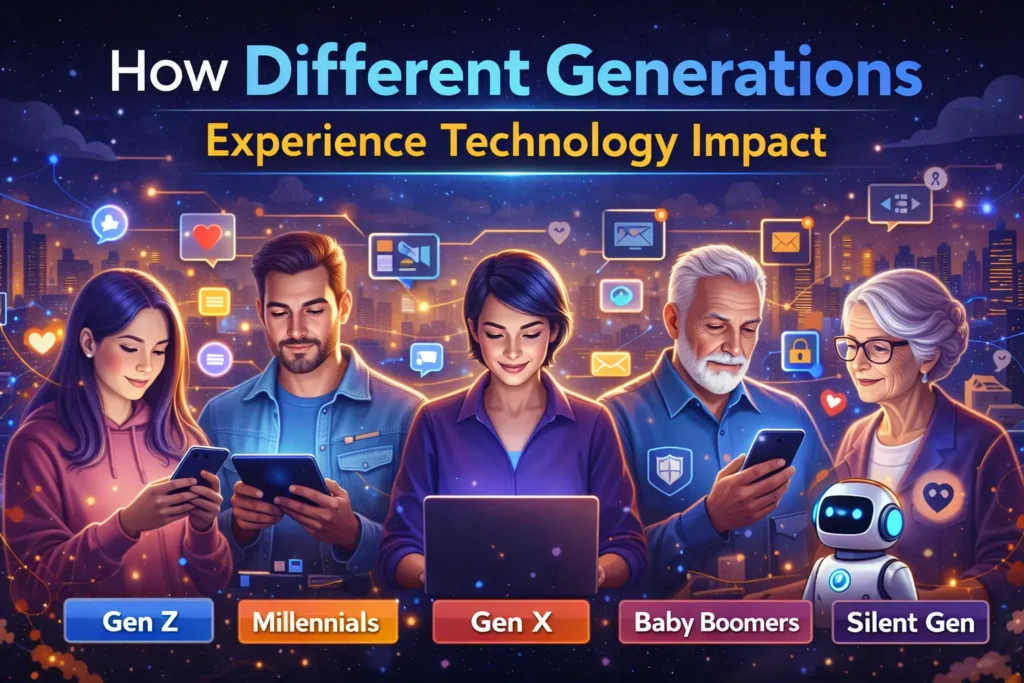
How Different Generations Experience Technology Impact
Technology affects age groups differently:
Gen Z (Born 1997-2012)
Digital Natives: First generation never knowing life without internet. Technology is not separate from life—it is life’s infrastructure.
Impacts:
- Social media shapes identity formation
- Online communities as important as physical
- Career expectations include flexibility and technology
- Mental health challenges from constant connectivity
Millennials (Born 1981-1996)
Digital Adapters: Grew up as technology evolved. Remember pre-internet childhood but embraced digital adulthood.
Impacts:
- Work-life boundaries blurred by always-on technology
- Gig economy and remote work adoption
- Student debt meets automation anxiety
- Social movements organized through technology
Gen X (Born 1965-1980)
Bridge Generation: Analog childhood, digital adulthood. Comfortable with technology but remember alternatives.
Impacts:
- Adapting to workplace technology changes
- Parenting digital natives
- Retirement planning with automation uncertainty
- Valuing both digital and analog experiences
Baby Boomers (Born 1946-1964)
Late Adopters: Many resistant initially but now engaged with technology.
Impacts:
- Healthcare technology extending quality of life
- Social connection with distant family
- Learning curves for new systems
- Companion technology addressing loneliness
Silent Generation (Born 1928-1945)
Technology Witnesses: Lived through most dramatic technological transformation in human history.
Impacts:
- Accessibility technology enabling independence
- Telehealth expanding medical access
- Digital exclusion risk without support
- Wisdom about life before technology
Regional Differences in Technology Impact
China:
- 87% believe technology makes world better (highest globally)
- 48% see research capabilities as top innovation driver
- Rapid smart city deployment
- Extensive digital payment adoption
India:
- 37% emphasize qualified people and education institutions
- Mobile-first technology adoption
- Leapfrogging infrastructure gaps
- Emerging tech hub status
United States:
- Technology skepticism rising
- Leading AI innovation
- Digital divide between urban and rural
- Privacy concerns increasing
Europe:
- Stronger data protection regulations (GDPR)
- 45-70% behind US in AI capabilities
- Focus on ethical technology
- Digital skills investment
France:
- 53% believe technology makes world better (lowest of surveyed)
- Highest skepticism consistently
- Concerns about cultural impact
- Regulation-first approach
Balancing Technology’s Impact: Path Forward
How can society maximize benefits while minimizing harms?
1. Invest in Digital Literacy and Education
Why It Matters: 87% of organizations face skill gaps. Education determines who benefits from technology.
Actions:
- Universal digital literacy programs
- Continuous learning opportunities
- Technology education starting young
- Retraining support for displaced workers
2. Develop Ethical Technology Governance
Why It Matters: Technology develops faster than regulation. Governance prevents harm.
Actions:
- Transparent AI decision-making
- Privacy protection enforcement
- Algorithmic accountability
- Inclusive development processes
3. Address Digital Divide
Why It Matters: 33% of population lacks internet access. Inequality worsens without intervention.
Actions:
- Universal broadband infrastructure
- Affordable device programs
- Community technology centers
- Accessibility standards
4. Prioritize Mental Health and Wellbeing
Why It Matters: Technology correlation with mental health challenges is documented.
Actions:
- Screen time guidelines
- Social media literacy
- Digital detox encouragement
- Mental health resources
- Technology design for wellbeing
5. Support Workforce Transitions
Why It Matters: Job displacement causes economic and psychological harm without support.
Actions:
- Retraining programs
- Social safety nets
- Portable benefits
- Economic diversification
- Job creation in emerging fields
6. Foster Human Connection
Why It Matters: Loneliness epidemic affects 1 in 6 people worldwide.
Actions:
- Community space investment
- In-person event encouragement
- Technology-free zones
- Companion technology for isolated
- Social prescription programs
7. Demand Sustainability
Why It Matters: Technology’s environmental footprint threatens climate goals.
Actions:
- Energy-efficient data centers
- E-waste recycling programs
- Sustainable design standards
- Renewable energy requirements
- Right-to-repair legislation
Expert Perspectives on Technology’s Future Impact
On Education: “When you use tools to engage curiosity instead of enforcing compliance, when you honor diversity instead of demanding conformity, schools spring to life.”
On Loneliness: “We are on the verge of something fundamentally different where technology values autonomy, empathy, and individual expertise.”
On Transformation: “In 2026, AI-driven transformation begins to gain real momentum. Major technological transformations rarely happen all at once but are built gradually.”
On Infrastructure: “The reason lies not only in social adoption processes which tend to be slow at first, but also in the need to build infrastructure.”
On Humanity: “The impact of artificial intelligence on society will be written by all of us. Invest in learning, support inclusive innovation, demand transparency, and use technology to elevate human judgment, creativity, and empathy.”
Conclusion: Technology as Tool, Humanity as Guide
Technology touches 3.5 billion lives daily. It extends lifespans, connects continents, democratizes knowledge, and multiplies human capability. Yet it also isolates, surveils, displaces, and misleads.
Key Takeaways:
- 71% believe technology makes world better (up from 69%)
- 3.5 billion people touched by AI daily
- Loneliness affects 1 in 6 worldwide
- 71% believe AI makes truth unknowable
- $4 trillion digital transformation spending by 2027
- 90% of organizations facing IT talent crisis
- Knowledge half-life in AI shrunk to months
- Companion robots showing 95% beneficial interactions
The Critical Choice:
Technology is neither inherently good nor bad. It is a tool that amplifies human intentions. The question is not whether technology impacts society—it obviously does—but whether we will shape that impact intentionally.
As one expert notes: “The opportunity before us is enormous. Imagine a world where AI enhances human creativity instead of replacing it, where technology bridges inequality rather than deepening it. That future depends on choices made today.”
What We Must Do:
- Design technology for human flourishing, not just engagement
- Educate every person to thrive alongside technology
- Support innovation that includes all communities
- Demand transparency and accountability
- Use technology to elevate human judgment
The future is not predetermined. Every organization, every policymaker, every individual makes choices daily that shape technology’s societal impact. The question is whether those choices will be made with wisdom, empathy, and long-term vision.
Technology is humanity’s most powerful tool. The impact—positive or negative—depends entirely on how we wield it.