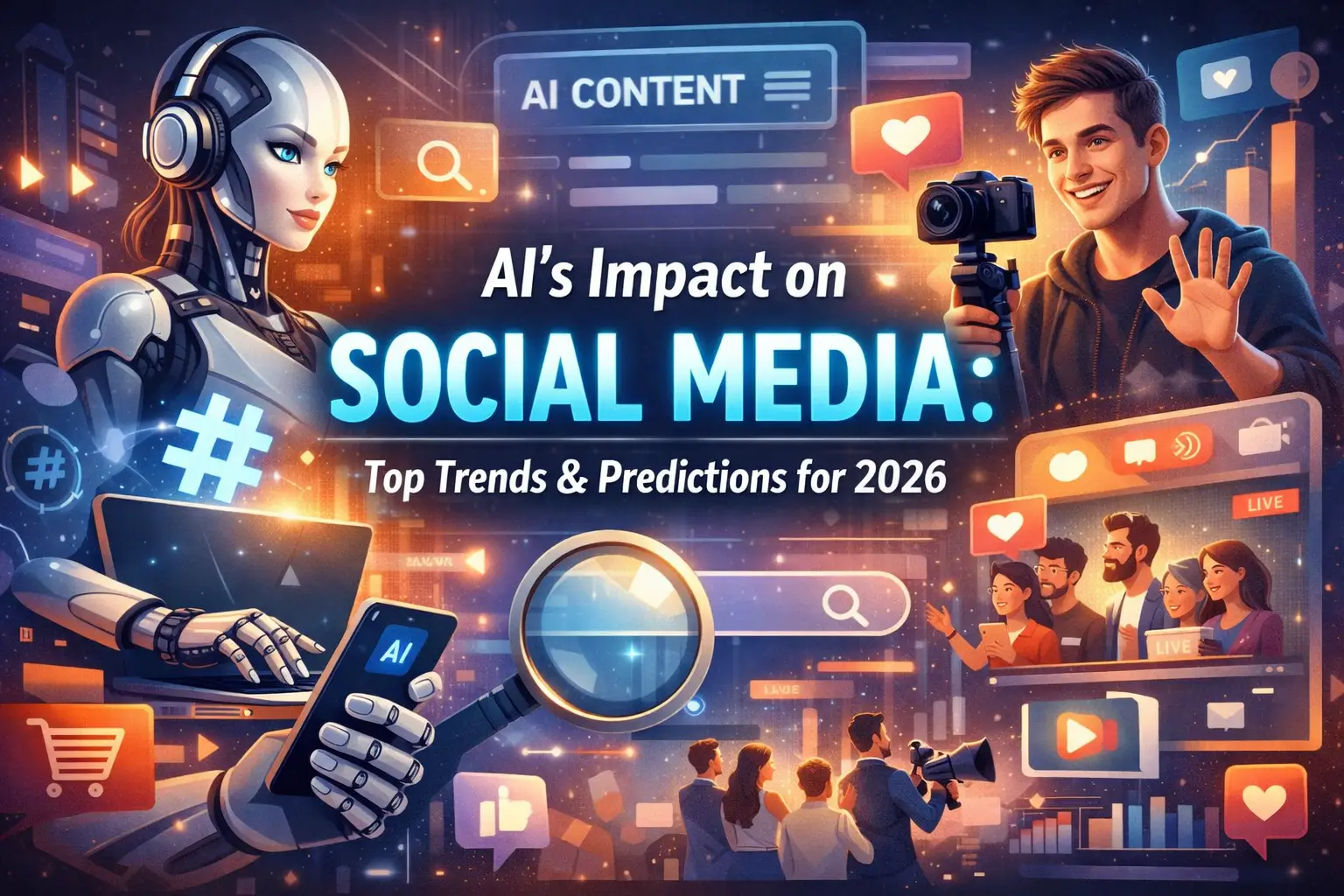
In 2025, AI-generated articles surpassed human-written content online for the first time. AI-only social platforms like Meta’s Vibes and OpenAI’s Sora launched and gained traction. Yet paradoxically, nearly a third of consumers say they are less likely to choose brands that use AI ads.
Welcome to the strange reality of social media in 2026—where AI tools are essential but authenticity is the ultimate differentiator.
According to Sprout Social’s research, 97% of marketing leaders now say marketers must know how to use AI. But according to their Q3 2025 Pulse Survey, the #1 consumer concern about brands on social media is companies posting AI-generated content without disclosing it. And 55% of users say they trust brands more when they publish human-generated content.
This tension defines social media today: AI is table stakes for efficiency, but human connection wins engagement. The brands succeeding in 2026 are not choosing between AI and authenticity—they are strategically combining both.
This comprehensive guide explores how AI is reshaping social media, what trends are dominating February 2026, and what predictions matter for the rest of the year. Whether you manage social media, create content, or lead marketing strategy, you need to understand these forces shaping how billions of people discover, engage with, and buy from brands.
The Current State of AI in Social Media (February 2026)
Let’s establish where we are before exploring where we are going:
AI Adoption:
- 97% of marketing leaders say marketers must know AI
- AI tools now handle ideation, drafting, image generation, captions, and video production
- AI agents are being integrated into social strategies within 12-18 months (81% of business leaders)
- Average brands published 9.5 posts per day across networks in 2024
Consumer Sentiment:
- Top concern: Brands posting AI content without disclosure (Sprout Social Q3 2025)
- 46% uncomfortable with AI influencers (Q3 2025 Pulse Survey)
- 55% more likely to trust human-generated content
- 67% of Gen Z and Millennials prefer human content
- Nearly 33% less likely to choose brands using AI ads (Hootsuite)
Platform Changes:
- AI-only platforms emerging (Meta’s Vibes, OpenAI’s Sora)
- Meta AI providing search summaries on Facebook and Instagram
- LinkedIn’s increasingly youthful audience with new video features
- Threads reaching 400 million users (poised to overtake X in 2026)
The Paradox: According to Hootsuite’s 2026 trends: “AI tools are now table stakes—but authenticity is the differentiator for successful brands and powerful consumer connections.”
Understanding how AI is changing marketing provides broader context for these social-specific shifts.
Top AI Trends Shaping Social Media in 2026
Based on research from Hootsuite, Sprout Social, Adobe, Marketing Brew, Facelift, and Social Insider, here are the defining trends:
1. Predictive Analytics Becoming Standard
AI tools now forecast audience behavior, identify emerging trends before they go mainstream, and optimize post timing for maximum engagement.
How It Works: According to Facelift’s January 9, 2026 analysis: “These tools analyze patterns in social media data to forecast future behavior, which helps brands improve timing and relevance in their content.”
Capabilities:
- Identify trending topics before they peak
- Share posts at optimal times for specific audiences
- Predict which content formats will perform best
- Forecast customer behavior and preferences
Action Step: Use platforms like Facelift Data Studio, Sprout Social Analytics, or Hootsuite Insights to spot patterns and adjust strategies before competitors.
Why It Matters: Speed is critical in 2026. According to Hootsuite: “Brands are expected to respond to cultural happenings almost instantly, as algorithmic shifts reward the sameness of content in the wake of a viral moment.”
2. The “AI Slop” Backlash Is Real
Multiple industry experts warned about “AI slop”—low-quality, mass-produced AI content flooding feeds.
Dan Murphy, SVP of Marketing at Liquid Death: “It’s this weird, confusing time where you see something with high production value and you assume a lot of thought has gone into it, but it’s no longer the case. The ability to create content has so far outpaced good content creation.” (Marketing Brew, January 6, 2026)
The Problem:
- Q4 2025 showed AI content was often just “slop”
- Consumers recognize and reject generic AI content
- High production value no longer signals quality or thought
- Content overload exhausts audiences
The Solution: According to Dorien Morin van Dam, Content Strategist: “To get away from this, brands will need to focus on bringing humans (back) into the picture and creating raw, human-centered content that speaks to humans, not bots.”
What Works:
- Human editing for tone and authenticity
- Employee-generated content
- Behind-the-scenes authenticity
- Live streaming (AI cannot replace real-time human presence)
3. AI as Creative Partner, Not Content Creator
The winning approach treats AI as a tool that enhances human creativity rather than replaces it.
Mihai Roventa, Digital Marketing Specialist: “AI will play a huge role, but not in the cold, automated way that scares people. It will work more like a creative partner that helps teams move faster, experiment more, and unlock ideas that used to take weeks. The brands that will stand out are the ones that use AI to enhance their personality, not replace it.” (Social Insider, February 2026)
How Leaders Use AI:
For Efficiency:
- Generating caption variations
- Suggesting hashtags
- Drafting initial content
- Automating scheduling
- Analyzing performance data
Not For:
- Final creative decisions
- Brand voice
- Strategic direction
- Authentic storytelling
- Community relationships
Josh Hackbarth, CMO of MGA Entertainment: “I definitely see it much more as backend support and maybe some slight tool enhancement as we see it going forward.” (Marketing Brew, January 6, 2026)
4. Micro-Creators Outperforming Mega-Influencers
According to Adobe’s 2026 social trends: “Roughly 75% of agencies believe that smaller creators with niche audiences are outperforming celebrities in engagement and ROI.”
Why This Shift:
- Authentic connections matter more than reach
- Niche audiences deliver higher engagement
- Lower cost with better ROI
- Trust in relatable people over celebrities
- Long-term partnerships build recognition
Strategy Shift: Brands are moving from one-off creator posts to ongoing partnerships with micro-creators who consistently produce content throughout the year.
What To Do: Find creators who align with your message and values, not just those with largest followings.
The AI Twist: Some brands experiment with AI-driven characters and hybrid human+AI influencers, but according to Sprout Social’s Q3 2025 Pulse Survey, 46% of users are uncomfortable with AI influencers.
Mae Karwowski, CEO of Obviously: “The Tilly Norwoods and Lil Miquelas of the world are seen as pretty toxic right now.” (Marketing Brew, January 6, 2026)
Learn about marketing for business growth to understand creator partnerships strategically.
5. Social Search Overtaking Traditional SEO
According to Sprout Social’s Q2 2025 Pulse Survey: “Nearly one in three consumers skip Google altogether, instead starting their search journey on networks like TikTok, Instagram or YouTube.”
What Changed:
- Google less useful than before
- Young generations use social search first
- Platforms introducing AI search summaries (like Meta AI)
- Social content appears in Google SERPs
Optimization Required:
- Social engine optimization (SEO for social)
- Answer engine optimization (AEO) for AI summaries
- Keywords in posts for platform search
- Attention to trending searches
Lacy Phillips, Digital Coordinator at P.S. Literary: “If you have good keywords in a post, expect it to be indexed and pushed by the algorithm when users search that keyword.” (Jane Friedman, December 30, 2025)
Strategy: Pay attention to search sources in insights, monitor trending keywords (SEMrush, TikTok Business Insights), and create content addressing popular searches.
Understanding entity-based SEO helps optimize for AI search across platforms.
6. Employee Advocacy Over Polished Brand Content
According to Hootsuite’s 2026 trends: “Audiences trust people more than they trust faceless brands. And they trust employees more than influencers or CEOs.”
Why It Works:
- Authenticity beats polish
- Employees bring human faces to brands
- Personal networks extend reach
- Real people create real connections
How To Implement: According to Facelift’s January 9, 2026 analysis: “Employee advocacy is a prime example. Facelift Amplify allows businesses to share pre-approved, branded content with employees, who can then customize it for their personal networks.”
The AI Enhancement: Use predictive analytics to identify what content performs best, then equip employees with insights to share relevant, impactful content they actually want to post.
7. Video Remains Dominant (But Authenticity Trumps Polish)
Short-form video continues driving attention, but the style is evolving.
Adobe’s 2026 Observation: “These videos are evolving away from being polished to looking more spontaneous and authentic. Audiences respond to relatable, story-driven clips over flashy edits.”
What Works:
- “Day-in-the-life” formats
- Behind-the-scenes content
- Personal touches
- Spontaneous moments
- Relatable stories
Production Value Paradox: According to Adobe: “While production value is less meaningful to followers than authenticity, it’s still important to grab attention in the first seconds in Reels and TikTok.”
AI’s Role: AI makes video production accessible to everyone. According to Facelift: “Video remains the most engaging content type in social media, and AI is making it accessible for everyone.”
But the AI-generated videos that win are those refined with human storytelling and authentic voice.
8. Social Commerce Integration Deepens
According to Adobe: “In 2026, it’s going to be even more seamless and personalized while merging community, entertainment, and convenience.”
Current Reality:
- TikTok Shop
- Instagram Checkout
- Pinterest Shopping
- Direct purchases without leaving platform
What Works: Soft sell showing how products make life better, not aggressive “buy now” calls-to-action. Authentic shoppable videos perform best.
AI Enhancement: Personalized product recommendations based on user behavior, interests, and previous interactions.
9. Community Over Content Volume
According to Sprout Social’s December 2025 predictions: “The future of social media for brands will re-center community, not just content.”
The Shift:
- Post quality matters more than quantity
- “Post more to win” mentality is dead
- Algorithms reward engagement depth over volume
- Social fatigue from content overload
Greg Swan, Senior Partner at FINN Partners: “The next wave will focus less on how often a brand posts, and more on how well it listens, engages and builds lasting relationships.”
Strategy Changes:
- Private communities
- Deeper creator collaborations
- Smarter AI for personalization
- Two-way conversations
- Long-term trust investment
Data Context: Brands published average 9.5 posts daily in 2024. Consumer-facing industries often quadrupled that. Result: extreme saturation and social media fatigue at all-time high.
10. Platform Diversification and Emerging Networks
Users are exploring alternative platforms beyond the big ones.
Rising Platforms:
- Threads: 400 million users in two years, poised to overtake X (600 million total)
- LinkedIn: Increasingly youthful audience with new video features
- Substack: No longer just newsletters—now a social platform with feeds, inbox, profiles
Lia Haberman, Creator Economy Expert: “Interest in Substack will explode in 2026. The appeal is obvious: direct audience access, more intentional engagement with the content than the average social post, and the opportunity to be part of the cultural zeitgeist.”
Strategy: Do not become over-reliant on any one platform. Focus on owned media (email lists, websites) as much as possible.
Learn about branding strategies for modern businesses to build platform-independent brand equity.
Predictions for the Rest of 2026 and Beyond
Based on current trajectories and expert analysis:
Prediction 1: AI Agents Become Standard
By 2028, 33% of enterprise software will include agentic AI according to Gartner. Social media will be early adopter.
What AI Agents Will Do:
- Handle routine customer inquiries 24/7
- Analyze user interactions to surface trends
- Flag issues for human escalation
- Provide crisis management support
- Generate custom responses at scale
Facelift’s January 9, 2026 Analysis: “The ability to create custom AI agents to meet your own business needs will become a fundamental part of any communication strategy.”
Critical Caveat: “We don’t predict that this means social media managers will become irrelevant. It is just another tool in their kits to make day-to-day, routine tasks easier and more efficient.”
Prediction 2: Authenticity Becomes Non-Negotiable
As AI content proliferates, human-generated content becomes premium.
Consumer Demand: According to Sprout’s Q4 2025 Pulse Survey, the #1 effort consumers want brands to prioritize in 2026 is crafting human-generated content.
Nicole Weltman, Head of Social at Taco Bell: “This whole unhinged social media manager, ‘I’m posting this and legal doesn’t know’ thing is really overplayed. The brands that will win online in 2026 are the ones with ‘ownable and distinctive’ voices.” (Marketing Brew, January 6, 2026)
Prediction 3: Live Streaming Resurgence
Dorien Morin van Dam: “Livestreaming is the last frontier. AI can do almost anything, but it simply can’t replace humans who show up live, with empathy and emotions, and expert knowledge, and answer questions in real time.”
Prediction 4: Social + Experiential Marketing Merge
Josh Hackbarth: “Social and experiential marketing will become more intertwined in 2026 given the surge of branded events and the growing popularity of large-scale events like music festivals.”
Expect more IRL events driving social content, and social building anticipation for real-world experiences.
Prediction 5: Regulatory Changes Impact Platforms
Australia banned under-16s from all social media. This could herald new regulatory waves.
Lacy Phillips: “The era of allowing social media platforms to conduct unchecked social experiments may be coming to an end in some regions of the world.”
Potential Changes:
- Platforms treated more like public utilities
- Increased protections for minors
- Forced sales or industry-disrupting regulations
- Functional regulatory bodies imposing constraints
What It Means: Volatility that could reduce reach and conversions. Do not over-rely on any single platform.
Prediction 6: Niche Communities Grow in Power
Kara Redman, CEO of Backroom: “[Brands should prioritize] more niche relatability to their specific customers. Less trend following, more curiosity about the people.”
Micro-communities, employee influencers, and in-person experiences will matter more than mass reach.
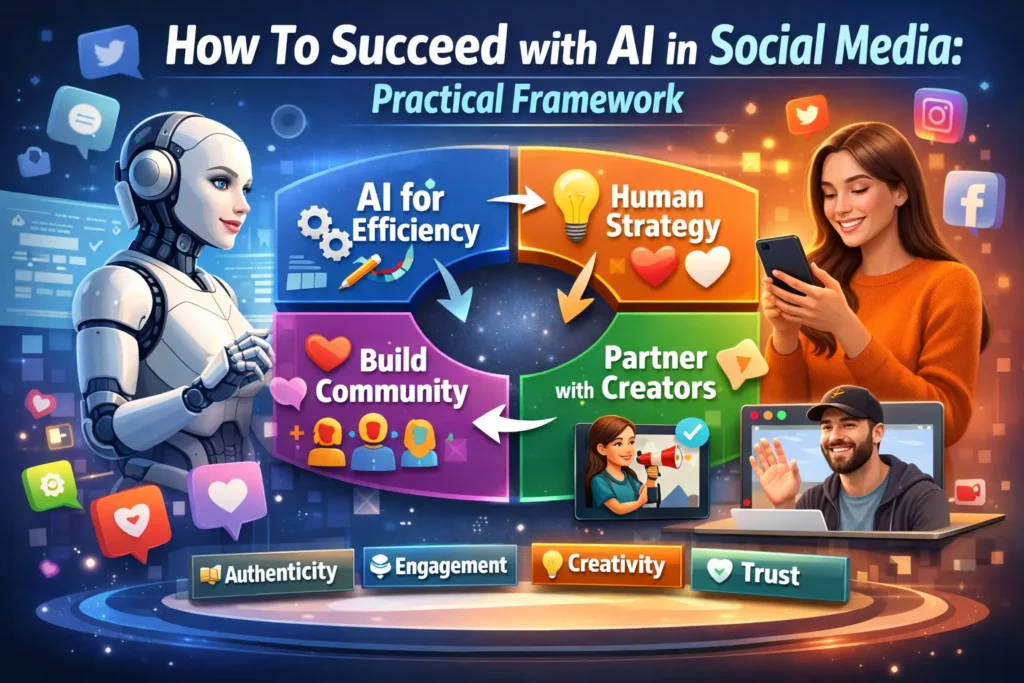
How To Succeed with AI in Social Media: Practical Framework
Based on all this research, here is your action plan:
1. Use AI for Efficiency, Humans for Strategy
AI Handles:
- Scheduling and publishing
- Performance analytics
- Trend identification
- Caption variations
- Hashtag suggestions
- Image generation drafts
Humans Handle:
- Brand voice and tone
- Strategic direction
- Community relationships
- Creative concepts
- Crisis management
- Authentic storytelling
2. Prioritize Quality Over Quantity
Stop the content treadmill. According to ALM Corp’s January 1, 2026 guide: “The ‘post more to win’ mentality is officially dead.”
New Approach:
- Post when you have something valuable to say
- Focus on engagement depth
- Measure quality metrics (saves, shares, meaningful comments)
- Build relationships, not just broadcast
3. Optimize for Social Search
Actions:
- Include relevant keywords in posts
- Monitor trending search terms
- Create content answering common questions
- Use platform search features yourself
- Track search traffic sources
4. Build Community, Not Just Audience
Greg Swan’s Framework: “The brands that win will treat social as a two-way street and a long-term investment in trust, not just a content calendar to fill.”
Specific Tactics:
- Establish response time goals (track as KPIs)
- Create dedicated community management roles
- Build exclusive spaces for superfans
- Implement social listening proactively
- Develop surprise-and-delight strategies
- Experiment with emerging platforms early
5. Embrace Employee Advocacy
Your employees are your most authentic influencers.
Steps:
- Share pre-approved content employees can customize
- Provide insights on what performs well
- Make sharing easy and optional
- Celebrate employee participation
- Train on brand guidelines and boundaries
6. Partner with Micro-Creators
75% of agencies see better ROI from smaller creators.
Approach:
- Find creators aligned with your values
- Build long-term partnerships (not one-offs)
- Give creative freedom
- Focus on authentic product integration
- Measure engagement and conversion, not just reach
7. Be Transparent About AI Use
Consumer Expectations: Top concern is brands posting AI content without disclosure.
Best Practice:
- Disclose AI-generated content
- Use AI for enhancement, not replacement
- Maintain human oversight
- Focus on AI improving human creativity
Common Mistakes to Avoid
Mistake 1: Treating AI as Complete Solution
AI generates content, but cannot create context, strategy, or authentic connection.
Mistake 2: Chasing Every Trend
According to Jenn Crim, Marketing Specialist: “We’ve seen trends start to feel ‘overdone’ by brands. This year we’ll see a larger lean-in to creativity, originality and brand building.”
Mistake 3: Ignoring Platform-Specific Behavior
Chris Wood, Marketing Director: “Brands that win next year will understand how to work in tandem synergistically with social media algorithms versus fighting them.”
Mistake 4: Over-Relying on One Platform
Platform volatility requires diversification.
Mistake 5: Prioritizing Vanity Metrics
Hootsuite’s 2026 trends note: “Follower count and engagement rate metrics are no longer reliable indicators of impact. Instead, brands are prioritizing storytelling quality, audience alignment, and ROI.”
Mistake 6: Generic AI Content
If AI generates it without human refinement, audiences will know and disengage.
Mistake 7: Ignoring Community Management
Social is two-way. Posting without engaging wastes opportunity.
Conclusion: The AI-Authenticity Balance
AI is reshaping social media fundamentally, but not in the way many predicted. The platforms want you to use AI. The tools make it easier than ever. The content volume is exploding.
Yet the brands winning are those balancing AI efficiency with human authenticity.
Key Takeaways:
- 97% of marketing leaders say AI knowledge is essential
- But 55% of consumers trust human content more
- AI-generated articles surpassed human content online in 2025
- 75% of agencies see better ROI from micro-creators than celebrities
- 33% less likely to choose brands using AI ads
- Quality beats quantity as “post more” mentality dies
- Social search overtaking Google for young consumers
- Employee advocacy outperforms polished brand content
- Community matters more than content volume
- Platform diversification reduces risk
What This Means:
Use AI to handle efficiency, speed, and scale. Use humans for strategy, creativity, and authentic connection. The brands succeeding in 2026 are not choosing one over the other—they are mastering both.
As we move through 2026, the gap will widen between brands that use AI as a creative partner and those that use it as a content replacement. The first group builds deeper relationships. The second creates forgettable noise.
The future of social media is not AI versus humans. It is AI empowering humans to focus on what makes brands memorable: authentic stories, genuine relationships, and value that resonates.
The social media revolution continues. Make sure your brand is part of shaping it, not just reacting to it.