96.55% of content gets zero traffic from Google. That shocking statistic reveals a harsh truth: most small businesses waste time and money on SEO strategies that simply don’t work.
According to January 2026 research, 60% of web traffic now comes from mobile devices, yet many small businesses still treat mobile as an afterthought. Meanwhile, 46% of all Google searches have local intent, but countless businesses ignore local SEO entirely, losing customers to competitors who show up in “near me” searches.
These are not isolated problems. They represent systemic SEO mistakes small business owners make when using SEO—mistakes that cost real revenue, waste precious marketing budgets, and hand market share directly to competitors.
This comprehensive guide exposes the most common SEO mistakes small businesses make in 2026, explains why each error damages your rankings, and provides specific fixes you can implement immediately. Whether you are just starting with SEO or trying to understand why your current efforts are not working, this guide transforms confusion into clarity.
Why SEO Mistakes Are So Costly for Small Businesses
Before diving into specific mistakes, understand why getting SEO wrong hurts small businesses more than large enterprises:
Limited Resources: Small businesses cannot afford to waste months on strategies that don’t work. Every dollar spent on ineffective SEO is a dollar not available for other growth initiatives.
Competitive Disadvantage: While you struggle with SEO mistakes, competitors who do it right capture customers searching for exactly what you offer.
Cumulative Damage: SEO mistakes compound over time. Months of incorrect optimization creates technical debt requiring significant effort to fix.
Opportunity Cost: The top three organic results capture over 54% of all clicks. Being on page two (or worse) means invisibility.
Local Market Impact: For local businesses, 76% of people who search for something nearby visit a business within 24 hours. SEO mistakes mean those visits go to competitors.
Understanding how to build a strong marketing plan requires getting SEO fundamentals right.
The 15 Biggest SEO Mistakes Small Business Owners Make
Based on analysis of thousands of small business websites and January 2026 data:
Mistake 1: Ignoring Local SEO Completely
The Error: Many small businesses believe general SEO automatically covers local results. It doesn’t.
Why It Hurts: If you serve a local community but don’t optimize for local search, you miss out on easy, high-intent traffic. When potential customers search “plumber near me” or “coffee shop in [city],” you are invisible.
The Data:
- 46% of all Google searches have local intent
- 76% of people who search locally visit a business within 24 hours
- 78% of location-based mobile searches result in offline purchases
How to Fix:
- Claim Google Business Profile: Verify and optimize your GBP completely
- Add Accurate NAP: Ensure Name, Address, Phone number consistency across all platforms
- Get Customer Reviews: Actively request and respond to reviews
- Use Local Keywords: Include city/neighborhood names in page titles, meta descriptions, content
- Create Location Pages: If you serve multiple areas, create dedicated pages for each
Expert Insight: According to professional SEO services like Elite SEO Rankers, local SEO is often the highest ROI opportunity for small businesses because competition is limited to your geographic area.
Learn about Entity-based SEO for local business optimization.
Mistake 2: Not Optimizing for Mobile
The Error: Treating mobile as an afterthought with unresponsive layouts or slow loading pages.
Why It Hurts: Google uses mobile-first indexing—it evaluates your mobile site to determine rankings. If your mobile experience is poor, your rankings suffer across all devices.
The Data:
- 60%+ of all web traffic comes from mobile devices
- Google prioritizes mobile experience in rankings
- Users abandon sites that load slowly on mobile
How to Fix:
- Use Responsive Design: Ensure your site adapts to all screen sizes
- Compress Images: Large images slow mobile loading dramatically
- Test Regularly: Use Google’s Mobile-Friendly Test tool
- Simplify Navigation: Mobile menus should be easy to use
- Improve Page Speed: Eliminate render-blocking resources
Mistake 3: Keyword Stuffing and Unnatural Writing
The Error: Cramming keywords into content as many times as possible, making it read unnaturally.
Why It Hurts: Google’s algorithms now detect keyword stuffing and penalize it. Content that reads like it was written for robots instead of humans ranks poorly.
What Keyword Stuffing Looks Like: “If you need SEO services, our SEO services company provides the best SEO services. Call our SEO services experts for SEO services consultation.”
The Right Approach: Write naturally for humans first. Include keywords where they fit organically. Use variations and synonyms.
How to Fix:
- Write for Humans: Focus on providing value, not hitting keyword density targets
- Use Keywords Naturally: Include them in titles, headings, and naturally throughout content
- Employ Variations: Use synonyms and related terms (LSI keywords)
- Check Readability: If it sounds robotic, rewrite it
Mistake 4: Using Wrong or Overly Broad Keywords
The Error: Targeting non-competitive, overly broad terms like “plumber” instead of “24/7 emergency plumber in Brooklyn.”
Why It Hurts: Broad keywords are too competitive for small businesses to rank for. Specific, long-tail keywords bring qualified traffic that converts.
Example:
- Too Broad: “marketing” (impossible to rank)
- Better: “digital marketing for small law firms in Chicago” (achievable and relevant)
How to Fix:
- Do Keyword Research: Use tools to find realistic opportunities
- Focus on Long-Tail: Target 3-5 word specific phrases
- Consider Intent: What is the searcher actually looking for?
- Include Location: Add city/neighborhood for local businesses
- Check Competition: Pick keywords you can actually rank for
Mistake 5: Ignoring Technical SEO
The Error: Neglecting behind-the-scenes elements like site speed, broken links, HTTPS security, XML sitemaps, and structured data.
Why It Hurts: Technical SEO problems prevent search engines from properly crawling, indexing, and understanding your site. This silently kills rankings.
Common Technical Issues:
- Broken links (404 errors)
- Slow server response times
- Missing or misconfigured XML sitemap
- No HTTPS security (not secure)
- Duplicate content
- Poor site architecture
How to Fix:
- Run Technical Audits: Use Google Search Console and PageSpeed Insights
- Fix Broken Links: Find and repair or redirect 404 errors
- Improve Site Speed: Compress images, enable caching, minimize code
- Install SSL Certificate: Ensure your site uses HTTPS
- Submit XML Sitemap: Help search engines find all your pages
2026 Priority: Only 39% of websites pass Core Web Vitals thresholds according to Advanced Web Ranking. Fixing technical issues creates immediate competitive advantage.
Mistake 6: Thin or Low-Quality Content
The Error: Publishing shallow, repetitive blogs or service pages that provide little value.
Why It Hurts: Google rewards trustworthy, detailed resources based on E-E-A-T (Experience, Expertise, Authoritativeness, Trustworthiness) principles. Thin content ranks poorly and causes visitors to bounce.
What Thin Content Looks Like:
- 300-word blog posts that barely scratch the surface
- Service pages with 2-3 sentences
- Content copied from competitors or manufacturers
- No unique insights or value
How to Fix:
- Create Comprehensive Content: Cover topics thoroughly (1,500+ words when appropriate)
- Show Expertise: Demonstrate knowledge through details, examples, case studies
- Add Unique Value: Provide insights competitors don’t
- Include Visuals: Use images, charts, videos to enhance understanding
- Update Regularly: Keep content current and accurate
Mistake 7: Neglecting Meta Tags and Descriptions
The Error: Missing, duplicate, or poorly written title tags and meta descriptions.
Why It Hurts: Meta tags tell Google and users what your page is about. They directly impact click-through rates from search results.
How to Fix:
- Write Unique Titles: Every page needs a distinct, descriptive title (50-60 characters)
- Craft Compelling Descriptions: Encourage clicks with clear value propositions (150-160 characters)
- Include Keywords: Use target keywords naturally in both
- Avoid Duplicates: Each page should have unique meta tags
- Add CTAs: “Learn more,” “Get quote,” “Download guide” in descriptions
Mistake 8: Poor or Missing Internal Linking
The Error: Failing to link between related pages on your own site, or using poor anchor text.
Why It Hurts: Internal linking helps search engines discover pages, understand site structure, and distribute link equity. Poor linking leaves pages orphaned and buried.
The Data: 71% of websites have broken or inefficient internal linking structures. Pages requiring more than three clicks receive 89% fewer crawl visits.
How to Fix:
- Link Related Content: Connect pages covering similar topics
- Use Descriptive Anchor Text: Link text should indicate destination page content
- Create Hub Pages: Link to comprehensive guides from related posts
- Fix Orphan Pages: Ensure every page is linked from somewhere
- Maintain Site Hierarchy: Important pages should be fewer clicks from homepage
Mistake 9: Ignoring Image Optimization
The Error: Using large, uncompressed images without alt text or descriptive filenames.
Why It Hurts: Large images slow page loading, hurting both user experience and rankings. Missing alt text wastes SEO opportunities and hurts accessibility.
How to Fix:
- Compress Images: Reduce file size without sacrificing quality
- Add Alt Text: Describe images for search engines and screen readers
- Use Descriptive Filenames: “red-running-shoes.jpg” not “IMG_1234.jpg”
- Choose Right Format: WebP for photos, SVG for logos/icons
- Lazy Load: Only load images as users scroll to them
Mistake 10: Not Tracking or Measuring Results
The Error: Failing to monitor Google Search Console, Google Analytics, or other performance metrics.
Why It Hurts: Without data, you cannot identify what works, what needs improvement, where traffic comes from, or which keywords drive conversions. You are working blind.
Essential Metrics to Track:
- Organic traffic volume and trends
- Keyword rankings for target terms
- Click-through rates from search results
- Bounce rates and time on page
- Conversions from organic traffic
- Technical errors in Search Console
How to Fix:
- Set Up Google Analytics 4: Track visitor behavior
- Use Google Search Console: Monitor search performance and issues
- Track Rankings: Use rank tracking tools for target keywords
- Review Monthly: Regular analysis reveals trends and opportunities
- Adjust Strategy: Use data to inform optimization decisions
Mistake 11: Duplicate Content Issues
The Error: Publishing identical or extremely similar content on multiple pages.
Why It Hurts: Duplicate content confuses search engines about which version to rank, diluting visibility and wasting crawl budget.
Common Causes:
- Same product descriptions on multiple pages
- Copied content from manufacturers
- Multiple pages targeting same keyword
- WWW vs non-WWW versions both accessible
- HTTP and HTTPS both active
How to Fix:
- Use Canonical Tags: Specify the original version
- Write Unique Content: Create original descriptions, even for similar products
- Consolidate Pages: Combine similar content into one comprehensive resource
- Implement Redirects: 301 redirect duplicate URLs to primary version
- Rewrite Manufacturer Content: Make product descriptions unique
Mistake 12: Expecting Instant Results
The Error: Expecting SEO to work like paid ads with immediate traffic.
Why It Hurts: Unrealistic expectations lead to premature strategy abandonment. SEO requires patience to see results.
The Reality:
- SEO typically takes 3-6 months to show meaningful results
- Competitive keywords may take 6-12 months
- Results compound over time (month 12 better than month 6)
- Consistency matters more than perfection
How to Approach It:
- Set Realistic Expectations: Understand SEO is long-term
- Track Leading Indicators: Monitor rankings, indexed pages, technical health
- Don’t Obsess Daily: Review performance monthly, not hourly
- Stay Consistent: Regular optimization beats sporadic bursts
- Combine with Other Channels: Use paid ads while SEO builds
Mistake 13: Ignoring Search Intent
The Error: Targeting keywords without considering what searchers actually want.
Why It Hurts: If your content doesn’t match search intent, it won’t rank—even if you use the right keywords.
Search Intent Types:
- Informational: “how to fix leaky faucet” (wants tutorial)
- Navigational: “Home Depot near me” (wants to find location)
- Transactional: “buy running shoes online” (ready to purchase)
- Commercial: “best lawn mowers 2026” (researching before buying)
Example of Mismatch: Someone searches “pest control tips” but you show them your service page with no tips. That doesn’t match intent and won’t rank.
How to Fix:
- Analyze Top Results: See what currently ranks for your target keyword
- Match Content Type: Tutorial for how-to queries, comparison for “best” queries
- Provide What Users Want: Give them the information or solution they seek
- Optimize for Journey Stage: Awareness vs. decision content differs
Mistake 14: Neglecting Backlinks
The Error: Focusing only on on-page SEO while ignoring link building.
Why It Hurts: Backlinks remain a crucial ranking factor. Quality links from authoritative sites signal trust and relevance.
How to Build Quality Backlinks:
- Create Link-Worthy Content: Original research, comprehensive guides, useful tools
- Guest Post on Relevant Sites: Write for industry blogs and publications
- Get Listed in Directories: Industry-specific and local business directories
- Earn Press Coverage: Share newsworthy stories with journalists
- Build Relationships: Network with complementary businesses and influencers
What to Avoid:
- Buying links
- Spammy directory submissions
- Reciprocal link schemes
- Low-quality blog comments
Professional SEO services like Elite SEO Rankers specialize in ethical, effective link building strategies that actually improve rankings.
Mistake 15: Focusing Only on Traffic, Not Conversions
The Error: Optimizing for traffic volume without considering whether visitors convert into customers.
Why It Hurts: What good is traffic if it doesn’t generate revenue? Irrelevant traffic inflates vanity metrics without business impact.
How to Fix:
- Target Intent-Based Keywords: Focus on commercial and transactional terms
- Create Content for Your Audience: Address specific pain points your customers have
- Optimize Conversion Paths: Make it easy to contact you or purchase
- Track Business Metrics: Monitor leads, sales, revenue—not just traffic
- Improve Landing Pages: Once traffic arrives, convert them
Learn about marketing for business growth that connects SEO to revenue.
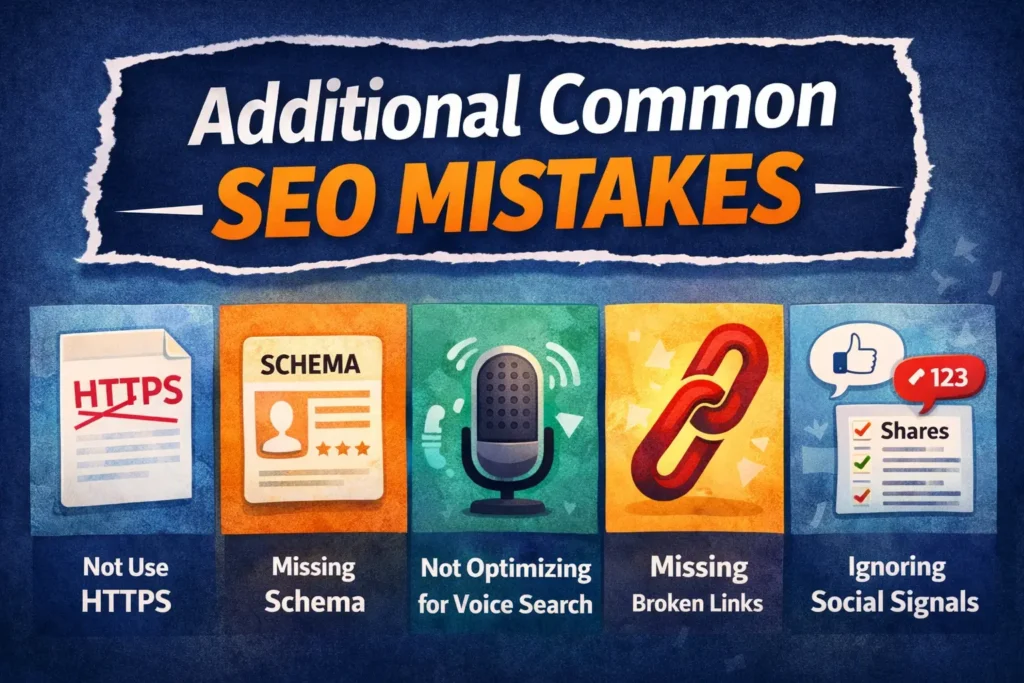
Additional Common SEO Mistakes
Beyond the top 15, watch for these errors:
Missing Schema Markup
Structured data helps search engines understand content and can trigger rich results. Add schema for business info, reviews, products, FAQs, and articles.
Not Optimizing for Voice Search
With conversational AI growing, optimize for natural language queries people speak, not just type.
Ignoring Social Signals
While not direct ranking factors, social shares increase visibility and can lead to backlinks.
Overlooking User Experience
Google’s algorithms now focus on user satisfaction. Poor UX (confusing navigation, intrusive popups, slow loading) hurts rankings.
Forgetting About HTTPS
Non-secure sites (HTTP instead of HTTPS) receive ranking penalties and scare away visitors.
How to Fix SEO Mistakes: Action Plan
If you have been making these mistakes, here is your recovery roadmap:
Week 1: Audit Current State
- Run technical SEO audit (Google Search Console, free audit tools)
- Check mobile responsiveness
- Review Google Business Profile
- Analyze current keyword rankings
- Check for duplicate content
Week 2: Quick Wins
- Fix broken links
- Add missing meta descriptions
- Compress large images
- Verify Google Business Profile
- Submit XML sitemap
Week 3-4: Content Improvements
- Identify thin content pages
- Expand or consolidate as appropriate
- Add internal links between related pages
- Optimize images with alt text
- Improve on-page keyword usage
Month 2: Technical Fixes
- Improve site speed
- Implement schema markup
- Fix duplicate content issues
- Strengthen site architecture
- Ensure HTTPS security
Month 3+: Ongoing Optimization
- Create regular quality content
- Build quality backlinks
- Earn customer reviews
- Monitor and adjust strategy
- Track performance metrics
When to Hire Professional Help
DIY SEO works for some businesses, but consider professional assistance if:
- You lack time to learn and implement SEO properly
- Your attempts haven’t produced results after 6 months
- You are in a competitive industry
- Technical issues overwhelm you
- You want faster, more reliable results
Reputable agencies provide regular reporting, transparent strategies, and measurable results.
Conclusion: Transform SEO from Burden to Growth Engine
SEO mistakes cost small businesses real money, waste precious time, and hand market share to competitors who get it right. But these mistakes are fixable.
Key Takeaways:
- 96.55% of content gets zero traffic—avoid being part of this statistic
- Local SEO is the highest ROI opportunity for most small businesses
- Mobile optimization is non-negotiable in 2026
- Keyword stuffing hurts more than it helps
- Technical SEO issues silently kill rankings
- Quality content beats thin content every time
- Track results to know what works
- SEO takes 3-6 months minimum for results
- Match content to search intent
- Focus on conversions, not just traffic
What To Do Now:
Start with the audit. Identify which mistakes you are making. Fix quick wins first (meta tags, broken links, mobile issues). Then tackle bigger challenges (content quality, link building, technical improvements).
SEO is not optional for small businesses anymore. It is table stakes for being found when customers search for what you offer. Get it right and you create a sustainable competitive advantage. Get it wrong and you are invisible.
For comprehensive marketing guidance, read our guides on what is marketing and Competitive Analysis.
Stop making SEO mistakes that cost you customers. Start implementing strategies that actually work.