“I want to start freelancing, but I have no idea where to begin.”
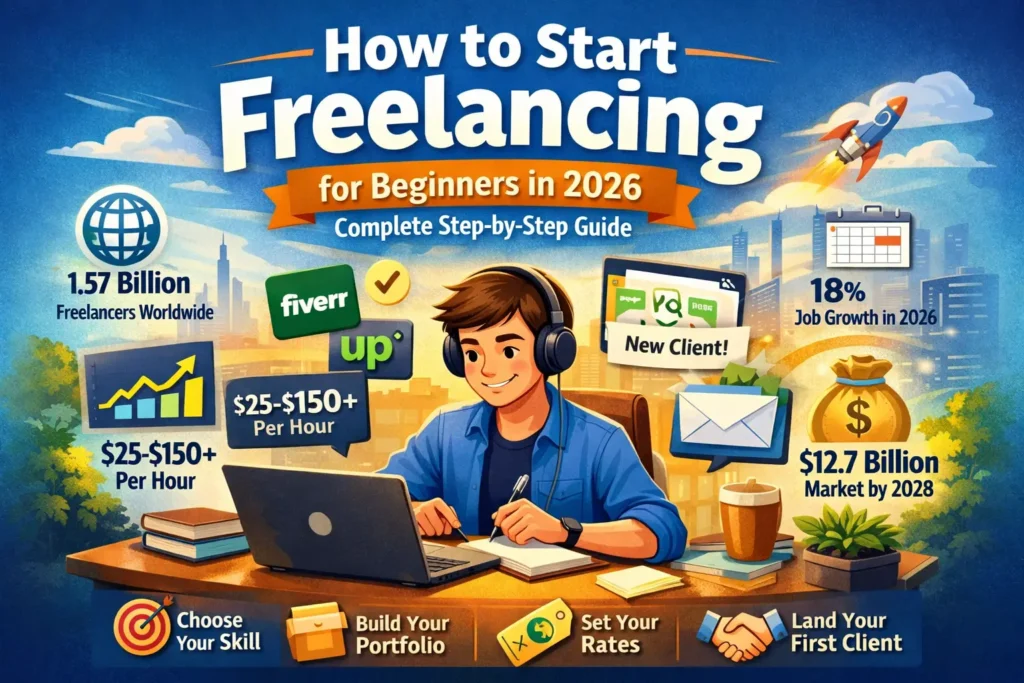
If that sounds familiar, you’re not alone. According to 2026 data, over 1.57 billion people worldwide now freelance—representing 47% of the global workforce. Yet 70% of beginners face rejection on their first attempts, not because they lack skills, but because they lack a clear roadmap showing exactly what to do and in what order.
The freelance market is projected to reach $12.7 billion by 2028 according to Grand View Research, with job postings increasing 18% in 2026 alone. Entry-level freelancers earn $25-$50 per hour on average, with experienced specialists commanding $75-$150+ hourly. The opportunity is real—but only for those who approach freelancing strategically rather than randomly.
The challenge for beginners is simple: everyone tells you to “just start,” but nobody explains the specific steps. Which platform? What services? How to price? How to find clients? Where to begin? This confusion leads to overwhelm, scattered effort, and eventual abandonment.
This comprehensive guide reveals exactly how to start freelancing for beginners in 2026, based on latest platform data, successful freelancer interviews, and proven strategies that actually work. You will learn which skills to offer, how to create a compelling profile, where to find your first clients, how to price services competitively, and strategies for building sustainable freelance income.
Whether you’re exploring freelancing as side income, planning full career transition, or seeking location-independent work, this roadmap transforms confusion into confident action and uncertainty into your first paid client.
Understanding Freelancing in 2026
Before diving into tactics, grasp what freelancing actually means today:
2026 Definition: Freelancing is selling specific services or skills to clients on a project or contract basis, working independently without traditional employment, setting your own rates and schedule, and building your own business one client at a time.
What Changed from 2020-2025:
Then: Freelancing was considered “gig work” or temporary employment Now: Freelancing is recognized as legitimate career path with professionals earning 6-7 figures annually
Then: Freelance platforms were dominated by international competition driving prices down Now: AI tools and specialized niches allow beginners to compete on value rather than just price
Then: Finding clients required extensive networking and outreach Now: Platforms, social media, and personal brands attract clients automatically when built strategically
Key Insight: Freelancing in 2026 isn’t about selling hours—it’s about selling results. Successful freelancers position themselves as problem-solvers who deliver specific outcomes, not workers who complete tasks.
Understanding how to choose the right career path helps evaluate if freelancing aligns with your goals.
Why Freelancing Makes Sense in 2026
Current data reveals why freelancing appeals to millions:
Market Size and Growth:
- 1.57 billion freelancers worldwide (47% of global workforce)
- $12.7 billion freelance platform market by 2028
- 18% year-over-year job posting increase in 2026
- 35% of SMB digital operations now outsourced to freelancers
Income Potential:
- Entry-level: $25-$50 per hour
- Intermediate (1-2 years): $50-$75 per hour
- Advanced (3+ years): $75-$150+ per hour
- Top specialists: $150-$300+ per hour
Lifestyle Benefits:
- Work from anywhere with internet
- Set your own schedule
- Choose clients and projects
- No commute or office politics
- Unlimited income potential
Career Flexibility:
- Start part-time while employed
- Test multiple skills and niches
- Build portfolio before going full-time
- Create multiple income streams
Low Barrier to Entry: Unlike traditional careers requiring degrees and years of experience, freelancing rewards demonstrable skills. Build portfolio proving competency and land paying clients immediately.
Learn about digital marketing skills for beginners for high-demand freelance opportunities.
The 7-Step Freelancing Launch Framework
Proven process for beginners:
Step 1: Identify Your Freelance Service
The Foundation: Choose ONE specific service to offer initially. Specialists earn more than generalists.
High-Demand Beginner-Friendly Services:
Writing & Content:
- Blog post writing
- Copywriting (emails, ads, websites)
- Technical writing
- Resume writing
- Transcription
Design & Creative:
- Graphic design (social media, logos)
- Presentation design
- Video editing
- Photo editing
- Illustration
Marketing:
- Social media management
- Email marketing
- SEO optimization
- Content marketing
- Paid advertising management
Development & Tech:
- WordPress website creation
- Simple web development
- Mobile app testing
- Data entry
- Virtual assistance
Business Support:
- Administrative assistance
- Customer service
- Project management
- Bookkeeping
- Research
How to Choose:
- Assess Current Skills: What do you already do well?
- Check Market Demand: Are businesses actively hiring this service?
- Evaluate Competition: Can you differentiate yourself?
- Consider Learning Curve: How quickly can you become proficient?
- Check Pricing Potential: Do freelancers earn reasonable rates?
Validation Method: Search platforms like Upwork and Fiverr filtering by your potential service. If hundreds of active job postings exist, demand is confirmed.
Common Beginner Mistake: Offering “anything and everything.” Focused freelancers earn more, land better clients, and build stronger reputations faster.
Step 2: Develop Your Skill to Marketable Level
The Reality: You don’t need to be world-class expert. You need to be competent enough to deliver value clients will pay for.
Skill Development Timeline:
Already Proficient (1-2 weeks):
- Polish existing skills
- Learn platform-specific best practices
- Study successful freelancer profiles
- Practice relevant tools
Need to Learn (1-3 months):
- Take focused online course
- Complete 3-5 practice projects
- Build portfolio samples
- Get feedback and iterate
Starting from Zero (3-6 months):
- Intensive training program
- Daily practice and project work
- Mentorship or coaching
- Portfolio building through volunteer work
Learning Resources:
Free Options:
- YouTube tutorials
- Freecodecamp (coding)
- HubSpot Academy (marketing)
- Canva Design School (design)
- Coursera audit courses
Paid Options ($10-$200):
- Udemy courses
- Skillshare subscriptions
- LinkedIn Learning
- Specific platform certifications
Practice Projects:
Instead of waiting until “ready,” create practice projects:
- Design fictional brand identity
- Write sample blog posts
- Build demonstration websites
- Create video editing portfolio
Pro Tip: Learning AI tools (ChatGPT, Claude, Canva AI) accelerates skill development dramatically. Beginners using AI assistance compete effectively with experienced freelancers.
Step 3: Create Compelling Online Presence
Why It Matters: Before clients hire you, they evaluate your professionalism. Strong online presence builds instant credibility.
Essential Components:
Professional Profile Photo:
- Clear, friendly headshot
- Professional but approachable
- Good lighting and background
- Dressed appropriately for niche
Compelling Bio:
- Who you help (target clients)
- What problems you solve
- Your unique approach or specialty
- Results you deliver
Portfolio Samples:
- 3-5 best work examples
- Even practice projects count initially
- Show process and results
- Case studies when possible
Where to Build Presence:
LinkedIn (Essential):
- Complete professional profile
- Add relevant skills
- Share insights about your niche
- Connect with potential clients
Personal Website (Recommended):
- Simple one-page site using WordPress, Wix, or Carrd
- Portfolio showcases
- Contact information
- Testimonials (get early ones from practice clients)
Freelance Platform Profile (Required):
- Detailed service description
- Portfolio uploads
- Skill tags and certifications
- Competitive initial pricing
Example Strong Bio: “I help health and wellness brands grow their audience through engaging blog content. With background in nutrition and passion for evidence-based wellness, I create articles that educate readers while driving organic traffic. My articles consistently rank on page 1 for target keywords.”
Example Weak Bio: “Freelance writer available for hire. I write about many topics. Good quality and fast turnaround.”
The Difference: Specificity. Strong bios target particular clients, solve specific problems, and demonstrate clear value.
Step 4: Choose the Right Freelance Platform
The Reality: Not all platforms are equal for beginners. Some favor established freelancers while others welcome newcomers.
Best Platforms for Beginners (2026):
Fiverr:
- Best For: Complete beginners
- How It Works: Create “gigs” at set prices, clients purchase
- Pros: Easy to start, no bidding required, buyer-driven
- Cons: Race to bottom pricing, 20% platform fee
- Success Strategy: Start low ($5-$25), build reviews, raise prices
Upwork:
- Best For: Professionals with some experience
- How It Works: Browse jobs, submit proposals, negotiate rates
- Pros: Higher-quality clients, better rates, professional environment
- Cons: Competitive, proposal system challenging, 10-20% fees
- Success Strategy: Hyper-targeted niche, personalized proposals, competitive initial pricing
Contra:
- Best For: Creatives (designers, writers, developers)
- How It Works: Portfolio-focused, zero commission
- Pros: No platform fees, showcase-driven, professional
- Cons: Smaller client base, requires strong portfolio
- Success Strategy: Invest in portfolio quality, active networking
PeoplePerHour:
- Best For: UK/Europe-based freelancers
- How It Works: Mix of job bidding and hourlie offerings
- Pros: Less competitive than Upwork, decent rates
- Cons: Smaller than major platforms
- Success Strategy: Respond quickly to project postings
Freelancer.com:
- Best For: Trying contests to build portfolio
- How It Works: Job bidding plus design contests
- Pros: Contests allow beginners to compete, large marketplace
- Cons: Very competitive, lower average rates
- Success Strategy: Focus on contests initially, build credentials
Platform Selection Strategy:
- Start with 1-2 platforms maximum
- Choose based on your service type
- Focus on platforms with lower competition for beginners
- Don’t spread yourself thin across 5+ platforms
Common Mistake: Creating profiles everywhere then abandoning most. Better to dominate one platform than be invisible on five.
Step 5: Set Competitive Pricing
The Challenge: Price too high and you get no clients. Price too low and you attract problem clients while devaluing your work.
Pricing Research Method:
- Search your service on target platform
- Filter by top-rated freelancers
- Note pricing range
- Identify the middle pricing tier
- Position 10-20% below middle initially
Example:
Service: Blog post writing (1,000 words)
- Low end: $20-$40
- Middle tier: $75-$150
- High end: $200-$400
Beginner positioning: $50-$75 (below middle, above bottom)
Pricing Strategy:
Months 1-2 (Building Reviews):
- Price competitively to win first 5-10 clients
- Focus on reviews over maximizing income
- Deliver exceptional value
Months 3-4 (Established Credibility):
- Raise prices 20-30%
- Maintain quality, test market response
- Begin targeting better clients
Months 5-6+ (Building Authority):
- Continue gradual price increases
- Focus on results and testimonials
- Position as specialist not commodity
Hourly vs. Project Rates:
Hourly:
- Easier for beginners
- Client sees exactly what they pay for
- Works well for uncertain scope
Project-Based:
- More professional
- Rewards efficiency
- Allows productized offerings
Recommendation: Start hourly, transition to project rates once experienced.
Learn about marketing for business growth to understand client needs and pricing psychology.
Step 6: Land Your First Client
The Reality: Getting first client is hardest. After that, momentum builds.
Strategy for First 3 Clients:
Method 1: Platform Job Applications
How It Works: Browse active job postings, submit customized proposals
Proposal Framework:
- Personal greeting (use client’s name)
- Acknowledge their specific need (show you read carefully)
- Explain relevant experience (even if limited)
- Outline your approach (how you’ll solve their problem)
- Include portfolio sample (relevant to their project)
- Close with clear call-to-action (suggest next steps)
Example Strong Proposal:
“Hi [Client Name],
I saw your project seeking blog content for your sustainable fashion brand. Your focus on ethical manufacturing and transparency really resonates with me.
I’m a content writer specializing in sustainability topics. While I’m new to Upwork, I’ve created articles for eco-brands that rank on page 1 for competitive keywords. [Link to portfolio sample]
For your project, I’d research your target keywords, interview subject matter experts if needed, and deliver SEO-optimized 1,500-word articles that engage your conscious consumer audience.
I’m offering competitive rates as I build my Upwork reputation. Would you be open to a brief call to discuss your content needs?
Looking forward to helping grow your audience!
[Your Name]”
Example Weak Proposal:
“Hi,
I’m interested in your project. I’m a good writer and can deliver quality work quickly. Please hire me.
Thanks, [Name]”
The Difference: Specificity, relevance, and professionalism.
Method 2: Personal Network
How It Works: Reach out to existing connections offering services
Outreach Template:
“Hey [Name],
Hope you’re doing well! I wanted to let you know I’m now offering [service] as a freelancer.
I’m helping [target client type] achieve [specific result]. If you know anyone who might benefit, I’d appreciate an introduction.
As a thank you for any referrals that become clients, I’m happy to [offer incentive].
Thanks! [Your Name]”
Method 3: Social Media Showcase
How It Works: Share your work publicly, attracting inbound interest
LinkedIn Strategy:
- Post about your freelance journey
- Share portfolio pieces
- Comment on industry posts
- Connect with potential clients
- Publish helpful insights
Success Metrics: First client typically comes within 2-4 weeks for active beginners applying 10-15 proposals weekly.
Step 7: Deliver Exceptional Results and Build Reputation
The Long Game: Freelancing success isn’t about getting clients. It’s about keeping them and earning referrals.
Excellence Framework:
Before Project Starts:
- Clarify expectations completely
- Confirm deadlines and deliverables
- Ask questions preemptively
- Set communication preferences
During Project:
- Provide progress updates
- Ask for feedback midway
- Meet deadlines consistently
- Go slightly beyond requirements
After Project:
- Deliver clean, organized work
- Provide usage instructions if needed
- Request testimonial/review
- Thank client professionally
Review Request Template:
“Hi [Client Name],
I really enjoyed working on [project] with you! It was great helping [achieve specific result].
If you were happy with my work, I’d greatly appreciate a brief review on [platform]. Positive feedback helps me attract similar clients.
I’m here if you need [service] again in the future!
Best, [Your Name]”
Building Long-Term Clients:
Retainer Strategy:
- After 2-3 successful projects, propose ongoing arrangement
- Offer monthly package (e.g., 4 blog posts per month)
- Provide discount for commitment
- Secure predictable income
Referral Strategy:
- Ask satisfied clients for introductions
- Offer referral incentive if appropriate
- Make asking easy with template
Portfolio Building:
- Request permission to showcase work
- Create case studies with results
- Document before/after examples
- Collect video testimonials when possible
Common Freelancing Mistakes Beginners Make
Avoid widespread errors:
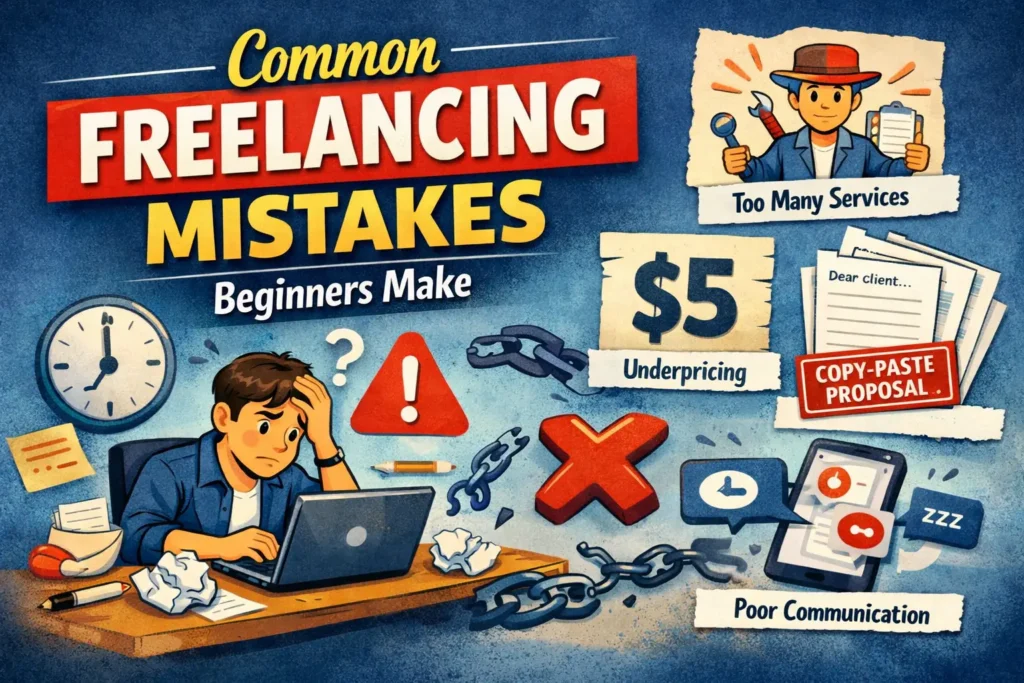
Mistake 1: Offering Too Many Services
The Error: “I do graphic design, web development, writing, social media, and virtual assistance.”
Why It Fails: Jack of all trades, master of none. Specialists earn more than generalists.
The Fix: Choose ONE service. Dominate that niche. Expand later.
Mistake 2: Underpricing Severely
The Error: Charging $5 per hour thinking it attracts clients.
Why It Fails: Attracts problem clients, creates unsustainable business, signals low quality.
The Fix: Price competitively but fairly. Value your time appropriately.
Mistake 3: Copying Templates Without Customization
The Error: Using same generic proposal for every job posting.
Why It Fails: Clients immediately spot copy-paste efforts and reject them.
The Fix: Customize every proposal. Reference specific project details. Show you actually read posting.
Mistake 4: Not Setting Boundaries
The Error: Being available 24/7, accepting scope creep, doing unlimited revisions.
Why It Fails: Leads to burnout, resentment, unprofitable projects.
The Fix: Set clear working hours, define scope carefully, limit revisions contractually.
Mistake 5: Ignoring Communication Quality
The Error: Using casual language, typos, slow responses.
Why It Fails: Professionalism matters. Poor communication signals poor work quality.
The Fix: Write professionally, proofread everything, respond promptly.
Mistake 6: Stopping After First Rejection
The Error: Submitting 3 proposals, getting no response, quitting.
Why It Fails: Numbers game initially. Most proposals get rejected—that’s normal.
The Fix: Commit to 50 proposals before evaluating approach. Refine based on patterns.
Mistake 7: Not Tracking Finances
The Error: Treating freelance income as “extra money” without business accounting.
Why It Fails: Tax issues, cash flow problems, no business visibility.
The Fix: Use accounting software, set aside taxes (25-30%), track expenses, maintain professional finances.
Essential Tools for Freelancing Success
Technology that enables efficiency:
Communication:**
- Slack (client communication)
- Zoom (video calls)
- Gmail (professional email)
- Calendly (scheduling)
Project Management:**
- Trello (task organization)
- Asana (complex projects)
- Notion (all-in-one workspace)
Time Tracking:**
- Toggl (simple time tracking)
- Clockify (free alternative)
- RescueTime (productivity monitoring)
Invoicing & Payment:**
- PayPal (widely accepted)
- Wise (international payments)
- FreshBooks (invoicing software)
- Wave (free accounting)
Portfolio & Presence:**
- LinkedIn (professional network)
- WordPress (website)
- Canva (design tool)
- Google Drive (file sharing)
AI Assistants:**
- ChatGPT (writing, research)
- Claude (detailed content)
- Jasper (marketing copy)
- Grammarly (editing)
Minimum Viable Stack: Platform profile + PayPal + Google Drive + basic communication tools. Expand as you grow.
Timeline: From Zero to Earning
Realistic expectations:
Weeks 1-2: Foundation
- Choose service
- Develop initial skills
- Create platform profiles
- Build 2-3 portfolio samples
- Research pricing
Weeks 3-4: Launch
- Submit 10-15 proposals weekly
- Apply to 20+ job postings
- Network on LinkedIn
- Refine profile based on feedback
- Expect first client
Months 2-3: Momentum
- Land 3-5 clients
- Build 5-star reviews
- Raise prices slightly
- Improve proposals based on wins
- Establish processes
Months 4-6: Growth
- Consistent client flow
- Higher rates
- Repeat clients emerging
- Referrals starting
- Consider specialization
Months 6-12: Sustainability
- Retainer clients
- Premium pricing
- Strong reputation
- Passive client attraction
- Full-time viable (if desired)
The Future of Freelancing
Where the market is heading:
AI Integration Accelerates: Freelancers who master AI tools deliver faster, better results. AI doesn’t replace freelancers—it amplifies capable ones while making incompetent ones obsolete.
Specialization Premium Increases: Generalists face downward price pressure. Specialists in narrow niches command 2-3x higher rates.
Platform Evolution: New platforms emerge focusing on creator-friendly terms, zero commissions, and better freelancer experiences.
Global Competition and Collaboration: Geographic boundaries disappear. Compete globally but also collaborate internationally.
Value-Based Pricing Dominates: Shift from hourly rates to project and results-based pricing rewards efficiency and outcomes.
Conclusion: Your Freelancing Journey Starts Now
Freelancing offers remarkable opportunity for those willing to approach it strategically. The market rewards practical skills, professional presentation, and consistent execution over credentials, connections, or luck.
Key Takeaways:
- 1.57 billion people freelance globally (47% of workforce)
- Freelance market reaching $12.7 billion by 2028
- 18% job posting increase in 2026
- Entry-level rates: $25-$50/hour, advanced: $75-$150+/hour
- Choose ONE specific service initially—specialists earn more
- Build portfolio before perfecting skills—practice projects count
- Price competitively but not desperately—10-20% below middle tier
- Fiverr best for complete beginners, Upwork for professionals
- First client typically within 2-4 weeks of active applications
- Customize every proposal—generic copy-paste gets rejected
- Excellence and reviews matter more than initial pricing
- AI tools dramatically accelerate beginner capabilities
What To Do Now:
This Week: Choose your freelance service. Take relevant skill assessment. Create free Fiverr or Upwork account.
This Month: Complete skill development course. Build 3 portfolio samples. Set up complete platform profile. Submit first 10 proposals.
Next 90 Days: Land first 3-5 clients. Build 5-star reputation. Raise prices gradually. Establish processes and systems.
The Bottom Line:
Freelancing success doesn’t require genius, expensive training, or insider connections. It requires choosing valuable skill, building competency, presenting professionally, and executing consistently. The tools are accessible, the resources are abundant, and the opportunity is real.
The question is not whether freelancing offers viable income. The question is whether you will commit to the focused effort required to capture that opportunity.
For related career guidance, read our articles on how to choose the right career path and digital marketing skills for beginners.
Start your freelancing journey today. Your first client is waiting.