
“How does my phone recognize my face instantly? How do self-driving cars see pedestrians? How does that app identify plants from photos?”
The answer to all these questions is computer vision—the technology enabling machines to understand visual information just like humans do. According to February 2026 data, the computer vision market reached $29.27 billion with projections to hit $72.80 billion by 2034, growing at 14.80% annually. This explosive growth reflects a fundamental reality: computer vision has moved from laboratory curiosity to mainstream business capability deployed across manufacturing (68% of projects), healthcare (66% imaging diagnostics), retail (44% using vision AI), and autonomous vehicles ($55.67 billion market).
Yet most people struggle to understand what computer vision actually means beyond vague notions of “AI that sees things.” The technology gap creates confusion: business leaders wondering if they should invest, professionals evaluating career opportunities, and curious individuals trying to grasp how the future actually works.
This comprehensive guide explains exactly what computer vision is in 2026, how it works from basic principles to advanced applications, why it matters across industries, real-world examples you encounter daily, and where the technology is heading. You will understand the fundamental concepts without requiring technical background, see practical applications transforming everyday life, and grasp why computer vision represents one of the most impactful AI technologies shaping the 2020s.
Whether you’re exploring career opportunities, evaluating business applications, or simply curious about the technology powering modern conveniences, this guide transforms confusion into clear understanding.
What Is Computer Vision? (Simple Definition)
Before diving into complexities, understand the core concept:
Computer Vision Definition: Computer vision is artificial intelligence technology that enables computers and machines to interpret and understand visual information from the world—including images, videos, and real-time camera feeds—so they can identify objects, understand scenes, and make decisions based on what they “see.”
The Simple Analogy: Just as human vision involves eyes capturing light and brains interpreting images, computer vision uses cameras to capture visual data and AI algorithms to understand what appears in those images.
What Computer Vision Does:
See: Captures visual information through cameras, sensors, or uploaded images
Understand: Analyzes images to identify objects, people, text, scenes, and relationships
Decide: Takes actions or provides recommendations based on visual understanding
Learn: Improves accuracy over time through machine learning and more data
2026 Reality: Computer vision in 2026 extends far beyond simple pattern matching. Modern systems understand context, recognize subtle details invisible to humans, and combine visual information with text, audio, and sensor data for comprehensive environmental understanding.
Understanding how artificial intelligence works provides foundation for grasping computer vision capabilities.
How Computer Vision Works (Basic Principles)
The technical process explained in accessible terms:
Step 1: Image Acquisition
What Happens: Cameras or sensors capture visual information as digital images—collections of pixels (tiny colored dots) forming complete pictures.
Sources:
- Digital cameras and smartphone cameras
- Security surveillance systems
- Satellite and drone imagery
- Medical imaging devices (MRI, X-ray, CT scans)
- Industrial inspection cameras
The Foundation: Everything begins with visual data. Higher quality images (better resolution, lighting, angles) enable more accurate computer vision analysis.
Step 2: Image Preprocessing
What Happens: Raw images undergo cleaning and preparation making analysis more effective.
Common Preprocessing:
Noise Reduction: Removing graininess or artifacts improving clarity
Contrast Adjustment: Enhancing visibility of important features
Resizing: Standardizing image dimensions for consistent processing
Normalization: Adjusting pixel values to standard ranges
Why It Matters: Like preparing ingredients before cooking, preprocessing ensures algorithms work with clean, consistent data.
Step 3: Feature Extraction
What Happens: Algorithms identify meaningful patterns, edges, shapes, and characteristics distinguishing objects from backgrounds.
What Gets Extracted:
- Edges and boundaries (where objects begin and end)
- Corners and key points (distinctive markers)
- Textures and patterns (surface characteristics)
- Colors and intensities (visual attributes)
- Shapes and contours (object forms)
The Concept: Instead of analyzing every pixel individually, computer vision identifies high-level features representing important visual information—similar to how humans recognize faces by noticing eyes, nose, and mouth rather than every skin pore.
Step 4: Pattern Recognition and Classification
What Happens: Machine learning models compare extracted features against learned patterns identifying what objects appear in images.
The Process:
Training Phase: Algorithms learn from thousands or millions of labeled images showing what different objects look like
Recognition Phase: When encountering new images, algorithms compare features against learned patterns, identifying matches
Classification: Systems assign labels categorizing identified objects (dog, car, tree, person)
The Power: Modern deep learning models recognize thousands of object categories with accuracy often exceeding human performance.
Step 5: Decision and Action
What Happens: Based on visual understanding, systems take appropriate actions or provide insights.
Examples:
- Self-driving cars detecting pedestrians and braking
- Medical systems flagging potential tumors for doctor review
- Retail systems alerting when shelves need restocking
- Security cameras notifying when unauthorized entry occurs
The Value: Computer vision transforms visual data into actionable intelligence driving better decisions and automated responses.
Learn about AI marketing predictions showing commercial applications.
Key Computer Vision Technologies in 2026
Modern computer vision relies on several advanced technologies:
Deep Learning and Neural Networks
What They Are: AI algorithms inspired by human brain structure, capable of learning complex patterns from massive datasets.
Why They Matter: Deep learning powers most 2026 computer vision breakthroughs, enabling accuracy impossible with traditional programming.
Impact: Object detection, facial recognition, medical imaging analysis, and autonomous driving all depend on deep neural networks.
Convolutional Neural Networks (CNNs)
What They Are: Specialized neural networks designed specifically for processing visual data.
How They Work: CNNs automatically learn hierarchical features—detecting edges in early layers, shapes in middle layers, and complete objects in final layers.
Applications: Image classification, object detection, semantic segmentation
Why They Dominate: CNNs excel at recognizing visual patterns regardless of position, size, or orientation within images.
Edge AI and Real-Time Processing
What It Is: Computer vision running directly on devices (smartphones, cameras, robots) rather than sending data to cloud servers.
The Advantage: Instant processing with no internet delay, privacy preservation (data stays local), reduced costs (less cloud computing)
2026 Reality: Edge AI enables sub-millisecond detection on low-power hardware, making real-time computer vision practical across industries.
Applications: Autonomous vehicles (instant obstacle detection), industrial inspection (zero-latency quality control), AR/VR (seamless overlay), smart cameras (local analysis)
Multimodal AI
What It Is: Systems combining computer vision with other data types—text, audio, sensor information—for comprehensive understanding.
Examples:
- Vision + text: Understanding image captions and descriptions
- Vision + audio: Video analysis combining what’s seen and heard
- Vision + sensors: Autonomous vehicles using cameras, LiDAR, radar together
Why It Matters: Real-world understanding requires integrating multiple information sources. Multimodal AI mirrors human perception better than vision alone.
Synthetic Data and Generative AI
What It Is: Creating artificial training images through AI rather than manually collecting and labeling millions of real photos.
The Breakthrough: Generative AI produces realistic synthetic images filling data gaps, simulating rare scenarios (accidents, emergencies), and creating training datasets quickly.
Impact: Companies train computer vision models faster and more cost-effectively while accessing scenarios difficult to capture in reality.
Real-World Computer Vision Applications You Use Daily
Examples demonstrating practical impact:
Facial Recognition (Smartphones and Security)
How It Works: Computer vision analyzes unique facial features (eye spacing, jawline, nose shape) creating biometric template matching your face.
Daily Use:
- Unlocking smartphones (Apple Face ID, Android face unlock)
- Airport security and passport control
- Photo organization (Google Photos, Apple Photos grouping by person)
- Social media tagging suggestions
The Technology: Deep learning models trained on millions of faces identify individuals even with different expressions, angles, or lighting.
Object Detection (Shopping and Photos)
How It Works: Algorithms identify and locate multiple objects simultaneously within images or videos.
Daily Use:
- Google Lens identifying products, plants, animals from photos
- Amazon visual search finding similar items from uploaded images
- Pinterest discovering similar pins from images
- Retail apps scanning barcodes and products
The Capability: Modern object detection processes complex scenes with dozens of items in real-time, understanding relationships and context.
Autonomous Vehicles (Self-Driving Cars)
How It Works: Multiple cameras combined with LiDAR and sensors create 360-degree environmental understanding, detecting vehicles, pedestrians, lane markings, traffic signs, and obstacles.
Current Status: Tesla, Waymo, Cruise, and traditional automakers deploy autonomous features using sophisticated computer vision.
The Challenge: Safety-critical applications require near-perfect accuracy under all conditions—rain, darkness, snow, unexpected scenarios.
2026 Reality: Autonomous vehicle computer vision market reached $55.67 billion growing at 39.47% annually, reflecting rapid commercial deployment.
Medical Imaging Analysis
How It Works: Computer vision analyzes X-rays, MRIs, CT scans, pathology slides identifying diseases, tumors, fractures, and abnormalities.
Clinical Applications:
- Cancer detection in radiology images
- Diabetic retinopathy screening from eye photos
- Skin cancer identification from smartphone images
- Surgical assistance with real-time 3D mapping
The Impact: AI-assisted diagnosis improves accuracy, catches diseases earlier, and enables specialists to focus on complex cases while AI handles routine screening.
Statistics: 66% of healthcare computer vision projects focus on imaging and diagnostics for clinical decision support (2026 data).
Retail and Manufacturing Quality Control
How It Works: High-speed cameras inspect products detecting defects, verifying assembly, ensuring quality standards.
Manufacturing Use:
- Automotive parts inspection (detecting microscopic defects)
- Electronics assembly verification
- Pharmaceutical packaging checking
- Food quality assessment
Retail Applications:
- Shelf monitoring tracking inventory
- Checkout-free stores (Amazon Go)
- Visual search and recommendations
Performance: 68% of manufacturing computer vision projects now focus on closed-loop defect reduction (2026 data).
Augmented Reality (AR)
How It Works: Computer vision maps real-world surfaces, recognizes objects, and tracks movement enabling digital overlays aligned with physical environments.
Daily Use:
- Snapchat and Instagram filters
- IKEA Place (visualizing furniture in rooms)
- Pokemon Go and AR gaming
- Virtual try-on for glasses, makeup, clothing
2026 Advancement: Consumer AR hardware launches signal mainstream spatial computing adoption powered by sophisticated computer vision.
Agriculture and Environmental Monitoring
How It Works: Drones and satellites with computer vision analyze crop health, predict yields, detect diseases, monitor livestock, and track environmental changes.
Applications:
- Precision agriculture optimizing irrigation and fertilization
- Livestock health monitoring through movement analysis
- Forest fire detection from thermal imaging
- Wildlife conservation tracking endangered species
The Impact: Computer vision enables sustainable practices, reduces resource waste, and protects ecosystems through data-driven decisions.
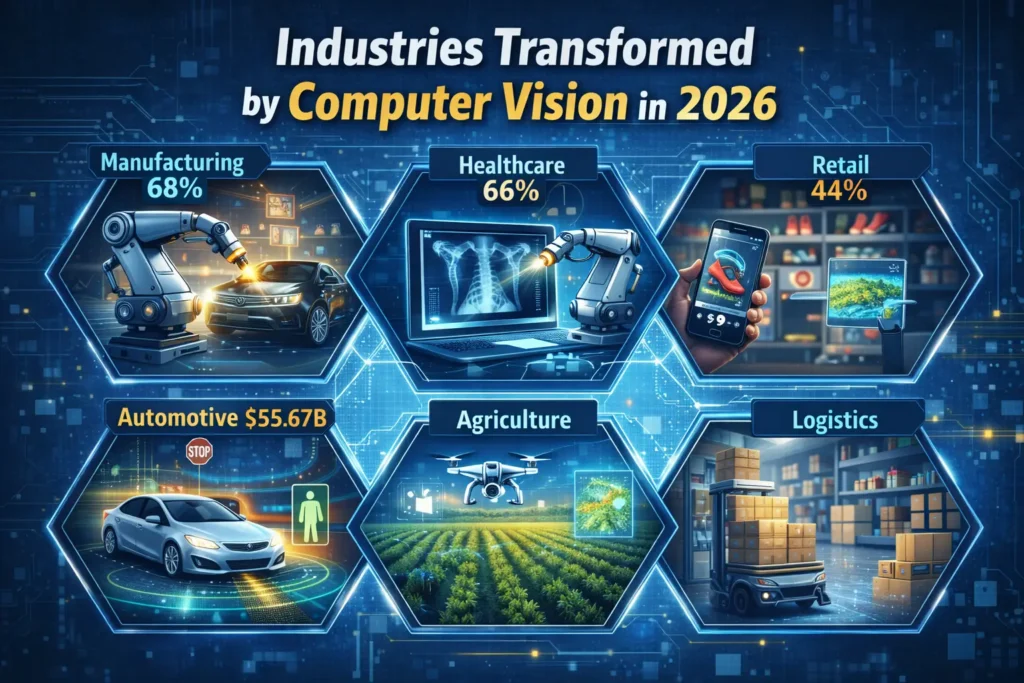
Industries Transformed by Computer Vision in 2026
Market adoption across sectors:
Manufacturing (68% Project Focus)
Primary Uses: Quality inspection, defect detection, assembly verification, safety monitoring, inventory management
Impact: Reduces waste, improves consistency, prevents recalls, accelerates production
ROI: Computer vision quality control often pays for itself within 6-12 months through defect reduction
Healthcare (66% Imaging/Diagnostics)
Primary Uses: Medical imaging analysis, surgical assistance, patient monitoring, drug discovery
Impact: Earlier disease detection, improved diagnosis accuracy, reduced healthcare costs
Critical Need: AI-assisted clinical decision support becoming standard practice
Retail (44% Using Vision AI)
Primary Uses: Inventory tracking, customer analytics, checkout automation, visual search, loss prevention
Impact: Enhanced customer experience, reduced labor costs, optimized inventory
Growth Driver: Seamless shopping experiences driving competitive differentiation
Automotive (Autonomous Vehicle Market: $55.67B)
Primary Uses: Advanced driver assistance, autonomous navigation, parking assistance, traffic monitoring
Impact: Improved safety, reduced accidents, enabled autonomous transportation
Trajectory: Fastest-growing computer vision application with 39.47% annual growth
Agriculture
Primary Uses: Crop monitoring, yield prediction, livestock health, precision farming, environmental tracking
Impact: Increased yields, reduced costs, sustainable practices, food security
Adoption: Drones and satellites making computer vision accessible to farms globally
Logistics and Warehousing
Primary Uses: Package sorting, inventory management, autonomous robots, damage assessment, delivery optimization
Impact: Faster processing, reduced errors, improved safety, lower costs
Automation: Computer vision enabling lights-out warehouses operating without human intervention
Energy and Infrastructure
Primary Uses: Equipment inspection, predictive maintenance, pipeline monitoring, power grid analysis
Impact: Prevented outages, extended asset life, reduced inspection costs, improved safety
Critical Role: 32% of energy projects use computer vision for infrastructure inspection
Security and Surveillance
Primary Uses: Threat detection, access control, crowd monitoring, incident analysis, forensic investigation
Impact: Enhanced security, faster response, crime prevention, evidence collection
Concern: Privacy considerations requiring ethical deployment frameworks
Learn about advantages and disadvantages of AI including computer vision implications.
The Future of Computer Vision (2026 and Beyond)
Where technology is heading:
Agentic Vision Systems: Computer vision evolving from passive observation to active decision-making without human prompts.
Spatial Computing: Digital intelligence merging with physical space through AR glasses and wearables.
Privacy-First Deployment: On-premise processing protecting sensitive data while maintaining analytical capabilities.
Multimodal Integration: Vision combining seamlessly with language, audio, and sensory data for human-like environmental understanding.
Edge AI Dominance: Most processing happening locally on devices rather than cloud servers.
Continuous Learning: Models adapting in production by learning from new visual streams without manual retraining.
Foundation Models: Large vision models providing general capabilities customizable for specific tasks with minimal training.
Democratization: No-code tools enabling non-technical users to build custom computer vision applications.
Common Computer Vision Challenges
Understanding limitations:
Data Quality Requirements: Models require large quantities of high-quality, properly labeled training images.
Environmental Variability: Performance degrades with poor lighting, weather, unusual angles, or scenarios absent from training data.
Computational Costs: Real-time processing demanding significant computing power and specialized hardware.
Bias and Fairness: Systems trained on non-representative data perpetuating discriminatory patterns.
Privacy Concerns: Visual data capturing sensitive personal information raising surveillance and consent issues.
Explainability: Deep learning models functioning as “black boxes” making decisions difficult to interpret.
Deployment Complexity: Moving from lab demonstrations to reliable production systems requiring significant engineering.
The Reality: Computer vision in 2026 is powerful but not magical. Success requires understanding capabilities and limitations.
Conclusion: Computer Vision Reshaping How Machines Understand the World
Computer vision in 2026 represents more than technological achievement—it fundamentally changes how artificial intelligence interacts with physical reality. From medical diagnosis to autonomous transportation, from retail experiences to environmental protection, computer vision enables machines to see, understand, and act on visual information with increasing sophistication.
Key Takeaways:
- Computer vision market reached $29.27 billion in 2026, growing to $72.80 billion by 2034 (14.80% CAGR)
- 68% of manufacturing projects focus on defect detection and quality control
- 66% of healthcare computer vision applications involve imaging and diagnostics
- Autonomous vehicle vision market hit $55.67 billion with 39.47% annual growth
- 44% of retailers use vision AI for improved customer experience
- Edge AI enables real-time processing directly on devices without cloud dependency
- Multimodal AI combines vision with text, audio, and sensors for comprehensive understanding
- Synthetic data and generative AI accelerate model training and deployment
- Applications span manufacturing, healthcare, retail, automotive, agriculture, logistics, energy, and security
- Future trajectory points toward agentic systems, spatial computing, and privacy-first deployment
What To Do Now:
If Exploring Career: Computer vision skills (deep learning, Python, OpenCV, TensorFlow) are highly valued across industries with strong salary potential.
If Evaluating Business Use: Identify visual inspection, monitoring, or analysis tasks currently manual or inconsistent—prime candidates for computer vision automation.
If Simply Curious: Computer vision surrounds you daily in facial recognition, photo organization, autonomous features, augmented reality, and countless background applications.
The Bottom Line:
Computer vision technology has moved from research labs to mainstream deployment transforming how machines perceive and interact with the world. Understanding these capabilities—and limitations—helps navigate an increasingly vision-enabled future whether planning careers, building businesses, or simply making sense of rapid technological change.
The machines are learning to see. Understanding how they see helps us shape how they’re used.