
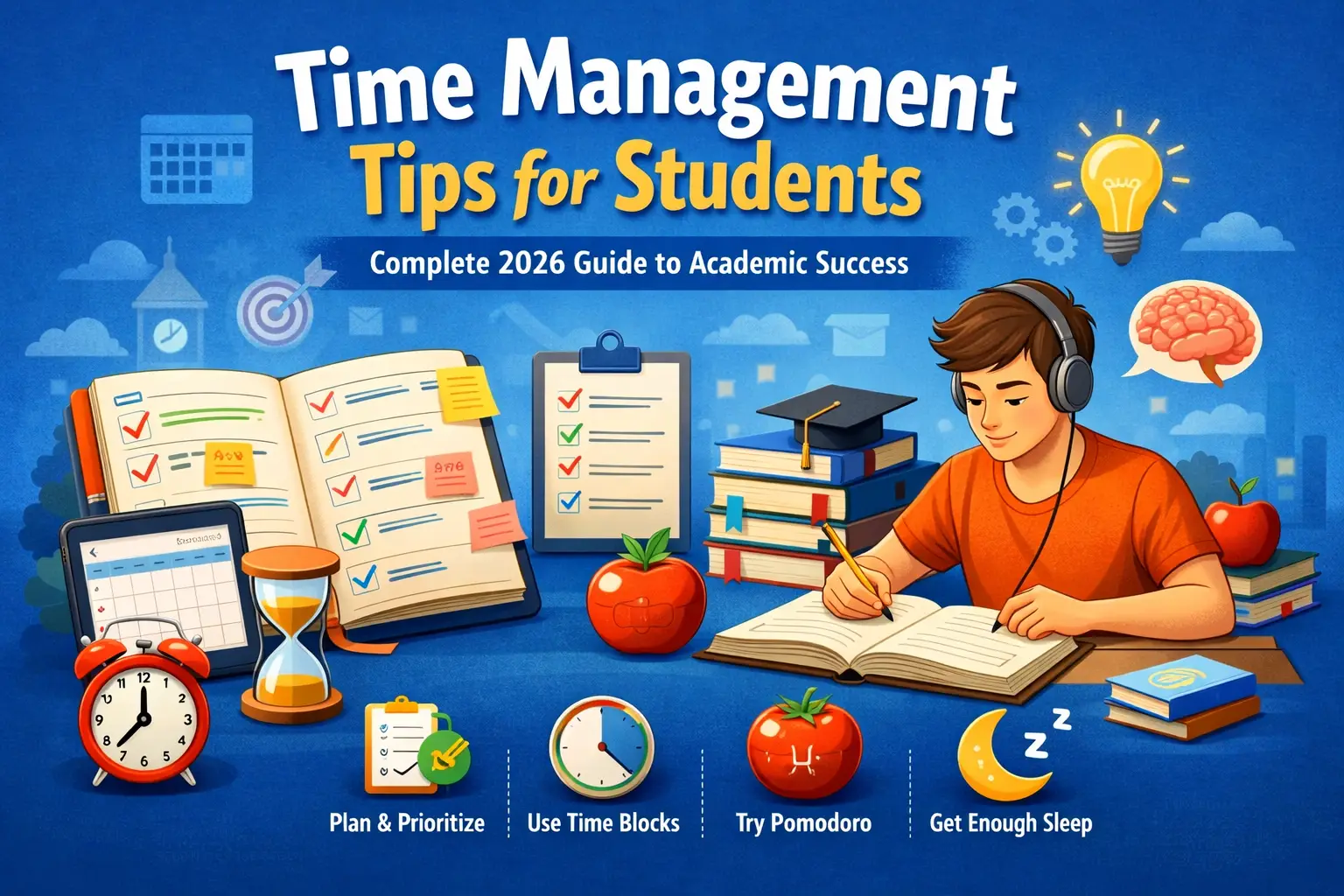
Time management is probably the single most important skill that will help a student succeed, according to academic advisors at Southern New Hampshire University. How well students manage time affects not just grades, but overall well-being at the end of each week and term.
Yet according to Harvard Summer School research, college can be stressful precisely because time management is one of the most crucial—but tricky—skills to master. Attending classes, studying for exams, making friends, and taking time to relax quickly fills schedules. Most students wish there were more hours in the day.
The good news? You don’t need to be a scheduling genius to stay balanced. Research from 2026 shows students using structured time management techniques report 30% less stress during exam seasons. The shift is toward energy management rather than just time management—teaching students to recognize circadian rhythms and ensuring deep work happens when brains are most alert.
This comprehensive guide presents 15 evidence-based time management tips for students in 2026, backed by research from Harvard, Princeton, and leading universities. You will learn proven techniques, avoid common mistakes, and build sustainable habits that reduce stress while improving academic performance.
Whether you struggle with procrastination, feel overwhelmed by assignments, or simply want to create better balance, these strategies transform chaos into control.
Why Time Management Matters for Students
Before diving into specific tips, understand why this skill determines success:
Academic Performance: Students who manage time effectively earn higher GPAs. They complete assignments on time, study thoroughly for exams, and produce quality work without last-minute rushing.
Stress Reduction: According to research, proper time management reduces anxiety by 30% during high-pressure periods. When you control your schedule, you control your stress.
Better Sleep: Time management prevents all-nighters. Students who plan ahead sleep 7-8 hours consistently, improving memory consolidation and cognitive function.
Social Life Balance: Effective time management creates space for friendships, activities, and relaxation without sacrificing academic responsibilities.
Career Preparation: Time management skills transfer directly to professional life. Employers consistently rank it among top desired qualities.
Personal Development: Managing time well creates opportunities for hobbies, exercise, volunteering, and other activities that build well-rounded individuals.
Understanding how to choose the right career path requires developing strong time management early.
15 Essential Time Management Tips for Students (2026)
Based on latest research and expert guidance:
Tip 1: Use a Planner or Digital Calendar
Why It Works: Writing down commitments prevents forgetting and provides visual overview of your week.
How to Implement:
- Choose one system (paper planner OR digital calendar, not both)
- Record all classes, assignments, exams, activities immediately
- Include due dates and deadlines
- Add buffer time before major deadlines
- Review weekly to stay aware of upcoming obligations
Digital Options:
- Google Calendar (syncs across devices)
- Microsoft Outlook (integrates with school email)
- Notion (combines calendar with notes)
- Todoist (task management focus)
Paper Options:
- Academic year planner
- Bullet journal
- Daily/weekly planner
Pro Tip: According to Harvard research, students who check planners daily complete 40% more assignments on time than those who don’t.
Tip 2: Prioritize Tasks Using Eisenhower Matrix
The Framework: Organize tasks by urgency and importance into four quadrants:
Quadrant 1 – Urgent & Important: Do these first (exams tomorrow, project due today)
Quadrant 2 – Important, Not Urgent: Schedule these (studying for exam next week, long-term projects)
Quadrant 3 – Urgent, Not Important: Delegate or minimize (some emails, minor requests)
Quadrant 4 – Neither Urgent Nor Important: Eliminate or save for free time (endless social media scrolling)
Action Steps:
- List all current tasks
- Categorize each into appropriate quadrant
- Focus primarily on Quadrants 1 and 2
- Minimize Quadrant 3 activities
- Eliminate most Quadrant 4 activities
The Result: This prevents “urgent but unimportant” tasks from consuming time better spent on “important but not urgent” activities that drive real progress.
Tip 3: Break Large Projects into Smaller Tasks
The Problem: Major assignments feel overwhelming, leading to procrastination and last-minute panic.
The Solution: Divide big projects into manageable chunks with individual deadlines.
Example – Research Paper: Instead of “Write 15-page paper (due in 4 weeks)”:
- Week 1: Choose topic, gather 10 sources
- Week 2: Create outline, read and take notes
- Week 3: Write introduction and half of body
- Week 4: Finish body, write conclusion, edit, format
Benefits:
- Reduces overwhelm
- Creates momentum through small wins
- Prevents last-minute cramming
- Improves final quality
- Reduces stress significantly
Tip 4: Time Block Your Schedule
What It Means: Assign specific time blocks for different activities rather than just listing tasks.
How to Do It:
- Block class times (fixed commitments)
- Block study time for each subject
- Block meals and sleep
- Block exercise and personal time
- Block social activities
- Leave buffer time for unexpected events
Sample Daily Schedule:
- 7:00-8:00 AM: Morning routine, breakfast
- 8:00-10:00 AM: Classes
- 10:00-12:00 PM: Study block (hardest subjects)
- 12:00-1:00 PM: Lunch, break
- 1:00-3:00 PM: Classes
- 3:00-5:00 PM: Study block (assignments)
- 5:00-6:00 PM: Exercise
- 6:00-7:00 PM: Dinner, social time
- 7:00-9:00 PM: Study/homework
- 9:00-10:00 PM: Personal time, relaxation
- 10:00 PM: Sleep preparation
The Key: Treat time blocks like appointments. Don’t skip them.
Tip 5: Follow the Two-Minute Rule
The Concept: If a task takes less than two minutes, do it immediately instead of adding it to your to-do list.
Examples:
- Replying to simple emails
- Filing handouts
- Adding assignment to calendar
- Sending quick message to group project team
- Cleaning study space
Why It Works: These tiny tasks accumulate mental weight. Completing them immediately prevents list overwhelm and creates momentum.
Tip 6: Use the Pomodoro Technique
How It Works: Study in focused 25-minute intervals with 5-minute breaks.
The Process:
- Choose a task
- Set timer for 25 minutes
- Work with complete focus (no phone, no distractions)
- Take 5-minute break when timer rings
- Repeat
- After 4 Pomodoros, take longer 15-30 minute break
Benefits:
- Prevents burnout
- Maintains high concentration
- Makes study time feel manageable
- Reduces procrastination (anyone can focus for 25 minutes)
- Trains brain for deep work
2026 Apps:
- Forest (gamifies focus time)
- Be Focused (simple Pomodoro timer)
- Pomofocus (web-based, free)
Tip 7: Identify and Eliminate Time Wasters
Common Student Time Wasters:
- Excessive social media scrolling
- Binge-watching shows during study time
- Unproductive group study sessions
- Perfectionism on minor assignments
- Disorganized study spaces requiring constant searching
Action Steps:
- Track your time for one week honestly
- Identify where hours disappear
- Set boundaries (e.g., social media only after 8 PM)
- Use website blockers during study time
- Replace time-wasting habits with productive ones
The 80/20 Rule: 80% of your results come from 20% of your activities. Identify that productive 20% and protect it fiercely.
Tip 8: Study Hardest Subjects When You’re Most Alert
Energy Management Principle: Your brain has peak performance times. Schedule demanding work then.
Most Students’ Peak Times:
- Morning (9 AM – 12 PM): High focus, best for learning new material
- Mid-afternoon (1 PM – 4 PM): Moderate energy, good for review
- Evening (7 PM – 10 PM): Lower focus, best for easier tasks
Action:
- Identify when YOU feel most alert (might differ from average)
- Schedule hardest subjects during peak hours
- Save easier review work for lower-energy times
- Never fight your biology—work with it
Warning: Late-night cramming when exhausted is drastically less effective than shorter study sessions when alert.
Tip 9: Learn to Say No
The Reality: College offers unlimited opportunities. Saying yes to everything leads to burnout.
What to Decline:
- Extra commitments when schedule is full
- Social events during crucial study periods
- Volunteering for every group project role
- Club activities that don’t align with goals
How to Say No Gracefully:
- “I’d love to, but I’m overcommitted right now”
- “I need to focus on academics this semester”
- “Can I help with the next one instead?”
- “That sounds great, but I have prior commitments”
Remember: Every “yes” to something unimportant is a “no” to something that matters more.
Tip 10: Batch Similar Tasks Together
The Concept: Group similar activities and complete them in dedicated sessions.
Examples:
- Answer all emails in one 30-minute block
- Review all lecture notes for the week on Sunday
- Complete all online discussion posts on Tuesday evenings
- Do all reading assignments for one subject consecutively
Why It Works:
- Reduces context switching
- Creates efficiency through repetition
- Minimizes decision fatigue
- Establishes productive routines
Tip 11: Prepare the Night Before
What to Prepare:
- Pack backpack with necessary materials
- Choose outfit for tomorrow
- Review schedule and priorities
- Prepare breakfast or lunch
- Charge devices
- Set out textbooks needed
Benefits:
- Reduces morning stress and rushed decisions
- Ensures nothing is forgotten
- Starts day with calm, organized mindset
- Saves 15-20 minutes each morning
Evening Routine: Spending 10 minutes preparing tonight saves 30 minutes of chaos tomorrow.
Tip 12: Use Waiting Time Productively
Available Pockets of Time:
- Waiting for class to start (5-10 minutes)
- Commuting on bus or train
- Waiting for appointments
- Between classes (15-30 minutes)
Productive Uses:
- Review flashcards
- Read assigned chapters
- Listen to lecture recordings
- Respond to emails
- Plan tomorrow’s schedule
- Review notes from last class
The Accumulation: Small time pockets add up to several hours weekly if used intentionally.
Tip 13: Create a Consistent Sleep Schedule
The Importance: According to research, sleep deprivation severely impairs memory, focus, learning ability, and decision-making.
The Goal:
- Same bedtime every night (including weekends)
- 7-9 hours sleep consistently
- Wake at same time daily
- Avoid all-nighters
Sleep Hygiene Tips:
- No screens 1 hour before bed
- Keep bedroom cool and dark
- Establish relaxing pre-sleep routine
- Avoid caffeine after 2 PM
- Exercise earlier in day, not before bed
Academic Impact: Well-rested students retain information better, perform higher on exams, and solve problems more effectively.
Tip 14: Schedule Breaks and Downtime
The Mistake: Packing schedules completely full without recovery time leads to burnout.
The Solution: Intentionally schedule breaks, relaxation, and social time.
What to Include:
- Daily: 30-60 minutes for hobbies or relaxation
- Weekly: Several hours for social activities
- Monthly: Full day off from academic work
- Semester: Plan for manageable course loads
The Paradox: Strategic rest actually increases productivity. Burned-out students accomplish far less than balanced ones.
Tip 15: Review and Adjust Regularly
Weekly Review: Every Sunday (or chosen day):
- Review what worked well last week
- Identify what didn’t work
- Look ahead at upcoming week
- Adjust schedule as needed
- Plan priorities for coming days
Monthly Assessment:
- Are current strategies working?
- What needs to change?
- Are you meeting academic goals?
- Is balance maintained?
- What new habits should you try?
The Growth Mindset: Time management is skill that improves with practice and adjustment. What doesn’t work initially might work after refinement.
Learn about impact of technology on society including student productivity tools.
Common Time Management Mistakes Students Make
Avoid these widespread errors:
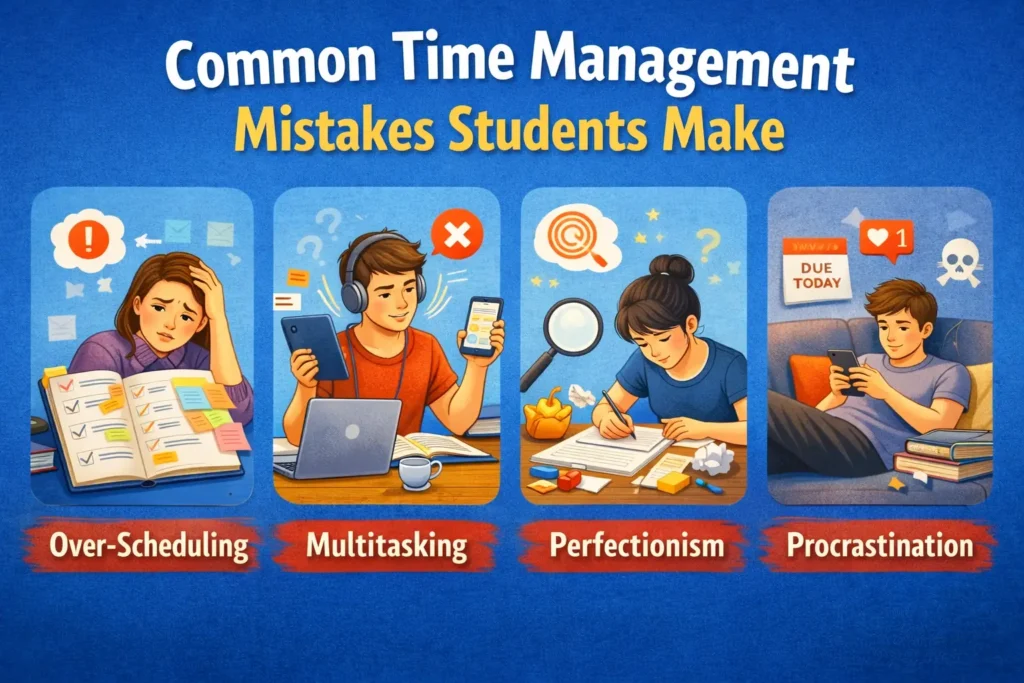
Mistake 1: Over-Scheduling
Packing every minute creates no buffer for unexpected events or necessary rest.
Mistake 2: Multitasking
Research proves multitasking reduces efficiency by 40%. Focus on one task at a time.
Mistake 3: Perfectionism
Spending excessive time making minor improvements yields diminishing returns. “Good enough” is often sufficient.
Mistake 4: No Priorities
Treating all tasks as equally important leads to focusing on easy but unimportant work while crucial tasks suffer.
Mistake 5: Procrastination Without Recognition
Recognizing procrastination patterns is first step to addressing them. Denial makes change impossible.
Mistake 6: Ignoring Energy Levels
Forcing study during low-energy times is ineffective. Work with your natural rhythms.
Mistake 7: No Buffer Time
Scheduling back-to-back commitments without transition time creates constant rushing and stress.
Best Time Management Tools for Students (2026)
Technology that actually helps:
Planning Apps
Notion:
- All-in-one workspace
- Calendar, notes, tasks combined
- Templates for students
- Free for education accounts
Google Calendar:
- Simple, reliable
- Syncs across devices
- Shareable with study groups
- Free
My Study Life:
- Designed specifically for students
- Tracks classes, homework, exams
- Rotation schedules support
- Free
Focus Tools
Forest:
- Gamifies staying off phone
- Grow virtual trees during focus time
- Visualizes productive time
- Small one-time cost
Freedom:
- Blocks distracting websites/apps
- Scheduled blocking sessions
- Cross-platform
- Free trial, then subscription
Cold Turkey:
- Powerful website/app blocker
- Cannot be bypassed once activated
- Free version available
Study Aids
Quizlet:
- Digital flashcards
- Study games and tests
- Huge library of existing sets
- Free (premium optional)
Anki:
- Spaced repetition flashcards
- Highly effective for memorization
- Free (iOS version paid)
Grammarly:
- Writing assistance
- Catches errors and improves clarity
- Free basic version
Conclusion: Master Time, Master Success
Time management isn’t about cramming more into already busy schedules. It’s about intentionally choosing how to spend limited hours in ways that support both academic success and personal well-being.
Key Takeaways:
- Time management is single most important skill for student success
- Students using structured techniques report 30% less stress
- Planners/calendars are essential for tracking all commitments
- Prioritize using Eisenhower Matrix (urgent vs. important)
- Break large projects into smaller, manageable tasks
- Time blocking creates structure and prevents overwhelm
- Two-minute rule prevents small task accumulation
- Pomodoro Technique (25-minute focus blocks) maintains concentration
- Study hardest subjects during peak energy times
- Learning to say “no” protects time for priorities
- Consistent sleep schedule (7-9 hours) is non-negotiable
- Schedule breaks and downtime to prevent burnout
- Weekly reviews enable continuous improvement
What To Do Now:
Choose 2-3 tips from this guide. Implement them consistently for two weeks. Assess results. Add more strategies gradually. Time management is marathon, not sprint.
The Bottom Line:
You cannot create more time. You can only manage it better. Students who master this skill don’t just succeed academically—they build foundation for lifelong success in all areas.
For related student guidance, read our articles on how to choose the right career path and nutrition tips for healthy lifestyle.
Start today. Your future self will thank you.