
You’re making money in your business. That’s great!
But here’s the question every owner asks: Where should I put my profits?
Should you buy new equipment? Hire more people? Save it? Invest somewhere else?
I get it. You work hard for your money. You want to make smart choices.
This guide shows you the best places to invest your business profits. Not fancy talk or confusing terms. Just real ideas that work.
Whether you have $5,000 or $500,000 to invest, you’ll find practical options here. Some grow your business. Some protect your money. Some do both.
Let’s talk about where to put your money so it works as hard as you do.
Why Business Owners Need Different Investment Strategies
You’re not like other investors.
Regular people invest for retirement. They buy stocks. They wait 30 years.
Business owners? You need different options.
Here’s why:
You need cash flow. Your business might need money fast. You can’t wait years to sell stocks.
You understand risk. Running a business teaches you about ups and downs. You know when to bet big and when to play safe.
You want control. You didn’t build a business just to hand your money to someone else. You want to see where it goes.
You think differently. You spot opportunities others miss. That’s what makes you good at business.
So you need investment options that fit your life. Not some cookie-cutter plan from a bank.
Let’s look at your best choices.
Learn about how to create a marketing budget to plan your investments.
Smart Investment Ideas for Your Business
These are the places where putting money back into your business makes sense.
1. Upgrade Your Technology
Old computers slow you down. Bad software wastes time. Outdated tools cost you money.
Smart tech investments pay for themselves fast.
What to invest in:
Buy better computers and equipment. Your team works faster with good tools.
Get automation software. Let computers do the boring stuff. Your people focus on important work.
Use AI tools for marketing and customer service. They save time and money. (90% of small businesses plan to use more technology in the coming years.)
Upgrade your website. A fast, modern site brings more customers.
Real example: A small marketing agency spent $15,000 on new design software and computers. Their team finished projects 40% faster. They took on 3 more clients that year.
Cost: $5,000 to $50,000 depending on your needs
Payback time: Usually 6 to 18 months
Bottom line: Good technology isn’t an expense. It’s a money maker.
2. Train Your Team
Your people are your best asset. Making them better makes your business better.
Training is one of the smartest investments you can make.
What this looks like:
Send employees to workshops or conferences. They learn new skills and bring back fresh ideas.
Buy online courses for your team. Sites like Udemy and Coursera have great classes for $20 to $200.
Hire coaches or consultants. Sometimes you need an expert to teach specific skills.
Create an internal training program. Have experienced employees teach newer ones.
Why it works: Trained employees stay longer. They work better. They make fewer mistakes. Your business runs smoother.
Cost: $500 to $5,000 per employee per year
Returns: Better work, happier customers, less employee turnover
Learn about digital marketing skills your team should have.
3. Marketing That Actually Works
Most businesses spend money on marketing. Few do it right.
Smart marketing investments bring customers. Bad ones waste cash.
Good marketing investments:
Build a real SEO strategy. Show up when people search for what you sell. This brings customers every single day.
Create content that helps people. Blogs, videos, guides. Give value first. Sales come later.
Try paid ads on Google or Facebook. Start small. Test what works. Scale up the winners.
Email marketing to past customers. It’s cheap and it works. People who bought before will buy again.
Real numbers: Businesses that invest in content marketing get 3 times more leads than traditional marketing. And it costs 62% less.
Cost: $1,000 to $10,000 per month
Returns: More customers, better sales, stronger brand
Check out AI marketing tools that save time and money.
4. Hire the Right People
Adding the right person to your team can change everything.
The wrong hire? That’s a costly mistake.
When hiring makes sense:
You’re turning down work because you’re too busy. That’s lost money.
You’re stuck doing tasks someone else could handle. Your time is worth more.
You found someone who brings a skill you don’t have. That opens new opportunities.
Your current team is stretched too thin. Quality drops when people are overwhelmed.
How to do it right: Start with contractors or part-time help. See if the role really needs to be full-time. Then hire permanent if it makes sense.
Cost: $30,000 to $80,000 per employee per year (with benefits)
Returns: More capacity, better service, ability to grow
5. Buy Equipment or Inventory
Sometimes you need to spend money to make money.
Smart equipment purchases:
Machines that do work faster or better. You serve more customers in less time.
Inventory of popular products. Running out of stock loses sales.
Delivery vehicles if you ship products. Control your own shipping and save money.
Production equipment that improves quality. Better products mean happier customers.
The key question: Will this equipment make me more money than it costs?
If yes, it’s a good investment. If no, skip it.
Financing tip: Many equipment purchases qualify for tax deductions. Talk to your accountant about Section 179 deductions.
Investments Outside Your Business
Don’t put all your eggs in one basket. Your business is great, but it’s risky to keep everything there.
Here are smart places to invest money outside your business.
1. Real Estate That Makes Money
Real estate is a favorite for business owners. You can see it. Touch it. Control it.
Commercial property: Buy the building your business operates from. Pay yourself rent instead of a landlord.
Rental properties: Buy houses or apartments. Rent them out. Get monthly income.
REITs: Real Estate Investment Trusts let you invest in property without buying buildings. You can start with just $1,000.
Real example: A restaurant owner bought their building for $400,000. Their monthly mortgage payment was less than their old rent. After 10 years, the building was worth $650,000. They built $250,000 in equity while running their business.
Starting amount: $25,000 to $500,000+
Returns: 8% to 12% per year on average
Risk level: Medium (property values can drop)
2. Index Funds and ETFs
Here’s the simple way to invest in the stock market.
Index funds own a little bit of many companies. When the market goes up, you make money. When it goes down, you lose money. But over time, markets go up.
Why business owners like them:
Low effort. Buy them and forget about them.
Diversification. One fund owns hundreds of companies.
Proven results. The S&P 500 has returned about 10% per year for decades.
Easy to cash out if you need money.
How to start: Open an account at Vanguard, Fidelity, or Schwab. Buy an S&P 500 index fund. Add money regularly.
Starting amount: You can begin with $100
Returns: 8% to 10% per year historically
Risk level: Medium (short-term ups and downs, but solid long-term)
3. Your Retirement Account
Here’s a secret: Many business owners forget to save for retirement.
They put everything into the business. Then they can’t retire when they want to.
Smart retirement moves:
Open a Solo 401(k) if you’re self-employed. You can put away up to $69,000 per year (for people under 50).
Set up a SEP IRA. It’s simple and lets you save a lot.
Contribute to a Roth IRA. Pay taxes now, grow the money tax-free forever.
The key: Make it automatic. Transfer money to retirement accounts every month. Don’t wait until year-end.
Tax benefit: Retirement contributions reduce your taxes now. You keep more of what you earn.
Starting amount: $500 to $1,000 per month
Returns: Depends on investments inside the account
4. Another Business or Franchise
Once you’ve built one successful business, maybe you want another.
Options to consider:
Buy another business in your industry. Get more market share and customers.
Start a related business. Use what you already know to expand.
Buy a franchise. They give you a proven system. You run it.
Become a partner in someone else’s business. Put in money and expertise. Share the profits.
Be careful here. Running two businesses takes serious time and energy. Make sure your first business runs smoothly before starting a second.
Starting amount: $50,000 to $500,000+
Returns: Varies wildly based on the business
Risk level: High (every business has risk)
5. Bonds and Safe Investments
Sometimes you just want to protect money. Not grow it aggressively. Just keep it safe.
Treasury bonds: Backed by the government. Super safe. Returns are lower (4% to 5% right now).
Corporate bonds: Companies pay you interest to borrow your money. Slightly riskier than Treasury bonds.
High-yield savings accounts: Banks pay 4% to 5% with zero risk. Your money is always available.
CDs (Certificates of Deposit): Lock up money for 6 months to 5 years. Get slightly higher returns than savings accounts.
When these make sense: You have a large expense coming up in 1 to 3 years. You want to protect that money from stock market drops.
Starting amount: $1,000 and up
Returns: 4% to 6% per year
Risk level: Very low to zero
Learn about advantages and disadvantages of AI in business investments.
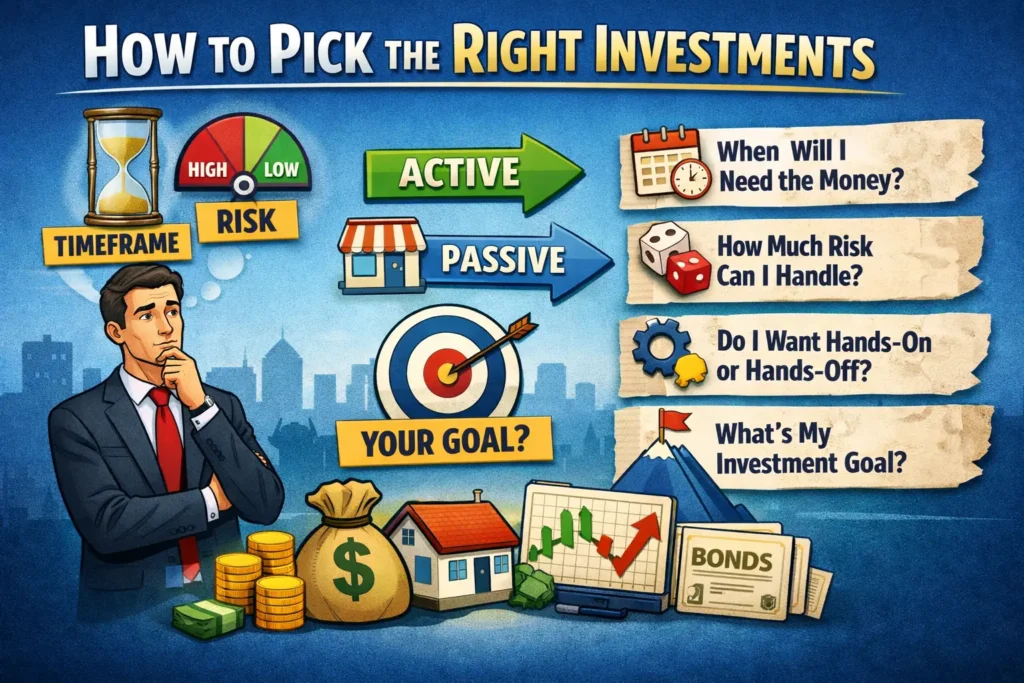
How to Pick the Right Investments
Here’s a simple framework for deciding where to put your money.
Ask These Questions
Question 1: How soon might I need this money?
Need it within a year? Keep it in savings or bonds.
Won’t need it for 5+ years? Stocks and real estate work great.
Somewhere in between? Mix of both.
Question 2: How much risk am I comfortable with?
Love excitement? Higher-risk investments like stocks or new businesses.
Want to sleep well at night? Safer options like bonds and index funds.
Somewhere in middle? Balanced mix of both.
Question 3: Do I want to be involved or hands-off?
Like to be active? Rental properties or a second business.
Prefer passive? Index funds or REITs.
Question 4: What’s my goal?
Want monthly income? Rental properties or dividend stocks.
Want to build wealth over time? Growth stocks or real estate.
Want safety? Bonds and savings accounts.
The 60-30-10 Rule
Here’s a simple way to split your investment money:
60% in your business. This is still your best opportunity. Put most of your money here if your business is growing.
30% in safe investments. Index funds, real estate, retirement accounts. These grow steadily over time.
10% in opportunities. New ideas, high-risk investments, experiments. If they work great. If not, you only lose 10%.
Adjust based on your situation. Newer business? Put more back in. Established business? Save more outside.
Start Small and Learn
You don’t need to invest everything at once.
Better approach:
Start with one investment type. Learn how it works.
Put in a small amount first. See how it goes.
Once comfortable, add more money.
Try a second type of investment.
Repeat this process. Build your investment portfolio over years, not weeks.
Why this works: You learn without risking too much. You figure out what fits your personality and goals.
Common Investment Mistakes to Avoid
Smart business owners still make dumb investment choices sometimes. Here’s what to watch out for.
Mistake 1: No Emergency Fund First
Never invest money you might need soon.
The rule: Keep 3 to 6 months of expenses in a savings account BEFORE you invest elsewhere.
This money saves you when:
- Business has a slow month
- Equipment breaks down
- You lose a big customer
- Personal emergency happens
Without emergency savings, you’re forced to sell investments at bad times. That costs you money.
Mistake 2: Following Hot Tips
Your brother-in-law has a “can’t miss” investment opportunity. Your buddy made money on crypto. You saw someone get rich on TikTok.
Don’t chase these.
The reality: Most “hot tips” lose money. The people making real money don’t share their secrets on social media.
Better approach: Stick to boring, proven investments. They’re boring because they work.
Mistake 3: Not Diversifying
Putting all your money in one place is risky. Even if that place is your business.
What happens: If that one investment goes bad, you lose everything.
Smart move: Spread money across different types of investments. Real estate. Stocks. Your business. Bonds.
When one drops, others might rise. You’re protected.
Mistake 4: Ignoring Taxes
Every investment has tax consequences. Some are good. Some are bad.
Examples:
Retirement accounts save you taxes now.
Long-term stock investments are taxed less than short-term.
Some real estate investments give you big deductions.
Business equipment purchases can be fully deducted in year one.
The smart move: Talk to an accountant BEFORE you invest. Not after. They help you keep more of your money.
Mistake 5: No Real Plan
“I’ll invest when I have extra money” is not a plan.
That “extra money” never appears. Life always has expenses.
Better approach: Set automatic transfers. Move money to investments every month. Treat it like any other business expense.
Even $500 per month adds up. That’s $6,000 per year. Do that for 10 years and you have real money.
Check out how to improve brand awareness while you grow your investments.
When to Get Professional Help
You’re smart. You run a business. But you can’t be an expert at everything.
Here’s when to hire help:
Hire a financial advisor when:
- You have $100,000+ to invest
- You’re planning for retirement
- You need complex tax strategies
- You don’t have time to research investments
Hire an accountant when:
- Your business makes over $100,000 per year
- You have employees
- You’re thinking about big purchases or investments
- Tax laws confuse you
Hire a lawyer when:
- Buying real estate or another business
- Creating partnerships or complicated deals
- Protecting your assets from lawsuits
Good professionals are worth it. They save you more money than they cost.
How to find them: Ask other business owners who they use. Check reviews. Interview at least 3 before choosing.
Conclusion: Build Wealth While You Build Your Business
You work hard for your money. Make sure it works hard for you too.
Smart investments do three things:
They grow your wealth over time.
They protect you when things go wrong.
They give you options and freedom.
Start today with these steps:
Build an emergency fund first. Get 3 to 6 months of expenses in savings.
Put money back in your business. Invest in technology, marketing, or people that increase profits.
Save for retirement automatically. Set it up once and forget it.
Diversify outside your business. Index funds or real estate are good places to start.
Learn as you go. Start small. Add more as you get comfortable.
Remember this: The best time to invest was yesterday. The second best time is today.
You don’t need huge amounts to start. Even $500 a month builds real wealth over time.
Your business gives you the money to invest. Smart investments give you freedom and security.
That’s a winning combination.
For more business growth tips, read our guides on content marketing strategy and AI tools for business.