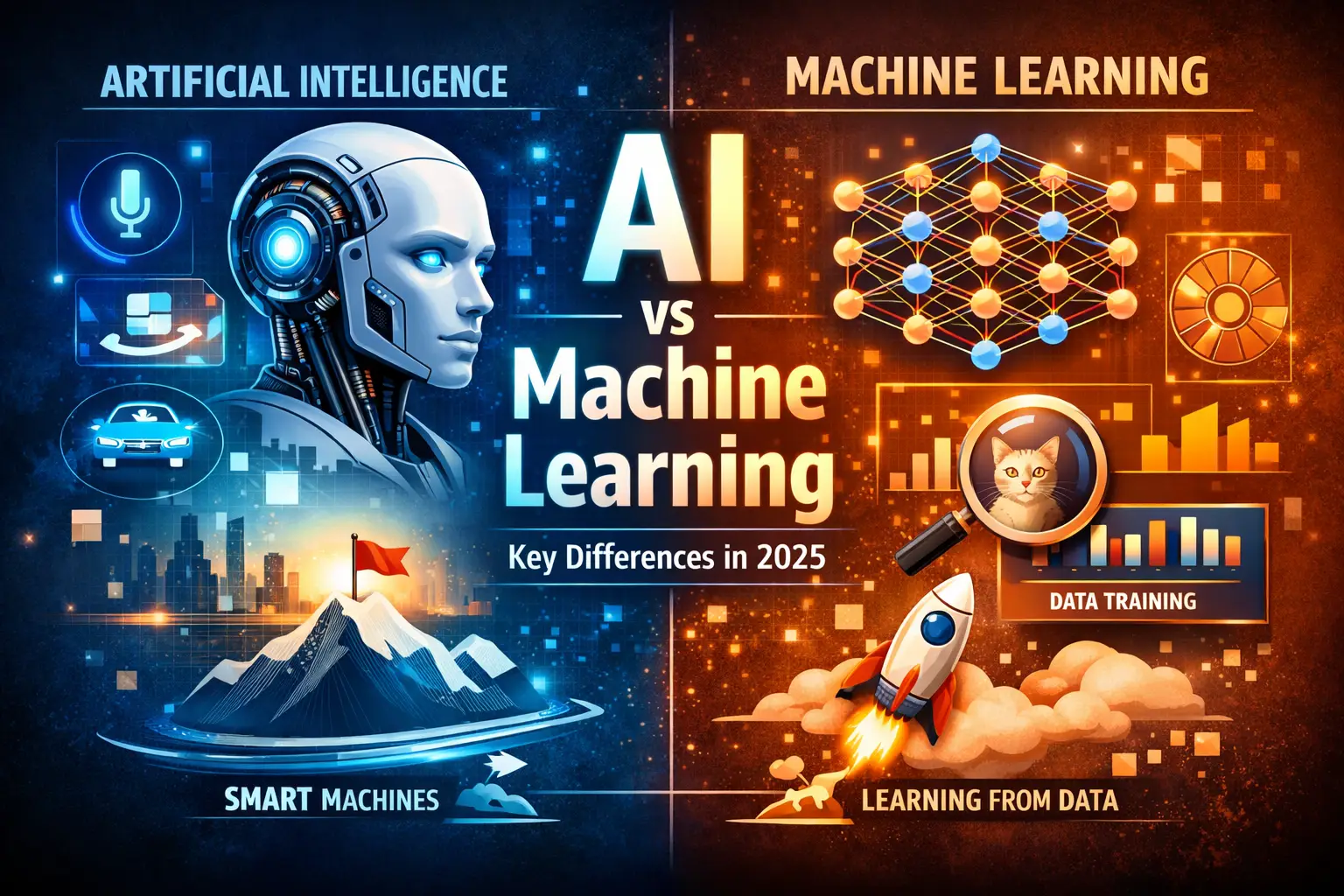
Are you confused about the difference between machine learning and artificial intelligence? You are not alone. Many people use these terms as if they mean the same thing, but they are actually different.
Think of it this way: artificial intelligence is like a big umbrella, and machine learning is one tool under that umbrella. In this guide, we will explain both concepts in simple words that anyone can understand.
By the end of this article, you will know exactly what AI and machine learning are, how they differ, and which one businesses are using more in 2026.
What Is Artificial Intelligence?
Artificial intelligence, or AI, means making computers act smart like humans. AI can think, learn, solve problems, and make decisions.
Imagine a robot that can see, hear, understand what you say, and respond to you. That robot uses AI to do all these things.
Simple Definition: AI is any technology that makes machines behave intelligently.
AI has been around for many years. Scientists started working on AI in the 1950s. Back then, they programmed computers with specific rules to follow. For example, if you type a question, the computer follows its rules to give you an answer.
Today, AI is much more advanced. It powers voice assistants like Siri and Alexa, helps doctors find diseases, and even drives cars without human drivers.
If you want to learn more about the benefits of artificial intelligence, we have a detailed guide that explains how AI helps businesses and people.
What Is Machine Learning?
Machine learning, or ML, is a special type of AI. Instead of following programmed rules, machine learning teaches computers to learn from experience.
Think about how you learned to ride a bike. At first, you fell many times. But each time you fell, you learned what not to do. Eventually, you could ride without thinking about it. Machine learning works the same way.
Simple Definition: Machine learning is when computers learn from data without being told exactly what to do.
For example, imagine teaching a computer to recognize pictures of cats. With old-style programming, you would need to write thousands of rules about what a cat looks like. With machine learning, you just show the computer thousands of cat pictures. The computer learns the patterns by itself.
Machine learning is now used everywhere. It helps Netflix recommend shows you might like, helps banks detect fraud, and helps websites show you ads for products you actually want.
Understanding how AI is changing marketing shows how machine learning helps businesses reach customers better.
AI vs Machine Learning: The Main Difference
Here is the simplest way to understand the difference:
Artificial Intelligence (AI) is the big goal: making machines smart like humans.
Machine Learning (ML) is one method to reach that goal: teaching machines to learn from data.
Think of it like this:
- AI is the destination (making smart machines)
- Machine learning is the vehicle (one way to get there)
All machine learning is AI, but not all AI is machine learning. Some AI systems use simple programmed rules. For example, a thermostat that turns on heating when the temperature drops below 68 degrees is a basic AI system. It does not learn anything new. It just follows a simple rule.
Machine learning systems, on the other hand, improve as they get more data. The more information they process, the smarter they become.
Types of Artificial Intelligence
AI comes in different forms. Let us look at the main types:
1. Narrow AI (Weak AI)
This is AI that does one specific job really well. Most AI we use today is narrow AI.
Examples:
- Voice assistants like Siri and Alexa
- Email spam filters
- Recommendation systems on Netflix and Amazon
- Face recognition on your phone
Narrow AI is very good at one task but cannot do other tasks. For example, the AI that recommends movies on Netflix cannot drive a car.
2. General AI (Strong AI)
General AI would be a computer that can think and learn like a human in any situation. It could solve any problem a human can solve.
Current Status: General AI does not exist yet. Scientists are working on it, but we are not there yet.
Some people call this AGI (Artificial General Intelligence). It would be able to understand, learn, and apply knowledge to many different tasks, just like humans do.
3. Super AI
Super AI is an idea for the future. It would be AI that is smarter than the smartest humans in every way.
Current Status: This is still science fiction. We are many years away from creating super AI, if we ever do.
These categories help us understand where AI is today and where it might go in the future. Right now, all the AI we use is narrow AI.
Types of Machine Learning
Machine learning also has different types. Each type learns in a different way:
1. Supervised Learning
This is like learning with a teacher. You show the computer examples with the correct answers, and it learns the pattern.
Example: You want to teach a computer to recognize spam emails. You give it thousands of emails labeled as “spam” or “not spam.” The computer learns what spam looks like.
Common Uses:
- Email spam filters
- Credit card fraud detection
- Medical diagnosis
- Price prediction
2. Unsupervised Learning
This is like learning on your own without a teacher. The computer finds patterns in data without being told what to look for.
Example: A store wants to group customers by shopping habits. The computer analyzes purchase data and creates groups on its own. It might find that one group loves outdoor gear while another group prefers electronics.
Common Uses:
- Customer segmentation
- Recommendation systems
- Finding unusual patterns in data
- Market research
3. Reinforcement Learning
This is like learning from trial and error with rewards and punishments. The computer tries different actions and learns which ones work best.
Example: Teaching a computer to play chess. When it makes a good move, it gets a reward. When it makes a bad move, it gets a penalty. Over time, it learns to play better.
Common Uses:
- Game AI (like AlphaGo that beat world champions)
- Self-driving cars
- Robot control
- Resource management
Understanding these different types helps businesses choose the right approach for their needs.
Deep Learning vs Machine Learning vs AI
Now let us add one more term to the mix: deep learning.
The Relationship:
- AI is the biggest category (making machines smart)
- Machine learning is inside AI (learning from data)
- Deep learning is inside machine learning (learning with neural networks)
Think of it like Russian nesting dolls. Deep learning fits inside machine learning, which fits inside AI.
What Is Deep Learning?
Deep learning uses artificial neural networks that work like the human brain. These networks have many layers (that is why we call them “deep”).
What Makes It Special: Deep learning is excellent at finding patterns in complex data like images, videos, and speech.
Examples of Deep Learning:
- Face recognition in photos
- Voice assistants understanding what you say
- Self-driving cars seeing the road
- Language translation
- ChatGPT and other AI chatbots
Deep learning needs a lot of data and computer power to work. But when it has enough data, it can do amazing things that other types of machine learning cannot do.
Many modern AI trends that are changing industries use deep learning technology.
Generative AI vs Machine Learning
You might have heard about generative AI. Tools like ChatGPT, DALL-E, and Midjourney use generative AI. How does this fit with machine learning?
Generative AI is a type of machine learning that creates new content. It can write text, make images, create music, or generate videos.
Traditional Machine Learning analyzes data and makes predictions or decisions.
The Key Difference:
- Traditional ML: “This email is spam” (classification)
- Generative AI: “Here is a new email about your topic” (creation)
Generative AI became very popular in 2022 when ChatGPT launched. Since then, businesses everywhere have started using it to:
- Write marketing content
- Create images for social media
- Generate code for software development
- Make personalized emails for customers
- Create video scripts and presentations
Both are types of machine learning, but they serve different purposes. Traditional ML helps make better decisions. Generative AI helps create new things.
Our guide on 8 ways to use AI in digital marketing shows how businesses use both types.
Data Science vs Machine Learning vs AI
Another common confusion is where data science fits in this picture.
Data Science is about extracting insights from data. It uses statistics, programming, and domain knowledge to understand what data tells us.
Machine Learning is one tool that data scientists use. But data science includes many other tools too, like data visualization, statistical analysis, and database management.
The Relationship:
- Data science is the field of working with data
- Machine learning is a method within data science
- AI is the broader goal of making intelligent machines
Think of it this way:
- A data scientist might use machine learning to build a model
- That model uses AI to make predictions
- The whole process is part of data science
Many data scientists work on both machine learning projects and other data analysis tasks.
AI Engineer vs Machine Learning Engineer
If you are thinking about a career in this field, you might wonder about the difference between these jobs:
AI Engineer
What They Do:
- Build complete AI systems
- Work with various AI technologies (not just machine learning)
- Integrate AI into products and services
- Focus on making AI solutions work in the real world
Skills Needed:
- Programming (Python, Java, C++)
- Understanding of various AI methods
- Cloud computing
- Software development
Machine Learning Engineer
What They Do:
- Build and train machine learning models
- Work specifically with data and algorithms
- Optimize model performance
- Deploy models to production
Skills Needed:
- Programming (especially Python and R)
- Mathematics and statistics
- Machine learning frameworks (TensorFlow, PyTorch)
- Data processing
Salary Differences: In most countries, both roles pay well. In India, for example:
- AI Engineers earn between ₹6-20 lakhs per year
- Machine Learning Engineers earn between ₹7-18 lakhs per year
The exact salary depends on experience, company, and location. Both careers are growing fast as more companies adopt these technologies.
If you are interested in technology careers, learning about how technology is changing businesses can help you see where opportunities are growing.
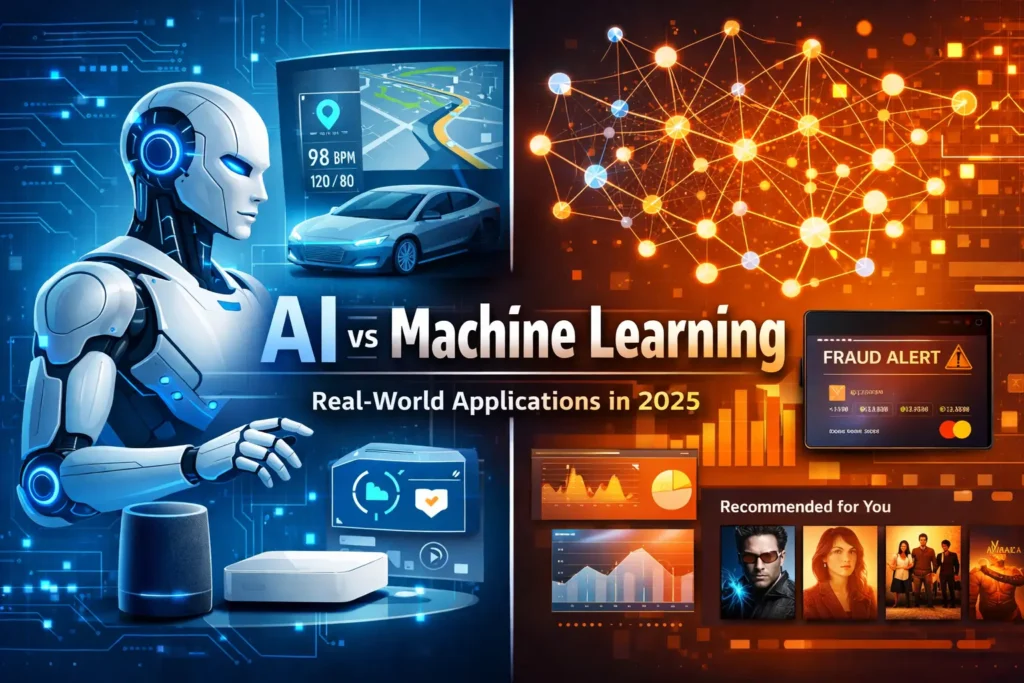
Real-World Examples: AI vs Machine Learning in Action
Let us look at how these technologies work in real life:
AI Examples
1. Smart Home Devices Your smart speaker uses AI to understand voice commands, control lights, and play music. Some of this is simple programmed rules, and some uses machine learning.
2. GPS Navigation Apps like Google Maps use AI to find the best route, predict traffic, and suggest arrival times. This combines rule-based AI with machine learning.
3. Video Game Opponents Computer-controlled characters in games use AI to play against you. Some use simple rules, while others use machine learning to adapt to your playing style.
Machine Learning Examples
1. Netflix Recommendations Netflix uses machine learning to study what you watch and suggest shows you might like. The more you watch, the better it gets.
2. Credit Card Fraud Detection Banks use machine learning to spot unusual purchases on your card. The system learns your normal spending patterns and alerts you to suspicious activity.
3. Email Spam Filters Your email app uses machine learning to identify spam. It learns from millions of emails which ones are junk and which are real.
4. Social Media Feeds Facebook, Instagram, and TikTok use machine learning to show you posts you will probably like. They learn from what you click, share, and watch.
When to Use AI vs Machine Learning
Businesses often ask: should we use AI or machine learning? The answer depends on your problem:
Use General AI Approaches When:
- You need rule-based systems with clear if-then logic
- The problem is well-defined with specific steps
- You do not have much data
- You need the system to be explainable and transparent
Example: A simple chatbot that answers frequently asked questions using pre-written responses.
Use Machine Learning When:
- You have lots of data
- The patterns are complex and hard to program manually
- You need the system to improve over time
- You want predictions or classifications
Example: A system that predicts which customers will stop using your service based on their behavior.
Use Deep Learning When:
- You have very large amounts of data
- You are working with images, video, or speech
- Traditional machine learning is not accurate enough
- You have the computing power to train complex models
Example: An app that identifies objects in photos or transcribes spoken words to text.
Understanding your specific needs helps you choose the right technology. Our article on the future of marketing with AI explains how businesses decide which AI tools to use.
Automation vs AI vs Machine Learning
Another term that causes confusion is automation. How does it fit?
Automation means making things happen automatically without human involvement.
AI-Powered Automation uses artificial intelligence to make smart automatic decisions.
Machine Learning Automation uses learning algorithms to improve automated processes over time.
The Differences:
Traditional Automation:
- Follows fixed rules
- Does the same thing every time
- Does not adapt or learn
- Example: A factory robot that repeats the same movement
AI Automation:
- Can make decisions based on conditions
- Adapts to different situations
- May or may not learn
- Example: A chatbot that answers customer questions
Machine Learning Automation:
- Learns and improves from data
- Gets better over time
- Adapts to new patterns
- Example: An email system that learns what you usually do and suggests actions
Most modern business automation now includes some AI or machine learning to make it smarter and more flexible.
Symbolic AI vs Machine Learning
In the early days of AI, most systems used symbolic AI (also called “good old-fashioned AI”).
Symbolic AI:
- Uses human-made rules and logic
- Represents knowledge in symbols (like words and concepts)
- Follows clear reasoning steps
- Easy for humans to understand
Machine Learning:
- Learns patterns from data automatically
- Represents knowledge in numbers and statistics
- May not follow clear logic we can explain
- More flexible and powerful for complex tasks
Why Machine Learning Won: For many years, symbolic AI was the main approach. But it had problems:
- Creating all the rules took too much time
- It could not handle exceptions well
- It struggled with complex real-world data like images
Machine learning solved these problems by learning patterns automatically. Today, most AI systems use machine learning instead of symbolic approaches.
However, some researchers are now trying to combine both approaches to get the best of both worlds.
Common Misconceptions About AI and Machine Learning
Let us clear up some common myths:
Myth 1: “AI and Machine Learning Are the Same”
Truth: Machine learning is one type of AI, but AI includes many other approaches too.
Myth 2: “AI Will Replace All Human Jobs”
Truth: AI will change jobs, not eliminate them. It works best when helping humans, not replacing them. Learn more about what jobs will AI replace and which are safe.
Myth 3: “Machine Learning Is Always Better Than Traditional Programming”
Truth: For simple, rule-based tasks, traditional programming is often better, faster, and cheaper.
Myth 4: “You Need to Be a Math Genius to Use AI”
Truth: While creating new AI requires math skills, using AI tools is becoming easier every day. Many no-code AI platforms let anyone use this technology.
Myth 5: “More Data Always Makes Machine Learning Better”
Truth: Quality matters more than quantity. Bad data makes bad predictions, no matter how much you have.
Myth 6: “AI Is Perfect and Never Makes Mistakes”
Truth: AI makes mistakes, sometimes serious ones. That is why humans still need to check its work.
The Future of AI and Machine Learning in 2026 and Beyond
Both AI and machine learning are growing fast. Here is what we can expect:
Short-Term Future (2026-2028)
1. More Accessible Tools AI and machine learning tools will become easier to use. Small businesses will be able to use advanced AI without hiring experts.
2. Better Generative AI Tools like ChatGPT will get much better at creating content, images, and videos.
3. AI in More Industries Healthcare, education, farming, and construction will all use more AI and machine learning.
4. Edge AI AI will run on your devices (like phones and smart home gadgets) instead of needing cloud servers.
Long-Term Future (2028-2035)
1. Improved Human-AI Collaboration AI will become a true partner to humans, not just a tool. It will understand context better and work with us more naturally.
2. More Explainable AI We will better understand how AI makes decisions, making it safer and more trustworthy.
3. Progress Toward General AI We might see early versions of AI that can handle many different tasks, moving closer to general AI.
4. AI for Scientific Discovery AI and machine learning will help scientists discover new medicines, materials, and solutions to big problems.
5. Ethical AI Standards Clear rules and guidelines will ensure AI is used responsibly and fairly.
The companies investing in AI and machine learning now will have big advantages in the future.
How to Get Started with AI and Machine Learning
If you want to start using these technologies, here are simple steps:
For Businesses
Step 1: Identify Problems to Solve What takes the most time? What could be automated? Where do you need better predictions?
Step 2: Start Small Begin with one simple project. Learn from it before taking on bigger challenges.
Step 3: Use Existing Tools You do not need to build everything from scratch. Many ready-made AI tools exist for common tasks.
Step 4: Train Your Team Make sure your employees understand how to use AI tools and work alongside them.
Step 5: Measure Results Track how AI helps your business. Use data to decide what works and what does not.
For Individuals
Step 1: Learn the Basics Take free online courses to understand AI and machine learning concepts.
Step 2: Choose a Path Decide if you want to build AI systems (more technical) or use AI tools (less technical).
Step 3: Practice with Real Tools Try ChatGPT, Google’s free machine learning courses, or other beginner-friendly platforms.
Step 4: Build Projects Create small projects to practice what you learn. Start simple and gradually work on harder problems.
Step 5: Join Communities Connect with others learning AI. Online forums, local meetups, and social media groups can help.
Conclusion
Understanding the difference between AI and machine learning helps you make better decisions about using these technologies.
Remember the Key Points:
- AI is the broad field of making machines intelligent
- Machine learning is one method of creating AI by learning from data
- Deep learning is a powerful type of machine learning that uses neural networks
- All machine learning is AI, but not all AI is machine learning
- Both technologies are changing how businesses work and how we live
The most important thing is to start exploring these technologies now. Whether you are a business owner, a student, or just curious about technology, AI and machine learning will affect your life more and more in the coming years.
You do not need to become an expert to benefit from AI. You just need to understand what it can do and how to use the tools available to you.