AI has created more than 500,000 jobs worldwide since 2020. Yet 87% of marketing teams still use AI at “Level 1″—as advanced autocomplete rather than strategic infrastructure.
According to February 2026 research, brands executing AI-powered content strategies are producing 5-10x more content at 60-80% lower cost per piece. Meanwhile, the Content Marketing Institute reports 78% of businesses now use generative AI in at least one marketing function, with effectiveness determining the gap between winners and those left behind.
The AI content marketing market will surpass $107 billion by 2028 according to Statista. This growth reflects not hype, but reality: teams treating AI as infrastructure rather than novelty are winning in search, social, and customer engagement. The shift isn’t from human to machine—it’s from manual processes to AI-augmented workflows where humans focus on strategy while AI handles execution.
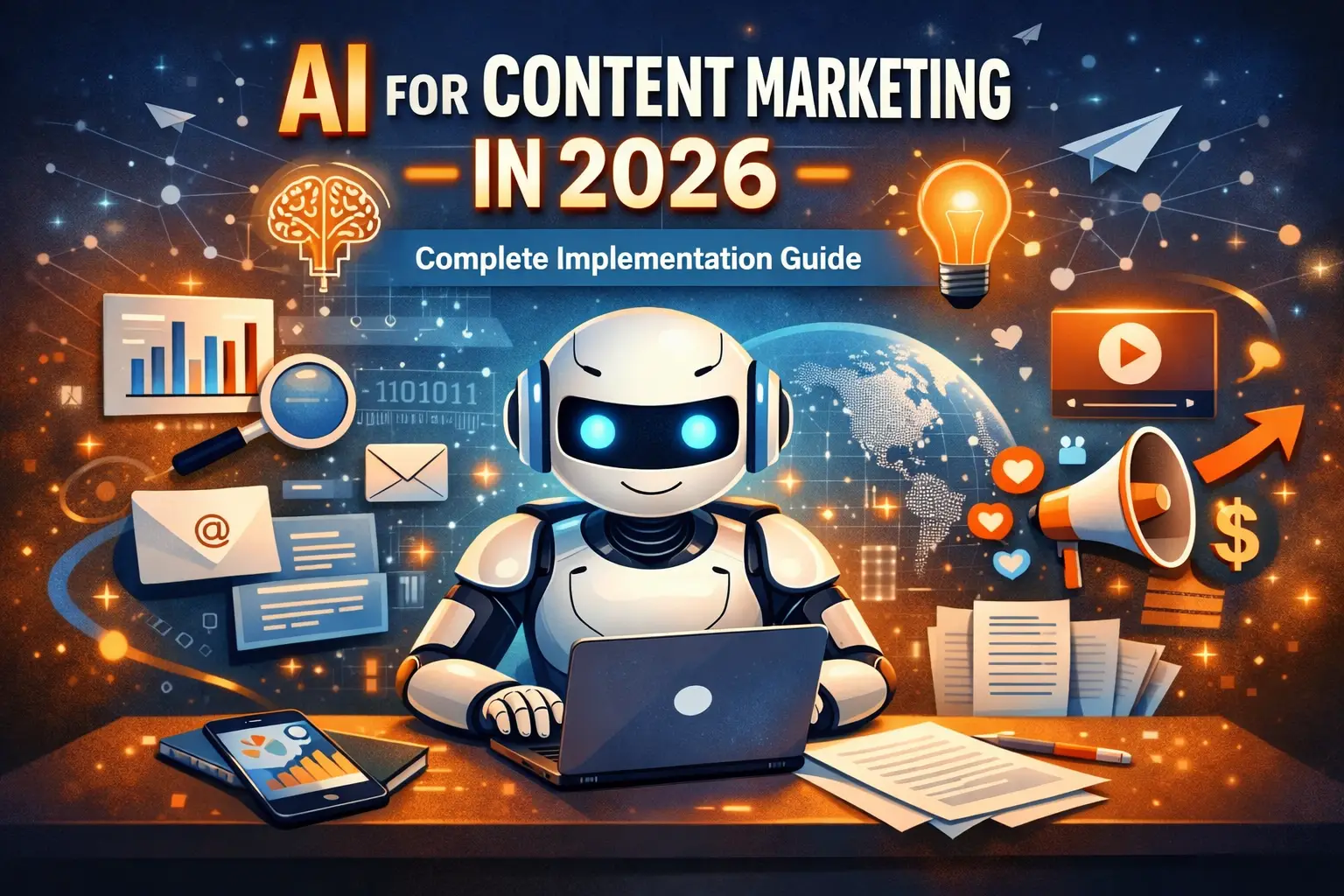
This comprehensive guide reveals exactly how to use AI for content marketing in 2026, based on latest data from Fortune 500 implementations, agency best practices, and real-world testing. You will learn proven workflows, essential tools, strategic frameworks, measurement approaches, and critical mistakes costing teams results.
Whether you manage content strategy, lead marketing operations, or run an agency, this guide transforms AI from buzzword into competitive advantage.
Understanding AI Content Marketing in 2026
Before implementation, grasp what AI content marketing actually means today:
2026 Definition: AI content marketing is the strategic use of artificial intelligence to create, optimize, distribute, and measure content that connects with audiences—using AI to handle research, first-draft production, optimization, and distribution while human strategists focus on positioning, narrative, and quality control.
What Changed from 2023-2024:
- Then: AI wrote blog post drafts
- Now: AI executes complete content systems from strategy to measurement
The Three Levels of AI Content Maturity:
Level 1 – AI Assistance (Where 87% Operate): Humans use AI tools (ChatGPT, Claude, Jasper) to speed up existing workflows. Faster drafting, better headlines, improved editing.
Level 2 – AI-Augmented Workflows: AI handles entire sub-tasks autonomously—keyword research, first drafts, social adaptation, performance reporting—while humans direct strategy and review outputs.
Level 3 – AI-Executed Content Systems: AI agents perceive market signals, generate content opportunities, produce complete pieces, publish across channels, monitor performance, and iterate—with human oversight at strategic level only.
The Reality: The gap between Level 1 and Level 3 isn’t technology—the technology exists. It’s implementation: teams that have built workflows and systems versus teams using AI as glorified autocomplete.
Understanding how artificial intelligence works provides essential foundation for strategic implementation.
Why AI Matters for Content Marketing (2026 Data)
Current state backed by recent research:
Productivity Gains: High-quality AI-generated first drafts require 20-40 minutes of human editing for 2,000-word articles—replacing 4-8 hours of human writing time with 30 minutes of editing time according to analysis.
Scale Without Sacrifice: AI makes publishing daily content across 5 platforms possible without hiring armies of writers or burning out existing teams. Quality content, consistent output, manageable workload.
Performance Impact: eMarketer reports majority of U.S. marketers cite increased performance as clear benefit of generative AI, linking model-assisted workflows to better campaign results.
Competitive Necessity: According to Content Marketing Institute, US and UK marketers’ top priorities for 2026 include experimenting with AI-generated content and creating episodic content. Teams not adopting AI fall behind rapidly.
Cost Efficiency: 60-80% lower cost per content piece when AI handles initial production, freeing budgets for distribution, promotion, and strategic initiatives.
The Harley-Davidson Example: NYC dealership used AI platform to expand prospecting and lift leads by 2,930% during trial period—demonstrating data-driven targeting and creative iteration improving outcomes dramatically.
Learn about AI marketing predictions shaping 2026 for broader strategic context.
Strategic Framework: AI Content Marketing Implementation
Proven approach for successful adoption:
Step 1: Define Baseline and Goals
Before Touching Any AI Tool: Document current content performance:
- How long does it take to create blog post? (Include research, writing, editing, optimization)
- What is your content production volume weekly/monthly?
- What is current engagement rate across channels?
- What is cost per content piece?
- What is conversion rate from content?
Set Specific AI Goals: Don’t say “use AI for everything”—that’s chaos, not strategy.
Better Goals:
- Reduce blog production time from 8 hours to 2 hours while maintaining quality
- Increase content output from 4 to 12 pieces monthly
- Improve email open rates by 20% through AI-powered personalization
- Cut content production costs by 50%
Create Dashboard: Track 3-5 key metrics. Check weekly, not daily. Daily checking leads to panic-driven decisions.
Step 2: Build Audience Intelligence
The Foundation: AI content marketing is only as good as audience data you feed it. Garbage in, garbage out.
How to Build Personas AI Can Use:
- Analyze Existing Customers: Demographics, behavior patterns, pain points, goals
- Survey Target Audience: Direct feedback on challenges and desires
- Mine Support Conversations: What questions do customers actually ask?
- Study Competitor Content: What resonates in your space?
- Review Analytics Data: What content drives engagement and conversions?
Format for AI: Create detailed persona documents including:
- Demographics and psychographics
- Goals and challenges
- Content preferences
- Buying triggers
- Language and terminology they use
Why This Matters: AI trained on detailed personas produces content that resonates. Generic inputs generate generic outputs.
Step 3: Choose Your AI Stack
2026 Tool Categories:
Content Strategy & Research:
- Perplexity (market research)
- Google AI Mode (trend analysis)
- ChatGPT/Claude (topic ideation)
Content Production:
- ChatGPT (speed, variations)
- Claude (quality, depth, brand voice)
- Jasper (marketing copy templates)
SEO Optimization:
- Surfer SEO (content optimization)
- MarketMuse (content gaps)
- Clearscope (keyword integration)
Social Media:
- ChatGPT (quick variations)
- Copy.ai (platform-specific formats)
Email Marketing:
- Typeface Email Agent (personalization)
- ChatGPT (campaign drafts)
Visual Content:
- ChatGPT with DALL-E (image generation)
- Midjourney (detailed images)
- Canva AI (design templates)
Analytics:
- Platform-specific AI tools
- Predictive analytics platforms
The Decision: Don’t choose every tool. Start with 2-3 covering your priority use cases. Expand after mastering basics.
Compare Claude vs. ChatGPT for marketing to select core writing tools strategically.
Step 4: Establish Workflows
The 80/20 Production Workflow:
Phase 1 – AI Drafting (20% effort, 80% speed):
- Feed AI detailed brief (topic, audience, angle, keywords, length)
- Provide brand guidelines and examples
- Generate initial draft
Phase 2 – Human Refinement (80% quality, final 20%):
- Fact-check all claims and statistics
- Add proprietary insights and examples
- Refine brand voice and tone
- Adjust opening and conclusion
- Optimize for search intent
- Final polish
Why This Works: Leverages each component’s strength. AI gets to 80% fast. Humans take final 20% from “good enough” to “genuinely excellent.”
Content Types Workflow:
Blog Posts:
- AI: Research, outline, first draft
- Human: Add unique insights, optimize, edit
- Time savings: 75%
Social Media:
- AI: Generate 10 variations
- Human: Select best, adjust tone, schedule
- Time savings: 85%
Email Campaigns:
- AI: Personalize at individual level
- Human: Set strategy, review samples
- Time savings: 60%
Video Scripts:
- AI: Draft structure and dialogue
- Human: Add personality, refine pacing
- Time savings: 70%
Step 5: Create Quality Control Process
Non-Negotiable Review Checklist:
Accuracy:
- ✓ All facts verified from reliable sources
- ✓ No hallucinated information or invented data
- ✓ Claims backed by citations
Brand Alignment:
- ✓ Voice matches brand guidelines
- ✓ Terminology consistent with brand
- ✓ Messaging aligns with positioning
Originality:
- ✓ Unique insights included
- ✓ Not just rewritten competitor content
- ✓ Adds new value to conversation
E-E-A-T Compliance:
- ✓ Demonstrates experience with topic
- ✓ Shows expertise through depth
- ✓ Author credentials appropriate
- ✓ Trustworthy presentation
SEO Optimization:
- ✓ Matches search intent
- ✓ Targets appropriate keywords
- ✓ Optimized structure and meta tags
Human Oversight: Assign editors to all AI-assisted pieces. Maintain human control over content strategy and brand messaging.
Learn about how AI content affects Google for quality standards.
Step 6: Distribution and Promotion
AI-Powered Distribution:
Timing Optimization: AI analyzes when your audience is most active and schedules posts automatically for maximum reach.
Platform Adaptation: AI transforms single content piece into platform-specific versions:
- Long-form blog → Twitter thread
- Whitepaper → LinkedIn carousel
- Webinar → Short video clips
Audience Targeting: AI identifies which segments respond to which content types and personalizes distribution accordingly.
A/B Testing at Scale: AI tests headlines, intros, CTAs, and social snippets across segments, predicting emotional triggers.
Step 7: Measure and Optimize
AI Analytics Capabilities:
Performance Tracking: AI monitors content performance across channels, identifying what works and what doesn’t faster than manual analysis.
Predictive Metrics: AI forecasts engagement before publishing using historical performance data.
Content Gap Analysis: AI identifies topics your audience cares about that you haven’t covered yet.
Competitive Intelligence: AI tracks competitor content performance, revealing opportunities and threats.
ROI Attribution: AI traces customer journeys across touchpoints, attributing revenue to specific content pieces accurately.
Optimization Recommendations: AI suggests specific improvements based on performance data—which headlines work, optimal length, best posting times.
Practical AI Content Marketing Applications
How leading teams use AI across content types:
Blog Content
AI Handles:
- Keyword research and topic clustering
- Competitive content analysis
- Outline generation
- First draft production
- SEO optimization suggestions
- Internal linking recommendations
Humans Handle:
- Strategic angle and positioning
- Proprietary insights and examples
- Brand voice refinement
- Final quality assurance
Result: Publish 3-5x more blog content without sacrificing quality or burning out team.
Social Media
AI Handles:
- Platform-specific format adaptation
- Multiple variation generation
- Optimal posting time identification
- Hashtag and keyword suggestions
- Performance prediction
- Trend monitoring
Humans Handle:
- Strategic messaging
- Visual selection
- Community engagement
- Crisis management
Result: Maintain consistent presence across platforms with fraction of previous effort.
Email Marketing
AI Personalization: According to testing, Email Agent can drive 4x higher conversions through personalization:
- Subject line optimization per recipient
- Content customization based on behavior
- Send time optimization individually
- Dynamic product recommendations
- Abandoned cart messaging
The Key: AI enables true 1-to-1 personalization at scale—something impossible manually.
Video Content
AI Applications:
- Script drafting and structuring
- Automated caption generation
- Short-form clip creation from long videos
- Thumbnail optimization
- Video SEO optimization
Growing Priority: Over 90% of businesses use video as marketing tool. Short-form video delivers highest ROI among formats. AI makes video scalable.
Paid Advertising
AI Optimization:
- Audience targeting refinement
- Ad copy variations testing
- Bid optimization real-time
- Creative performance prediction
- Budget allocation across campaigns
Harley-Davidson Example: 2,930% lead increase demonstrated AI’s potential for paid acquisition when properly implemented.
Customer Service Content
AI Chatbots: Provide 24/7 support, handle FAQs, guide users through processes, maintain friendly professional demeanor.
Content Creation: AI generates help documentation, knowledge base articles, troubleshooting guides based on common support queries.
Advanced AI Content Strategies
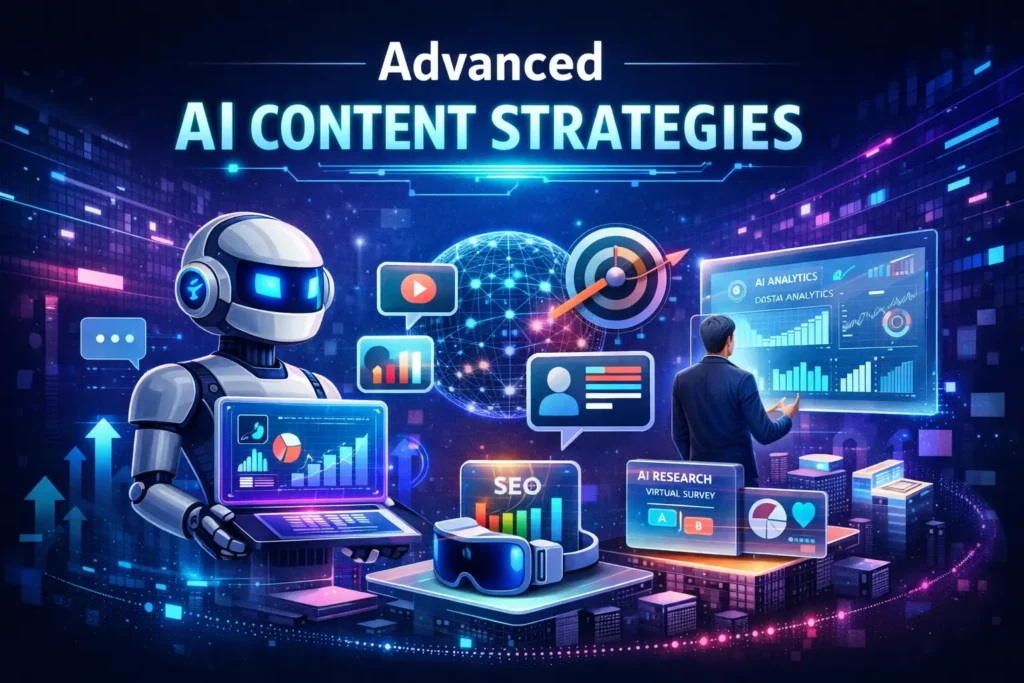
Beyond basics, sophisticated implementations:
AI Agent Systems
What They Are: Autonomous AI that perceives signals, makes decisions, executes actions, and iterates based on results—minimal human intervention.
Marketing Applications:
- Monitor social mentions, identify engagement opportunities, respond appropriately
- Analyze competitor content, identify gaps, suggest strategic responses
- Track performance metrics, identify declining content, trigger refresh workflows
- Detect market trends, generate timely content, publish across channels
Gartner Projection: By 2028, 33% of enterprise software applications will include agentic AI, enabling autonomous day-to-day marketing decisions.
Current Reality: Technology exists. Most teams haven’t built workflows to leverage it yet.
Synthetic Research
Emerging Capability: AI agents answer market research surveys as “synthetic respondents”—simulating target audience responses for faster insights.
Use Cases:
- Test messaging concepts before expensive research
- Explore audience segments quickly
- Validate assumptions about customer preferences
Caution: Supplement, don’t replace, real customer research. AI reflects training data patterns, not novel human insights.
Omnichannel Orchestration
The Vision: AI reconciles signals across web, apps, ads, email, retail—then times next action automatically.
McKinsey Insight: Personalization shifting from isolated use cases to end-to-end workflows requiring operational discipline.
Implementation: Most teams build toward this gradually rather than attempting overnight transformation.
Multimodal Search Optimization
The Change: Google processes 12 billion+ visual searches monthly with Lens. Voice search remains steady usage.
AI Strategy:
- Optimize for spoken queries
- Make products discoverable in visual search
- Structure content for AI Overview inclusion
- Build for “snapped or circled” queries
Action: Test how your content appears in AI search experiences across ChatGPT, Perplexity, Google AI Mode.
Learn about AI visibility tools for tracking content performance in AI search.
Common AI Content Marketing Mistakes
Avoid widespread errors:
Mistake 1: Publishing Raw AI Output
The Error: Generating content and publishing without editing, assuming “good enough.”
Why It Fails: AI produces competent drafts but requires human refinement for excellence. Brand voice, factual accuracy, strategic alignment all need verification.
The Fix: Always edit. Budget 20-40 minutes per 2,000-word piece minimum.
Mistake 2: No Quality Control Process
The Error: Trusting AI without systematic review.
Why It Fails: AI hallucinates facts, invents sources, produces generic content, misses brand nuance.
The Fix: Establish review workflows. Assign human editors. Maintain quality standards.
Mistake 3: Using AI Without Strategy
The Error: Adopting tools because they’re trendy without clear goals.
Why It Fails: Technology without strategy wastes resources and produces mediocre results.
The Fix: Start with business objectives. Choose AI capabilities supporting those goals.
Mistake 4: Over-Relying on AI for Everything
The Error: Believing AI can replace human judgment across all content decisions.
Why It Fails: AI excels at busywork but struggles with nuanced analysis. Powerful copilot for experts but dangerous autopilot for novices.
The Fix: Use AI for speed and scale. Reserve strategic decisions for humans.
Mistake 5: Ignoring Data Privacy
The Error: Feeding sensitive customer data into AI tools without governance.
Why It Fails: Creates legal liability, violates trust, potentially breaches regulations.
The Fix: Choose enterprise-grade AI platforms with clear data policies. Implement governance frameworks. Be transparent about AI usage.
Mistake 6: Not Training Team
The Error: Expecting team to use AI effectively without training or guidelines.
Why It Fails: AI tools require skill development. Teams without training produce poor results and blame the technology.
The Fix: Invest in training. Create clear guidelines. Share best practices. Celebrate wins.
Mistake 7: Chasing Every New Tool
The Error: Adopting every new AI tool that launches rather than mastering core capabilities.
Why It Fails: Tool overload creates confusion and prevents deep expertise development.
The Fix: Choose 2-3 core tools. Master them completely. Expand only when capabilities are fully leveraged.
Measuring AI Content Marketing Success
Track what matters:
Efficiency Metrics
Time Savings:
- Hours to create blog post (before vs. after AI)
- Content production volume (pieces per month)
- Team capacity freed for strategic work
Cost Reduction:
- Cost per content piece
- Total content budget efficiency
- ROI on AI tool investment
Quality Metrics
Engagement:
- Time on page
- Scroll depth
- Social shares
- Comment quality
SEO Performance:
- Organic traffic trends
- Ranking improvements
- Featured snippet captures
- Backlink acquisition
Business Impact
Lead Generation:
- Content-attributed leads
- Lead quality scores
- Conversion rates
Revenue Attribution:
- Content-influenced deals
- Customer lifetime value
- Sales cycle length
Brand Metrics:
- Brand awareness scores
- Share of voice
- Sentiment analysis
AI-Specific Metrics
Adoption:
- Percentage of content using AI
- Team AI literacy scores
- Tool utilization rates
Quality Control:
- Edit time required
- Content rejection rate
- Hallucination detection rate
The Future: What’s Next for AI Content Marketing
2026 and beyond:
Trend 1: From Tools to Systems eMarketer identifies shift from AI tools to AI agent systems as defining trend—composable, agent-first stacks replacing monolithic platforms.
Trend 2: Experience-First Content Google favors “experience-first” content. AI must incorporate genuine human experience and expertise to rank.
Trend 3: Real-Time Optimization AI adjusts campaigns mid-flight based on performance—swapping creatives, tuning bids, reallocating budget automatically.
Trend 4: Predictive Content Strategy AI forecasts which topics will trend, what content will perform, which formats will resonate—before creation.
Trend 5: Immersive AI Content Integration of AI with AR/VR creates interactive, deeply personalized content experiences.
The Constant: Human creativity, strategy, and oversight remain essential. AI amplifies human capability—it doesn’t replace it.
Conclusion: Transform AI from Hype to Infrastructure
AI content marketing in 2026 is not about replacing human marketers with chatbots. It’s about building content systems where AI handles research, production, optimization, and distribution—while humans focus on positioning, narrative, and quality control.
Key Takeaways:
- Brands using AI produce 5-10x more content at 60-80% lower cost
- 87% of teams still at “Level 1” (AI assistance vs. AI systems)
- High-quality AI drafts require 20-40 minutes editing for 2,000 words
- The 80/20 workflow: AI drafts (20% effort), humans refine (final 20% quality)
- 78% of businesses use generative AI in at least one function
- AI market in marketing will surpass $107 billion by 2028
- Quality control is non-negotiable—establish review workflows
- Start with clear goals and baseline metrics
- Choose 2-3 core tools, master them before expanding
- Measure efficiency, quality, and business impact—not just output volume
What To Do Now:
This Month: Document current content performance, set specific AI goals, choose 1-2 core tools Next 90 Days: Implement 80/20 workflow, establish quality control, train team This Year: Scale successful workflows, measure business impact, optimize continuously
The Bottom Line:
The question is no longer whether to use AI for content marketing. Teams not adopting AI fall behind rapidly. The question is how to use AI strategically—as infrastructure enabling better work rather than shortcut replacing thinking.
For comprehensive implementation guidance, read our related guides on how AI works, Claude vs. ChatGPT comparison, and AI content and Google.
Build your AI content system. Start today. Your competitors already have.