Your competitor just launched a product that undercuts your pricing by 30%. Another expanded into your top market. A third raised $50 million and is hiring aggressively. How did you miss this? More importantly, what are you going to do about it?
In February 2026, competitive pressure is rising dramatically. Yet according to Crayon’s 2025 report, 44% of companies admit having zero competitor visibility. Zero. They are operating blind while rivals systematically capture market share.
This is not just about watching competitors. It is about transforming market intelligence into strategic advantage. Companies running structured competitive analysis programs report higher revenue growth than those flying blind. The difference between winners and losers in 2026 often comes down to one factor: how well you understand the battlefield you are competing on.
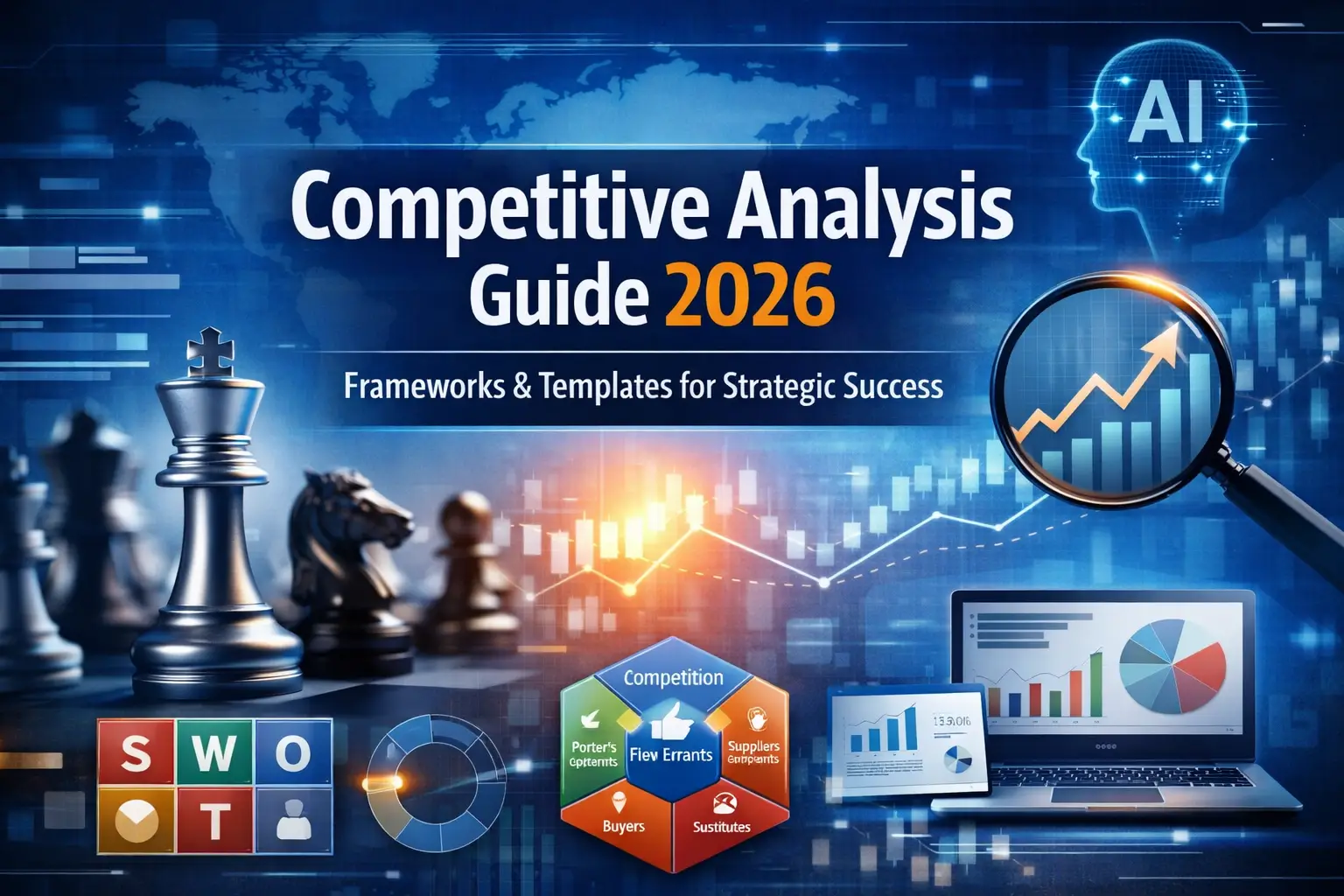
This comprehensive guide explains exactly what competitive analysis is, why it matters more than ever, the proven frameworks that work in 2026, and how to turn analysis into action. Whether you are a startup founder, marketing director, or business strategist, you will learn the practical steps to outmaneuver competitors systematically.
What Is Competitive Analysis?
Competitive analysis is the systematic process of identifying, evaluating, and understanding your competitors to make informed strategic decisions. It involves researching who your competitors are, what they offer, how they operate, and where they succeed or fail.
Simple Definition: Competitive analysis means studying your competitors to find opportunities you can exploit and threats you need to defend against.
Think of it like a sports team studying game film. Coaches do not just watch what opponents do—they analyze patterns, identify weaknesses, and develop specific plays to exploit those weaknesses. Business competitive analysis works the same way.
What Competitive Analysis Includes:
- Identifying direct and indirect competitors
- Analyzing their products, pricing, and positioning
- Evaluating their marketing strategies and messaging
- Understanding their strengths and weaknesses
- Tracking their market share and growth
- Monitoring their customer satisfaction
- Assessing their technology and capabilities
- Predicting their next moves
Understanding how to build a strong marketing plan requires competitive analysis as a foundational component.
Why Competitive Analysis Matters in 2026
The business environment changes faster than ever. What worked last quarter might fail next month. Here is why competitive analysis is critical right now:
The Market Moves Too Fast to Ignore
According to January 2026 research, keeping tabs on competitors is “more than just a business tactic, it’s a strategic necessity.” By conducting competitive landscape analysis, businesses uncover untapped market gaps competitors have overlooked.
Recent Changes Making Competition Fiercer:
- AI tools lower barriers to entry across industries
- Global remote work expands competitive reach
- Customer switching costs decrease continually
- Information spreads instantly through social media
- New funding rounds enable rapid competitor scaling
Revenue Impact Is Measurable
Businesses running structured competitive analysis programs see higher revenue growth according to Shopify’s 2026 data. This is not correlation—it is causation. Understanding competitors enables:
- Faster response to market changes
- Better product development decisions
- More effective pricing strategies
- Stronger marketing positioning
- Earlier identification of threats
Blind Spots Are Expensive
The 44% of companies with zero competitor visibility pay heavy prices:
- Market share losses they do not see coming
- Products that miss customer needs
- Marketing that fails to differentiate
- Pricing that leaves money on the table
- Strategic decisions based on incomplete information
As one 2026 analysis notes: “Competitors aren’t waiting for a quarterly review to poach your customers. It’s happening right now.”
Investor Expectations Include Competition
For startups, competitor analysis improves investor pitch deck effectiveness according to January 2026 research. Investors expect you to know:
- Who you are competing against
- Why customers choose you over alternatives
- How you will defend market position
- What competitive advantages are sustainable
Learn more about business growth strategies for long-term success that incorporate competitive intelligence.
Types of Competitive Analysis
Not all competitive analysis serves the same purpose. Different situations require different approaches:
Product Competitive Analysis
Focus: Features, functionality, user experience, technology, roadmap
When to Use: Before launching products, during development cycles, when competitors release updates
Key Questions:
- What features do competitors offer that we do not?
- Where is our product stronger?
- What user experience advantages exist?
- What technologies do they use?
- What is on their roadmap?
Marketing Competitive Analysis
Focus: Messaging, positioning, channels, content, campaigns
When to Use: Planning marketing strategy, developing campaigns, creating content
Key Questions:
- What messages resonate with their audience?
- Which channels drive their growth?
- What content performs best?
- How do they position against us?
- What campaigns are currently running?
SEO Competitive Analysis
Focus: Keywords, rankings, backlinks, content strategy, technical SEO
When to Use: Building content strategy, improving search visibility, identifying opportunities
According to the RACE framework from February 2026, competitive analysis in 2026 requires tracking traditional metrics plus AI visibility, LLM citations, and zero-click optimization. Ignoring these new frontiers means missing 30% of the competitive picture.
Key Questions:
- What keywords do they rank for?
- Where do their backlinks come from?
- What content types perform best?
- How is their technical SEO?
- Do AI tools cite them?
Pricing Competitive Analysis
Focus: Pricing models, tiers, discounts, value propositions
When to Use: Setting prices, adjusting strategy, packaging offerings
Key Questions:
- How do they price versus us?
- What pricing models do they use?
- What discounts do they offer?
- How do they communicate value?
- Where are pricing opportunities?
Strategic Competitive Analysis
Focus: Business models, partnerships, funding, expansion, capabilities
When to Use: Long-term planning, strategic decisions, market positioning
Key Questions:
- What is their business model?
- Who are their partners?
- How are they funded?
- Where are they expanding?
- What capabilities are they building?
The 5-Step Competitive Analysis Process for 2026
Based on current best practices, here is the proven process:
Step 1: Identify Your True Competitors
Do not just list business competitors. Identify SERP competitors—companies actually competing for visibility in your space.
Three Types to Consider:
Direct Competitors: Companies offering similar products to similar customers
- Same market segment
- Similar pricing
- Comparable features
- Direct alternatives
Indirect Competitors: Companies solving the same problem differently
- Different approaches to same need
- May become direct competitors
- Often innovate in ways to watch
Replacement Competitors: Alternatives customers consider
- Different solutions to same pain
- Budget competitors
- DIY or manual alternatives
How to Find Competitors:
Method 1: Google Search Search for your product or service. The top 10 results are likely competitors. As February 2026 guidance notes: “Start with 5-10 true SERP competitors, not just business competitors.”
Method 2: Customer Research Ask customers: “What other solutions did you consider?” Their answers reveal true competitive landscape.
Method 3: Category Sites Check G2, Capterra, or industry-specific directories listing alternatives.
Method 4: Funding Databases Use Crunchbase to find funded companies in your space.
Method 5: Social Listening Monitor industry hashtags and discussions to identify rising competitors.
Understanding branding strategies for modern businesses helps position against identified competitors.
Step 2: Gather Intelligence
Systematic data collection transforms guesswork into strategy.
Information to Collect:
Company Basics:
- Founding date and history
- Leadership team
- Company size
- Locations
- Funding and financials (if public)
Product/Service Details:
- Features and capabilities
- Pricing and packaging
- Technology stack
- User experience
- Product roadmap signals
Marketing Approach:
- Messaging and positioning
- Content strategy
- Channel mix
- Campaign types
- Brand voice
Customer Feedback:
- Review sites (G2, Trustpilot)
- Social media mentions
- Support interactions
- Case studies
Sales Process:
- Sales cycle length
- Demo approach
- Pricing negotiation
- Contract terms
Data Sources:
Primary Research:
- Buy competitor products
- Attend their webinars
- Download their content
- Mystery shop their sales
- Interview their customers
Secondary Research:
- Company websites
- Social media profiles
- Review platforms
- News articles
- Earnings calls (public companies)
- Job postings
- Patent filings
Tool-Assisted Research:
- SEMrush for SEO data
- SimilarWeb for traffic
- BuiltWith for tech stack
- Crunchbase for funding
- Glassdoor for employee insights
Step 3: Analyze Using Proven Frameworks
Raw data becomes strategic insight through systematic evaluation. As February 2026 guidance emphasizes: “Create a capability assessment framework comparing competitors across key dimensions.”
Framework 1: SWOT Analysis
SWOT (Strengths, Weaknesses, Opportunities, Threats) is the most common framework. A twist for 2026: Apply SWOT to competitors, not just yourself.
For Each Competitor, Identify:
Strengths: Advantages difficult to replicate
- Proprietary technology
- Exclusive partnerships
- Strong brand recognition
- Large customer base
- Financial resources
Weaknesses: Vulnerabilities you can exploit
- Product gaps
- Poor customer service
- High prices
- Slow innovation
- Limited markets
Opportunities: External factors favoring them
- Market growth
- Regulatory changes
- Technology trends
- Partnership potential
Threats: External factors challenging them
- New competitors
- Changing customer needs
- Economic conditions
- Technology disruption
Framework 2: Porter’s Five Forces
Porter’s framework analyzes industry structure and competitive intensity. According to CFA Institute’s 2026 curriculum, this framework interprets competitive environment systematically.
The Five Forces:
1. Competitive Rivalry: How intense is competition?
- Number of competitors
- Market growth rate
- Product differentiation
- Exit barriers
2. Threat of New Entrants: How easy is market entry?
- Capital requirements
- Economies of scale
- Brand loyalty
- Regulatory barriers
3. Bargaining Power of Suppliers: How much control do suppliers have?
- Number of suppliers
- Switching costs
- Importance of volume
- Availability of substitutes
4. Bargaining Power of Buyers: How much control do customers have?
- Number of buyers
- Switching costs
- Price sensitivity
- Product importance
5. Threat of Substitutes: What alternatives exist?
- Substitute availability
- Relative prices
- Switching ease
- Customer propensity to substitute
Framework 3: Competitive Positioning Matrix
Create a graph with X and Y axes representing the two most important competitive factors.
Common Axes:
- Price vs. Quality
- Features vs. Ease of Use
- Speed vs. Accuracy
- Automation vs. Control
Plot yourself and competitors on this matrix to visualize positioning and identify white space opportunities.
Framework 4: Feature Comparison Matrix
Create a spreadsheet comparing key features across competitors:
- List features down the left
- List competitors across the top
- Mark which features each offers
- Add pricing for context
This reveals gaps in competitor offerings and areas where you lead or lag.
Step 4: Extract Actionable Insights
Analysis without action wastes time. As Monday.com’s February 2026 guide emphasizes: “Focus analysis on actionable gaps, not just competitor features.”
Transform Analysis Into Strategy:
Messaging Refinement: Craft narratives highlighting advantages your analysis revealed
Product Priorities: Focus development on high-impact differentiators
Market Positioning: Define specific territory you will own in customers’ minds
Pricing Strategy: Adjust models to exploit competitor weaknesses while maintaining profitability
Key Insights to Extract:
Market Gaps: Unmet customer needs no competitor addresses adequately
Differentiation Opportunities: Areas where you can stand out meaningfully
Pricing Opportunities: Segments underserved at certain price points
Partnership Possibilities: Complementary offerings competitors lack
Acquisition Targets: Smaller competitors filling strategic gaps
Competitive Threats: Moves rivals might make requiring defense
Step 5: Execute and Monitor Continuously
Static analysis loses value quickly. As February 2026 best practices emphasize: “Build continuous intelligence systems, not periodic reports.”
Turn Insights Into Action:
Project Creation: Convert insights into tracked projects with:
- Clear owners
- Specific timelines
- Success metrics
- Resource allocation
Strategic Initiatives: Launch efforts addressing:
- Product improvements
- Marketing campaigns
- Pricing adjustments
- Partnership development
Monitoring Systems: Set up automated workflows tracking:
- Competitor website changes
- New product launches
- Pricing updates
- Marketing campaigns
- Content publishing
- Hiring patterns
Review Cadence:
Weekly: Monitor for immediate threats or opportunities
Monthly: Review key metrics and competitive moves
Quarterly: Deep analysis of strategic shifts and market changes
Annually: Comprehensive landscape assessment and strategy refresh
According to SEO competitive analysis guidance from February 2026: “Consistent quarterly deep-dives plus monthly monitoring create sustainable competitive advantage. Irregular analysis wastes time without strategic continuity.”
Learn more about marketing for business growth that incorporates continuous competitive monitoring.
2026-Specific Competitive Analysis Considerations
The competitive landscape evolved dramatically. Your analysis must account for these changes:
AI Visibility Tracking
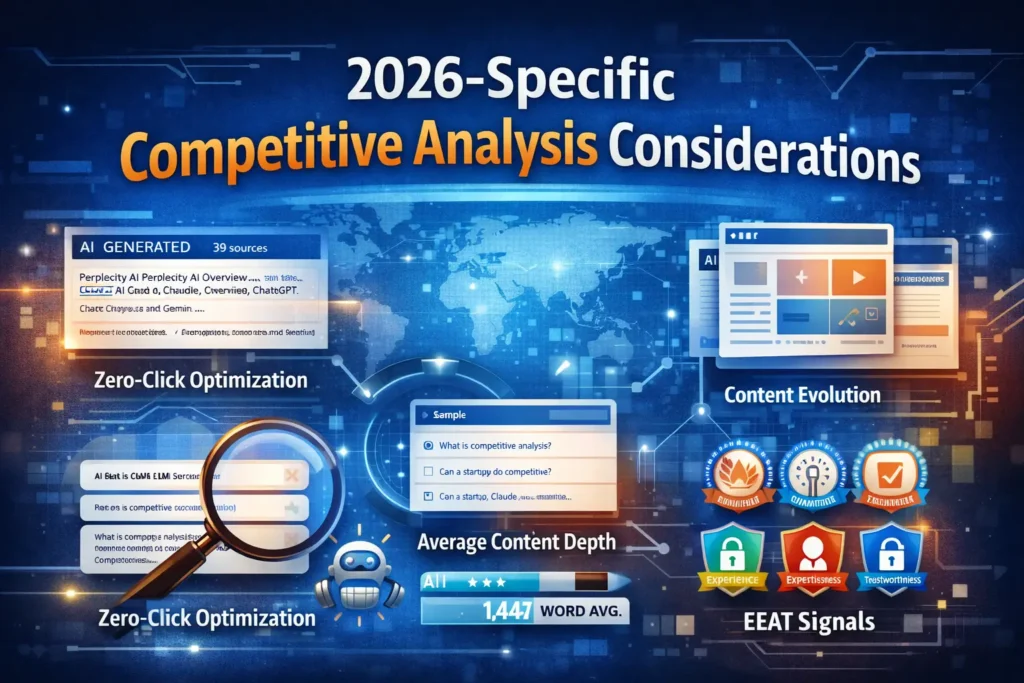
Traditional SEO metrics miss critical competitive intelligence. According to February 2026 research: “Competitive analysis in 2026 requires tracking traditional metrics plus AI visibility, LLM citations, and zero-click optimization.”
Track:
- ChatGPT search citations
- Perplexity AI references
- Google AI Overview appearances
- Claude and Gemini mentions
- LLM training data inclusion
Zero-Click Optimization
AI-generated content and rich results reduce organic CTR by 30% according to 2026 data. Every ranking position matters more.
Monitor:
- Featured snippet ownership
- Knowledge panel presence
- People Also Ask appearances
- Rich result eligibility
- Video snippet inclusion
Content Format Evolution
Google prioritizes pages combining text and video in 2026, giving users format choice. According to recent analysis: “If competitors include video tutorials and you don’t, you’re missing a ranking signal.”
Analyze:
- Video content integration
- Interactive tools (calculators, quizzes)
- Visual content (infographics, diagrams)
- Downloadable resources
- Community features
Average Content Depth
Webnyxt reports that average word count across top 10 results is about 1,447 words in 2026. Depth wins when topics demand it.
E-E-A-T Signals
Google emphasizes Experience, Expertise, Authoritativeness, and Trustworthiness. Competitors winning in YMYL topics demonstrate:
- Author credentials with relevant expertise
- Real case studies and examples
- Original research and data
- Expert quotes and interviews
- Trust badges and certifications
Common Competitive Analysis Mistakes
Avoid these pitfalls that waste time without generating value:
Mistake 1: Analysis Paralysis
Trying to track everything about everyone results in overwhelm and inaction.
Solution: Focus on 5-10 true competitors and the metrics that matter most for your goals.
Mistake 2: Copying Without Understanding
Seeing competitors do something and copying it without understanding why or if it works.
Solution: Analyze the strategy behind tactics. Test before full commitment.
Mistake 3: Irregular Monitoring
Conducting analysis once and never updating it.
Solution: Build continuous monitoring systems with regular review cadence.
Mistake 4: Ignoring Indirect Competitors
Focusing only on direct competitors misses threats from adjacent markets.
Solution: Map the full competitive ecosystem including indirect and replacement competitors.
Mistake 5: No Action Plan
Creating detailed reports that sit unused.
Solution: Connect every insight to specific actions with owners and deadlines.
Mistake 6: Wrong Competitors
Analyzing business competitors instead of SERP competitors who actually compete for your customers.
Solution: Start with who appears when customers search for solutions.
Mistake 7: Missing New Frontiers
Tracking only traditional metrics while competitors win on AI, voice, or video.
Solution: Evolve tracking to include emerging channels and formats.
Tools for Competitive Analysis in 2026
The right tools make analysis efficient and continuous:
SEO and Content Tools
SEMrush: Keyword research, backlink analysis, traffic estimates, competitive keywords
Ahrefs: Backlink profiles, organic search traffic, content gap analysis, rank tracking
Moz: Domain authority, link analysis, keyword tracking, SERP features
Clearscope or Surfer SEO: Content optimization, topic coverage, semantic analysis
Market Intelligence Tools
Crayon: Competitive intelligence automation, real-time competitor tracking, insights delivery
Kompyte: Automated competitive monitoring, sales battlecards, competitive insights
Klue: Competitive intelligence platform, insights distribution, win-loss analysis
Website Analysis Tools
SimilarWeb: Traffic estimates, traffic sources, audience insights, competitive benchmarking
BuiltWith: Technology stack identification, tool usage, platform detection
Wappalyzer: Website technology profiler, competitive tech analysis
Social Listening Tools
Brandwatch: Social media monitoring, sentiment analysis, trend identification
Sprout Social: Social listening, competitor analysis, engagement tracking
Mention: Brand monitoring, competitor tracking, social media alerts
Customer Intelligence Tools
G2: Software reviews, competitive comparisons, buyer insights
Trustpilot: Customer reviews, satisfaction ratings, feedback analysis
Glassdoor: Employee reviews, company culture, salary insights
AI-Powered Analysis
SEOZilla: AI agents crawling competitor sites, automated content analysis, pattern detection
ChatGPT/Claude: Analyzing competitor content, summarizing findings, identifying patterns
Many tools offer free or entry-level plans for startups with budget constraints, as noted in February 2026 guidance.
Competitive Analysis Template
Here is a practical template you can use:
Company Overview
- Name:
- Website:
- Founded:
- Headquarters:
- Company Size:
- Funding:
Products/Services
- Core Offerings:
- Key Features:
- Pricing:
- Target Market:
Market Position
- Market Share:
- Growth Rate:
- Geographic Presence:
Marketing Strategy
- Key Messages:
- Channels Used:
- Content Types:
- Campaign Frequency:
SEO Performance
- Organic Traffic:
- Top Keywords:
- Domain Authority:
- Backlink Profile:
Customer Feedback
- Review Ratings:
- Common Complaints:
- Common Praise:
Strategic Implications
- Opportunities:
- Threats:
- Recommended Actions:
Conclusion: From Analysis to Advantage
Competitive analysis is not academic exercise—it is strategic weapon. In February 2026, with 44% of companies having zero competitor visibility, systematic competitive intelligence creates measurable advantages.
Key Takeaways:
- Competitive analysis transforms market uncertainty into strategic clarity
- 44% of companies have zero competitor visibility (Crayon 2025)
- Structured programs correlate with higher revenue growth
- Start with 5-10 true SERP competitors
- Use proven frameworks (SWOT, Porter’s Five Forces, Positioning Matrix)
- Track 2026-specific factors (AI visibility, zero-click, E-E-A-T)
- Focus on actionable gaps, not just feature lists
- Build continuous monitoring, not periodic reports
- Connect insights to projects with owners and deadlines
- Average top 10 content is 1,447 words in 2026
- AI reduces organic CTR by 30%, making every position crucial
What This Means for Your Business:
Competitors are not waiting for you to catch up. Every day without competitive intelligence is a day you make decisions blind while rivals operate with clarity.
Start small: Pick your top 5 competitors. Choose one framework. Gather basic intelligence. Extract one actionable insight. Execute one improvement. Then expand systematically.
The goal is not perfection—it is progress. As February 2026 research concludes: “Competitive analysis transforms this uncertainty into strategic advantage. By systematically monitoring, analyzing, and responding to competitor activities, you gain intelligence needed to make informed decisions.”
Your competitors are studying you. The question is whether you are studying them back—and doing it better.