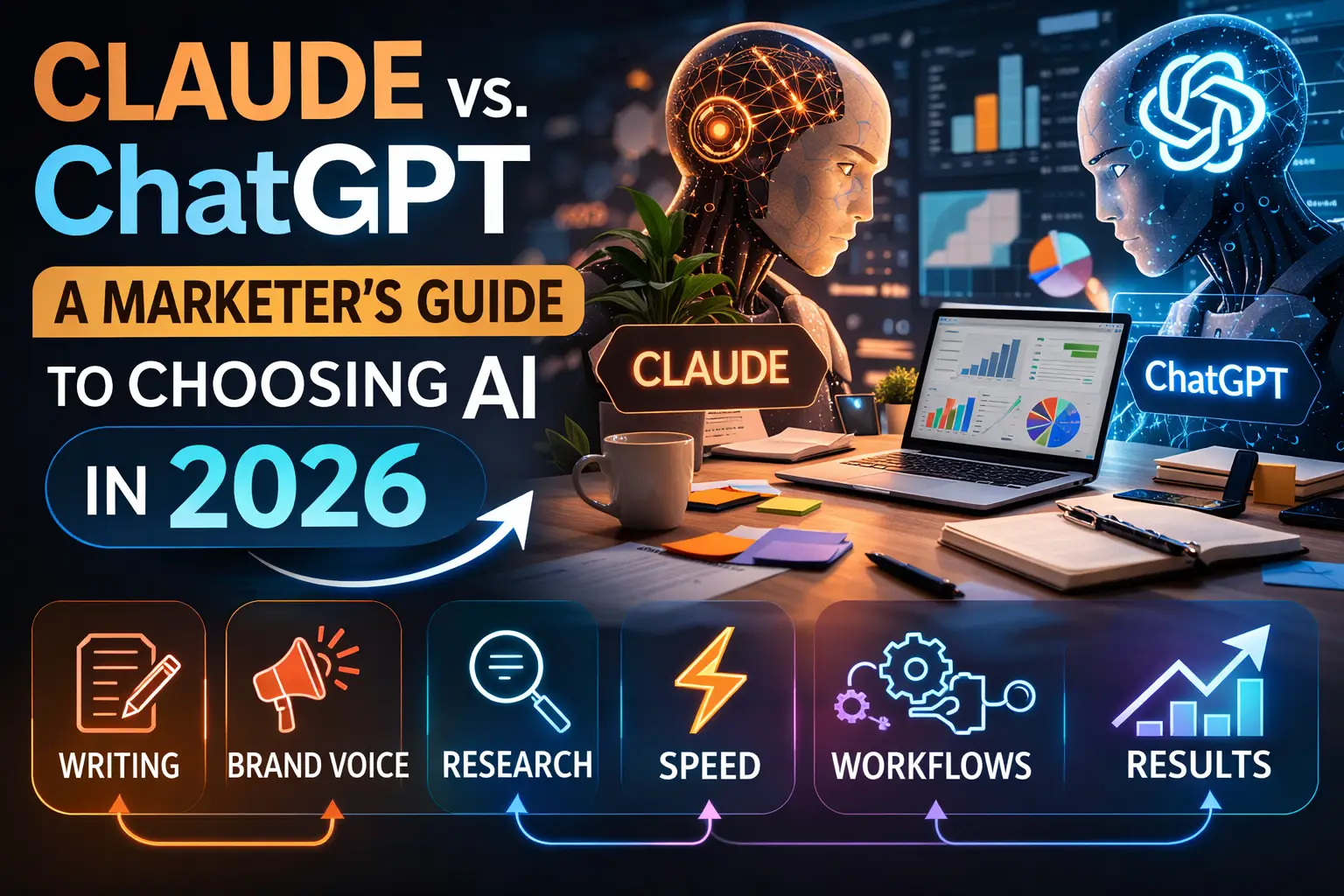
“What’s better: Claude or ChatGPT?” is the question every marketer asks. But it’s the wrong question.
According to February 2026 research, 80% of marketers prefer Claude’s output for customer-facing copy like emails and ads, yet few have fully switched from ChatGPT. The reason isn’t quality—it’s workflow dependencies. Custom GPTs, existing projects, team systems built inside ChatGPT.
The sophisticated truth? Most successful marketing teams stopped debating which tool wins. They built what industry experts call an “LLM stack”—using Claude for writing depth and brand consistency, ChatGPT for multi-format speed and team collaboration, switching strategically based on task requirements.
ChatGPT holds 60% of the U.S. generative AI chatbot market and processes over 1 billion queries daily from approximately 800 million weekly users. Meanwhile, Claude captures 29% of the enterprise AI assistant market and is used by 70% of Fortune 100 companies for professional work through API integrations.
This comprehensive guide examines both platforms across criteria that matter for marketing: writing quality, brand voice control, research capabilities, workflow integration, pricing, and the subjective but significant “feel” factor. You will see real use cases, understand where each tool excels, and learn how to build workflows that use both strategically.
Whether you manage content creation, run campaigns, or lead marketing strategy, this guide transforms the binary “which is better?” into the actionable “which tool for which task?”
Understanding the Fundamental Differences
Before comparing specific features, grasp what makes these platforms fundamentally different:
Architecture and Design Philosophy
ChatGPT (OpenAI): Built on GPT-4o and GPT-5 models, optimized for conversational flow, creative ideation, and multimodal capabilities. Prioritizes versatility, accessibility, and rapid iteration.
Claude (Anthropic): Built on proprietary Constitutional AI models (Claude 3.x, 3.5, and 4.6), optimized for safety, analytical depth, and context handling. Prioritizes thoughtful responses, accuracy, and enterprise reliability.
The Philosophy Gap: ChatGPT’s design favors breadth—handling diverse tasks across formats quickly. Claude’s design favors depth—providing nuanced, careful responses with consistent quality.
Market Position and User Base
ChatGPT’s Dominance:
- 60% of U.S. generative AI chatbot market
- 800 million weekly active users
- 1 billion+ daily queries
- Broad consumer adoption
Claude’s Professional Focus:
- 29% of enterprise AI assistant market
- 70% of Fortune 100 companies use it
- 3.5% consumer market but strong professional usage
- Preferred by developers and technical users
What This Means: ChatGPT is where volume lives. Claude is where many high-value professional evaluations happen.
How They Approach Recommendations Differently
ChatGPT: Tends toward breadth in recommendations. When asked “what’s the best marketing automation tool?” it provides comprehensive lists covering multiple categories, sometimes 5-10 options with balanced pros/cons.
Claude: Tends toward depth and qualification. Same question yields fewer options but with more nuanced analysis of specific use cases, often pushing back with clarifying questions before recommending.
Impact on Marketing: Neither approach is universally better, but they have different implications for how your brand gets represented when prospects ask AI for recommendations.
Understanding AI marketing predictions provides broader context.
Head-to-Head Comparison: Marketing Use Cases
Detailed evaluation across critical marketing workflows:
Writing Quality and Natural Language
The Test: Same prompt to both platforms: “Write an email introducing our new enterprise CRM feature that improves sales forecasting.”
Claude’s Approach: Produces writing that “sounds like a person thinking through an idea, not assembling marketing phrases.” Varies sentence rhythm naturally. Uses conversational transitions. According to G2 users, Claude’s natural conversation scores 9.5/10.
Example Claude Output Style: “You know that moment when a deal you thought was solid suddenly goes cold? That uncertainty costs time, resources, and trust with leadership. Our new forecasting feature eliminates it.”
ChatGPT’s Approach: Produces clean, scannable copy that gets to the point quickly. More structured and organized. Efficient but sometimes formulaic.
Example ChatGPT Output Style: “Introducing Advanced Sales Forecasting—your solution for accurate pipeline predictions. Key benefits include: [bullet points follow]”
The Verdict: Claude wins on natural language. If you care about prose that reads well aloud and varies in rhythm, Claude is better choice. ChatGPT produces clean, efficient copy, but prioritizes structure over natural flow.
When to Use Claude:
- Long-form content (blog posts, whitepapers, case studies)
- Email sequences requiring personalization
- Brand storytelling
- Content requiring emotional resonance
When to Use ChatGPT:
- Social media posts (quick, punchy)
- Ad copy requiring multiple variations
- Structured content (listicles, how-tos)
- High-volume content production
Brand Voice Consistency
Claude’s Strength: Maintains consistent brand voice across longer content pieces. Marketing teams report Claude “feels like an extension” of their work while maintaining IP protection—critical for proprietary campaign data.
How It Works: Upload brand guidelines, sample content, style guides into Claude’s large context window (200K tokens for Sonnet, 500K for Enterprise, 1M for upcoming Opus 4.6). Claude references these throughout conversations without re-prompting.
ChatGPT’s Strength: Custom GPTs let you build reusable tools with embedded instructions, uploaded brand guidelines, and preset workflows. Once configured, a Custom GPT remembers tone, terminology, and formatting preferences.
Key Difference: Claude maintains voice through comprehensive context understanding. ChatGPT maintains voice through structured configuration and memory features.
Real-World Feedback: According to recent testing, 80% of marketers prefer Claude for customer-facing copy (emails, Facebook ads) because it avoids predictable corporate patterns often found in ChatGPT.
Best Practice: Use Claude for maintaining sophisticated brand voice across lengthy content. Use Custom GPTs in ChatGPT for repeatable workflows with specific voice requirements.
Content Creation Speed
ChatGPT Wins: Generally faster for rapid ideation and multiple variations.
The Data: In 2026 testing, ChatGPT produced social media variations 30-40% faster than Claude when asked for 10 different approaches to same message.
Claude’s Trade-off: Slightly slower but more thoughtful. Takes time to consider nuance, which improves quality but reduces speed.
Strategic Use:
- ChatGPT: Brainstorming sessions, rapid content variations, quick first drafts
- Claude: Final polish, strategic content, anything representing brand publicly
Context Handling and Long Documents
Claude’s Massive Advantage:
- Claude 3.x/3.5 Sonnet: 200,000 tokens (~150,000 words)
- Claude Enterprise: 500,000 tokens
- Claude Opus 4.6: 1,000,000 tokens (~750,000 words)
What This Enables:
- Analyze entire content libraries in one session
- Reference complete brand guideline documents
- Process comprehensive research reports
- Maintain context through extended conversations
ChatGPT’s Capability: Large context windows in GPT-4o and ChatGPT Plus/Team/Enterprise support substantial documents effectively, though generally smaller than Claude’s capacity.
When Claude’s Context Wins: According to enterprise users, when buyers do serious due diligence—asking follow-up after follow-up in single thread—Claude is often the model they use. The context window allows deep, sustained investigation without losing thread.
Practical Example: Marketing team uploads: annual report (50 pages), brand guidelines (30 pages), competitor analysis (40 pages), customer research (60 pages). Total: 180 pages.
- Claude: Handles entire set, references all simultaneously
- ChatGPT: May require breaking into chunks or multiple sessions
Research and Fact-Checking
Claude’s Reputation: Generally regarded as more cautious about stating things it doesn’t know. When Claude lacks information, it’s more likely to say so explicitly rather than provide confident (but potentially incorrect) answer.
ChatGPT’s Approach: More willing to provide answers even with uncertainty, which can be helpful for ideation but risky for fact-sensitive content.
Testing Results: In data analysis challenges with real marketing data, users report preferring “Claude’s plainer style over ChatGPT’s embellishments” when accuracy matters most.
Best Practice:
- Critical Facts: Use Claude, then verify
- General Research: Either works, but verify claims
- Creative Ideation: ChatGPT’s confidence can spark ideas
Important Note: According to testing, both models hallucinate when making deliverables from insights. A prompt around “funnel metrics to monitor” made up columns that didn’t exist in data but looked plausible. Always verify AI claims.
Multimodal Capabilities
ChatGPT’s Clear Win: Integrates DALL-E for seamless AI image generation. Perfect for visual tasks like creating marketing assets, illustrations, infographics.
Example: Prompt “Generate an image of a futuristic workspace” yields detailed, customizable results immediately within same interface.
Claude’s Limitation: Lacks built-in image generation. Relies on text descriptions or requires external tools for visual content.
Testing Data: In 2026 blind test, ChatGPT produced more vibrant and on-prompt images compared to alternatives, scoring higher in user satisfaction for visual creativity.
When This Matters:
- Social media teams creating visual content
- Marketing campaigns requiring rapid mockups
- Presentations needing quick illustrations
- Content requiring images and text integration
Claude Alternative: For image analysis and understanding, Claude handles uploaded images well. For generation, teams pair Claude with separate image tools.
Code and Technical Implementation
Claude’s Superiority for Code: 2026 benchmarks highlight Claude’s advantages:
- Larger context window manages large codebases better
- Claude Code feature enables direct code execution
- More accurate with complex logic
- Better at explaining code decisions
Example Use Case: Building custom marketing analytics dashboard, implementing tracking pixels, creating automated reporting scripts.
ChatGPT’s Capability: Solid for general coding tasks and quick scripts. Integrated Code Interpreter feature handles data analysis and visualization well.
Marketing Relevance: Technical marketers and marketing ops teams often prefer Claude for building sophisticated tools, automations, and integrations.
Learn about how AI is reshaping development for technical context.
Pricing and Access
ChatGPT Pricing (2026):
- Free tier (with limitations)
- ChatGPT Go: $8/month (includes ads)
- ChatGPT Plus: $20/month
- ChatGPT Team: $30/user/month
- ChatGPT Enterprise: Custom pricing
- ChatGPT Pro: $200/month (power users)
Claude Pricing (2026):
- Free tier (limited usage)
- Claude Pro: $20/month
- Claude Team: $30/user/month
- Claude Enterprise: Custom pricing
Key Difference: OpenAI testing advertisements in free and basic tiers. Anthropic committed to remaining ad-free, which appeals to marketers concerned about data usage.
Value Assessment: For most marketing teams, both platforms’ professional tiers ($20-30/month per user) provide similar value. Decision comes down to feature priorities rather than cost.
The Strategic LLM Stack Approach
Rather than choosing one platform, sophisticated marketing teams build multi-tool workflows:
Recommended Division of Labor
Use Claude For:
- Long-form content editing and refinement
- Brand-critical customer-facing copy
- Strategic analysis requiring depth
- Complex document analysis
- Content requiring nuanced voice
- Enterprise documentation
Use ChatGPT For:
- Rapid ideation and brainstorming
- Social media content variations
- Email subject line testing
- Image generation needs
- Quick first drafts
- Team collaboration via Custom GPTs
The 80/20 Rule in Practice
According to marketing practitioners, this workflow delivers best results:
- ChatGPT for Drafting (20% effort, 80% speed): Generate initial concepts, outlines, multiple variations quickly
- Claude for Refining (80% quality, final 20%): Polish drafts, ensure brand voice, add strategic depth, prepare for publication
Why It Works: Leverages each platform’s core strength. ChatGPT’s speed gets content to 80% completion fast. Claude’s quality takes final 20% from “good enough” to “genuinely excellent.”
Workflow Integration
Tools That Enable LLM Stacks:
- Copy content between platforms
- Use APIs for programmatic access
- Leverage both platforms’ native integrations
- Build team processes acknowledging both tools
Team Adoption: Marketing teams report successful adoption when:
- Clear guidelines establish which tool for which task
- Templates reduce decision fatigue
- Training emphasizes strategic use, not tool worship
- Regular review optimizes approach based on results
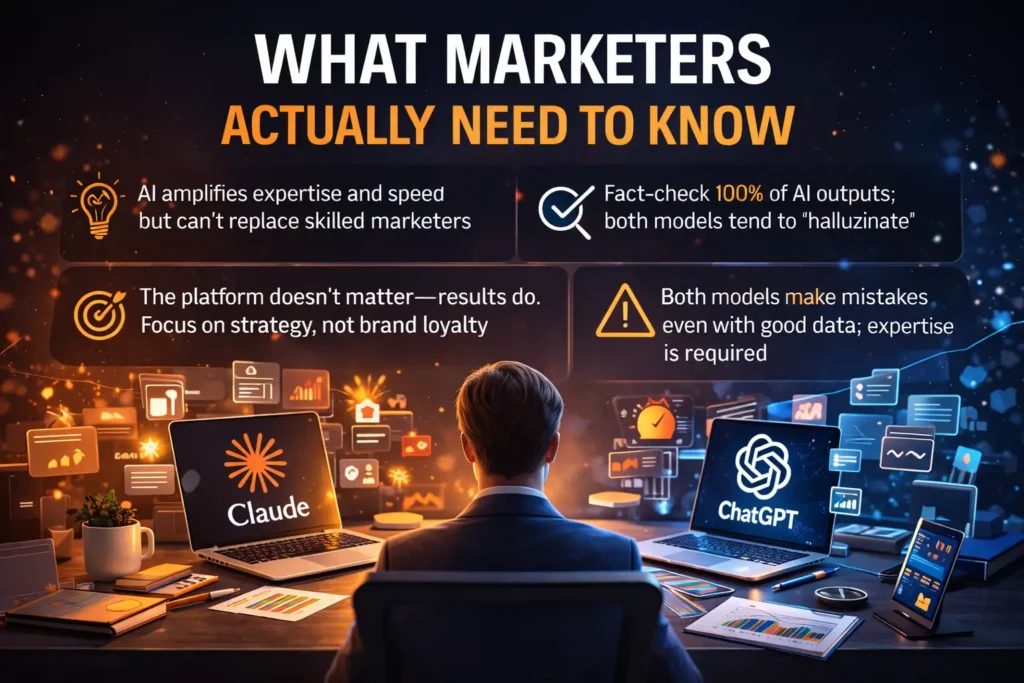
What Marketers Actually Need to Know
Beyond features, understand strategic implications:
AI Models Compress Entire Buying Journey
The Old Way: Prospect searches “best marketing automation tool” → Gets list of links → Does own research across multiple sites → Makes decision
The 2026 Way: Prospect asks ChatGPT or Claude “best marketing automation tool” → Keeps asking follow-ups in same conversation → Gets recommendation → Makes decision
Critical Insight: Both models now compress weeks of research into single conversation. Your brand must appear correctly in these conversations, regardless of which platform prospects use.
What Each Model Says About Your Brand Matters
The question isn’t just “which AI is better?” It’s “which AI is your buyer using, and what is that AI telling them about you?”
The Strategic Shift: As AI models become primary way buyers research categories, compare vendors, and make purchasing decisions, marketers must ensure accurate brand representation across all major platforms.
How to Audit: Test how both ChatGPT and Claude describe your brand, products, and positioning. Ask the questions your prospects would ask. Fix gaps and inaccuracies through better content, stronger online presence, and clearer differentiation.
Learn about AI visibility tools for tracking brand representation.
Neither Tool Replaces Marketing Expertise
Testing Verdict: LLMs excel at busywork but struggle with nuanced analysis. They’re powerful copilots for experts but potentially dangerous autopilots for novices.
What This Means:
- Use AI to work faster, not to replace thinking
- AI gets you to 80% done; human intervention required for final 20%
- Templating prompts doesn’t have magical results some claim
- Deep expertise + AI tools = exceptional output
- No expertise + AI tools = mediocre or wrong output
Data Quality Determines AI Utility
The Challenge: Both Claude and ChatGPT struggle with undirected analysis and unprocessed data. Real-world marketing data has interrelationships that create superficial insights without expert guidance.
Examples of Useless AI Insights:
- “Campaign name had strongest correlation with daily spend” (obvious, not useful)
- “Results count has strongest correlation with cost per results” (true but meaningless)
Solution: Provide clean, structured data with clear questions. Guide AI toward meaningful analysis rather than expecting it to discover insights independently.
Common Mistakes and How to Avoid Them
Mistake 1: Treating AI Output as Final
The Error: Publishing AI-generated content without editing, assuming it’s “good enough.”
Why It Fails: Both platforms produce competent drafts but require human refinement for excellence. Brand voice, factual accuracy, strategic alignment all need verification.
Mistake 2: Using Wrong Tool for Task
The Error: Using ChatGPT for content requiring deep brand voice consistency, or Claude for rapid social media variations.
Solution: Match tool to task based on strengths. Use decision framework in this guide.
Mistake 3: Not Customizing for Brand
The Error: Using generic prompts without providing brand context, guidelines, or examples.
Solution: Upload brand materials, provide clear instructions, reference past successful content. Both platforms improve dramatically with context.
Mistake 4: Ignoring Fact-Checking
The Error: Trusting AI-generated statistics, claims, or examples without verification.
Solution: Verify all factual claims, especially data, statistics, and specific examples. AI hallucinates confidently.
Mistake 5: Expecting Magic from Prompts
The Error: Believing perfect prompt templates unlock exceptional results automatically.
Reality: According to testing, templating prompts doesn’t have magical effects. Results depend more on task clarity, data quality, and human expertise than prompt engineering.
Mistake 6: Choosing Based on Others’ Recommendations
The Error: Adopting tool because competitors, influencers, or consultants recommend it without testing for your specific needs.
Solution: Trial both platforms with your actual workflows, brand materials, and team processes. Best choice is situational.
Mistake 7: Building Entire Workflow Around One Platform
The Error: Committing exclusively to single platform, missing benefits of strategic multi-tool approach.
Solution: Build LLM stack leveraging strengths of multiple tools based on task requirements.
Conclusion: The Real Answer
Claude vs. ChatGPT for marketing isn’t binary choice. It’s strategic allocation based on task requirements, team needs, and workflow integration.
Key Takeaways:
- 80% of marketers prefer Claude for customer-facing copy
- ChatGPT holds 60% consumer market; Claude dominates enterprise (70% of Fortune 100)
- Claude wins: Natural writing, brand voice consistency, context handling, thoughtful analysis
- ChatGPT wins: Speed, multimodal capabilities, rapid ideation, visual content
- Best approach: Use both strategically (ChatGPT drafts, Claude refines)
- AI compresses buying journey into single conversation—your brand must appear correctly
- Neither tool replaces expertise; they amplify it
- Fact-check everything; both platforms hallucinate
- Test with your workflows before committing
What To Do Now:
- Trial Both: Test ChatGPT and Claude with your actual content and workflows
- Define Use Cases: Map which platform serves which marketing tasks best
- Build Guidelines: Create team processes specifying tool selection criteria
- Train Team: Ensure marketers understand strategic deployment, not just features
- Audit Brand Presence: Check how both platforms describe your brand
- Measure Results: Track quality, speed, and business outcomes
The Bottom Line:
The question “which is better?” misses the point. Claude and ChatGPT excel at different things. Sophisticated marketers stopped debating and started deploying both strategically.
For comprehensive AI strategy, read our guide on how AI content affects Google.
Build your LLM stack. Use the right tool for each job. Focus on results, not platform loyalty.