“I’m paying $20/month for AI, but am I using the right one?”
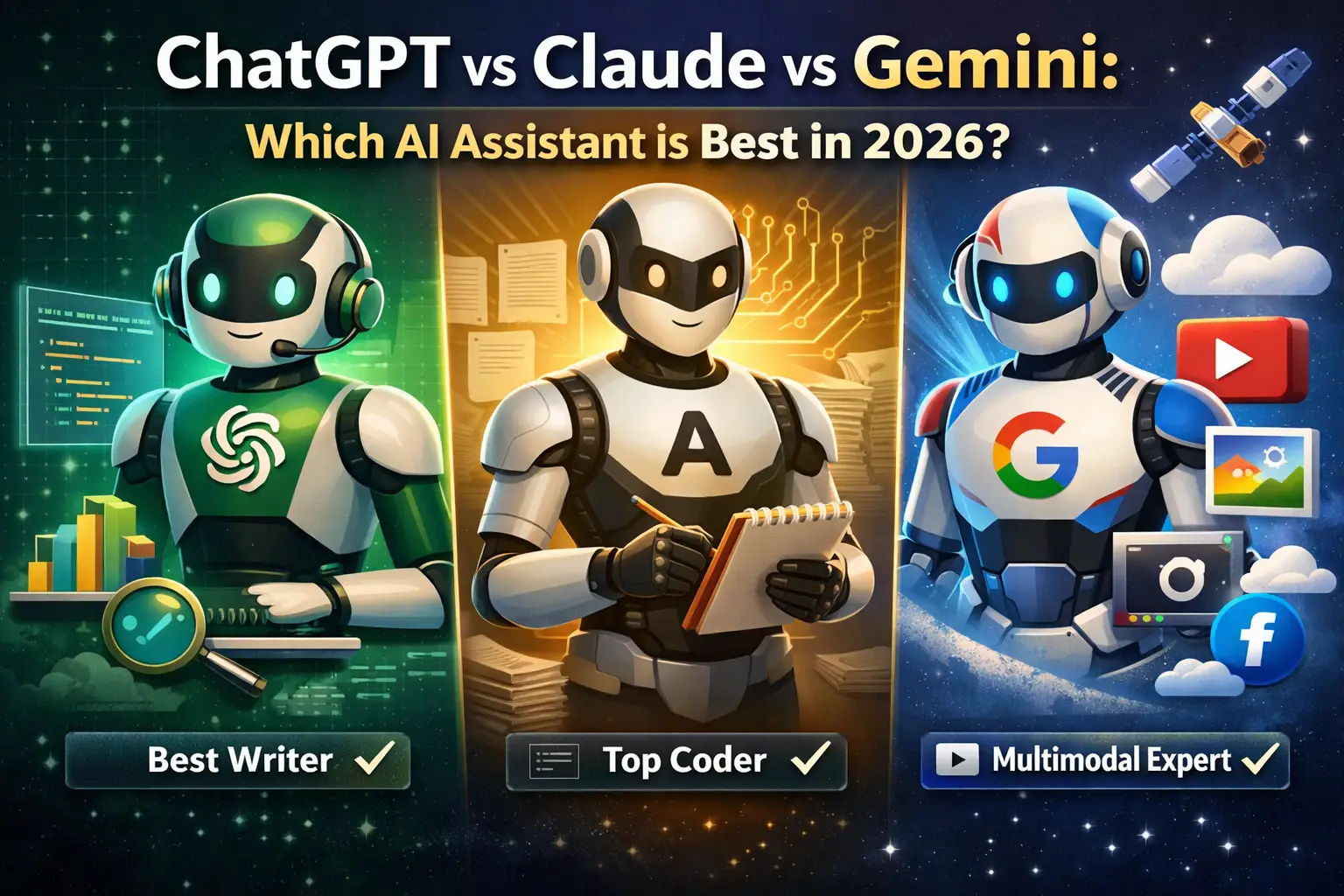
After blind testing ChatGPT, Claude, and Gemini across 8 different prompts with 100+ voters in February 2026, the results surprised everyone: Claude won 4 rounds, Gemini took 3, and ChatGPT—the only AI most people have heard of—won exactly once. When Claude won writing tasks, it dominated by 35-54 point margins. Yet ChatGPT commands 200 million weekly users while many still treat Gemini as an afterthought.
The disconnect reveals a fundamental truth: brand recognition doesn’t equal capability. Most users stick with ChatGPT because they’ve never seriously tested alternatives. Meanwhile, developers report Claude’s 80.9% SWE-bench Verified score crushes ChatGPT’s 70% and Gemini’s 65% for coding tasks. Google Workspace power users find Gemini’s native integration saves hours daily. Each AI excels at different strengths, yet 76% of users subscribe to just one without comparing.
This comprehensive guide reveals exactly which AI assistant wins for specific tasks in 2026, comparing ChatGPT, Claude, and Gemini across writing quality, coding performance, research capabilities, pricing, features, and real-world workflows. You will see blind test results showing what actual users prefer, benchmark data revealing technical performance, and decision frameworks matching AIs to use cases rather than marketing claims.
Whether you’re choosing your first AI subscription, evaluating if you should switch, or wondering if paying $20/month makes sense, this guide transforms confusion into confident selection backed by testing data rather than hype.
Understanding the Three Major AI Assistants (2026)
Before comparing performance, understand what each AI actually is:
ChatGPT (OpenAI)
Current Model: GPT-4.5, GPT-5.2 (Pro tier)
Creator: OpenAI (backed by Microsoft)
Best Known For: Versatility, conversational ability, largest user base
Market Position: 200 million weekly active users, most recognized AI brand
Core Strength: General-purpose assistant handling mixed workflows—drafting, analysis, research, coding—in single sessions without app switching
Unique Features:
- Memory (learns preferences across conversations)
- DALL-E image generation integration
- Custom GPTs (personalized AI assistants)
- Web browsing and research
- Voice Mode for natural conversation
- Code Interpreter for data analysis
Target User: Individual professionals and teams wanting one versatile tool for diverse tasks
Learn about AI marketing predictions showing ChatGPT’s commercial impact.
Claude (Anthropic)
Current Model: Claude 4.5 Sonnet, Claude 4.6 Opus
Creator: Anthropic (founded by former OpenAI researchers)
Best Known For: Writing quality, coding accuracy, long-context understanding
Market Position: Developer favorite, 53% of developers use Claude for code
Core Strength: Sustained long-form writing and iterative refinement with superior factual accuracy and lower hallucination rates
Unique Features:
- 200K-500K token context window (processes hundreds of pages)
- Extended thinking mode for complex reasoning
- Claude Code (agentic coding tool)
- Claude Cowork (desktop automation)
- Artifacts (interactive workspaces)
- Strong ethical guardrails
Target User: Knowledge workers, developers, and teams prioritizing quality over speed for technical and creative content
Gemini (Google)
Current Model: Gemini 3 Pro, Gemini 3 Flash
Creator: Google DeepMind
Best Known For: Multimodal capabilities, Google ecosystem integration, speed
Market Position: #1 searched AI term globally in 2025, fastest-growing adoption
Core Strength: Native integration with Google Workspace (Gmail, Docs, Sheets, Drive) enabling in-context productivity without app switching
Unique Features:
- 1 million+ token context window (largest available)
- Fastest response times
- Multimodal understanding (text, images, video, audio)
- Deep Google ecosystem integration
- Veo 3 video generation
- Nano Banana image generation
- Agent mode for web automation
Target User: Google Workspace users and teams requiring multimodal processing with productivity tool integration
Blind Test Results: What Users Actually Prefer (February 2026)
Real performance data from user voting:
Test Methodology
Setup: 134 participants evaluated 8 different prompts across writing, strategy, and creative tasks
Blind Protocol: Outputs stripped of branding, randomized order, no hints about which AI generated what
Prompt Types:
- Creative writing (storytelling, dialogue)
- Professional writing (business memos, explanations)
- Strategic thinking (competitive analysis, recommendations)
- Technical content (process documentation)
Voting: Participants selected best output per round without knowing AI source
Overall Results
🥇 Claude: 4 wins (Rounds 1, 2, 5, 6) 🥈 Gemini: 3 wins (Rounds 3, 7, 8) 🥉 ChatGPT: 1 win (Round 4)
Victory Margins
When Claude Won: Dominated by 35-54 points (overwhelming preference)
When Gemini Won: Closer contests, 3-11 point margins (competitive but clear)
When ChatGPT Won: 53% on strategic round, 25 points ahead (decisive in its category)
Key Patterns
Claude’s Dominance: Writing rounds weren’t even close—Claude produced most human-sounding, natural copy
ChatGPT’s Strength: Analytical/strategic round was ChatGPT’s one win, suggesting strength in structured business reasoning
Gemini’s Consistency: Never dominated but never bombed—steady second or first place across every category
The Takeaway: If Claude is the writer and ChatGPT is the strategist, Gemini is the generalist who’s never the worst choice for any task.
Head-to-Head Performance Comparison
Detailed capability analysis:
Writing Quality and Tone
Claude Wins Writing:
- Produces most human-sounding copy in blind tests (80% preference for customer-facing content)
- Excels at maintaining logical flow in long-form content
- Superior at nuanced, thoughtful writing requiring minimal editing
- Best for blog posts, white papers, case studies, thought leadership
- Strong at creative exercises (dialogue, fiction, storytelling)
ChatGPT Strengths:
- More versatile across different content types
- Better at brainstorming and ideation (generates 20+ variations quickly)
- Excellent conversational tone for casual content
- Strong at headlines and short-form marketing copy
Gemini Position:
- Solid all-around performance without specialization
- Good for summaries and structured content
- Fastest content generation speed
- Better at data analysis writing than creative prose
Editing Requirements: Marketing teams report 30-40% less editing time on Claude outputs versus ChatGPT or Gemini for quality content.
Coding and Technical Performance
Claude Dominates Coding:
SWE-bench Verified (Real-World Coding):
- Claude: 80.9%
- ChatGPT (GPT-5.2): ~70%
- Gemini: ~65%
Why Claude Wins for Developers:
- Produces more accurate, production-ready code
- Better at finding and fixing bugs in existing codebases
- Superior code review with actionable feedback
- Clearer, more thorough technical documentation
- Fewer hallucinations on complex algorithms
- 200K-500K context handles entire repositories
ChatGPT Strengths:
- Most versatile across programming languages
- Faster for “just make it work” quick solutions
- Broader knowledge of frameworks and libraries
- Code Interpreter runs Python and shows results
- Strong plugin ecosystem
Gemini Advantages:
- Fastest code generation speed
- 1 million token context (processes massive codebases)
- Excellent for Google Cloud and Firebase development
- Good for Android development
Developer Verdict: 53% of developers use Claude as primary coding assistant. For complex problems: Claude. For quick snippets: ChatGPT. For Google ecosystem: Gemini.
Research and Fact Accuracy
Claude Leads Accuracy:
- Lowest hallucination rate across all three AIs
- Best for research requiring high factual accuracy
- Superior at processing and analyzing long documents (200K-500K tokens)
- Strongest at maintaining consistency across large context
ChatGPT Research Features:
- Memory retains context across sessions
- Web browsing for current information
- Deep Research mode (5-30 minute comprehensive reports)
- ChatGPT Atlas sidebar for page-specific questions
- Good breadth across topics
Gemini Research Strengths:
- Fastest search and synthesis
- 1 million token context (largest available)
- Native Google Search integration
- Access to Google Scholar and academic resources
- Multimodal analysis (text + images + video)
Use Case Guidance: For research depth and accuracy, Claude. For research breadth and speed, Gemini. For ongoing research projects with memory, ChatGPT.
Multimodal Capabilities (Images, Video, Audio)
Gemini Wins Multimodal:
- Best image generation (Nano Banana)
- Video generation (Veo 3)
- Processes images, video, and audio natively
- Analyzes videos frame-by-frame
- Transcribes and analyzes audio
- Creates infographics and visual content
ChatGPT Multimodal:
- DALL-E 3 image generation (competitive with Gemini)
- Good at image analysis
- Voice Mode for natural conversation
- Video analysis (slower than Gemini)
- No native audio transcription
Claude Multimodal:
- Strong image understanding and analysis
- No native image or video generation
- Can process images in context
- Focus on text-based tasks
Verdict: For image/video work, Gemini edges ChatGPT. Claude trails on multimodal but dominates text.
Ecosystem Integration and Workflow
Gemini Integration Advantage:
- Native Gmail, Google Docs, Sheets, Drive, Calendar access
- Pulls information from Google Workspace without configuration
- In-document AI assistance
- Seamless Google Search integration
- Best for users living in Google ecosystem
ChatGPT Integration:
- Custom GPTs create specialized assistants
- API access for developers
- Plugin ecosystem (though less robust than 2024)
- Works across platforms but requires manual context
Claude Integration:
- Excellent for coding with Claude Code
- Desktop automation via Claude Cowork
- Strong API for developers
- Less consumer ecosystem integration
- Best for development and writing workflows
Workflow Impact: If your day lives in Google Workspace, Gemini saves hours by accessing existing documents. If you code or write extensively, Claude’s quality justifies context recreation. If you need versatility, ChatGPT adapts to varied workflows.
Learn about content marketing strategy integrating AI assistants.
Pricing Comparison (2026)
Complete cost breakdown:
Free Tiers
ChatGPT Free:
- Limited GPT-4o access
- Good for occasional use
- Rate limited (fewer messages)
- Basic features only
Claude Free:
- Most limited free tier
- Claude Sonnet access
- Daily message caps hit quickly
- Still capable for testing
Gemini Free:
- Most generous free tier
- Gemini 3 Flash access
- Good for students (free year offer)
- Reasonable usage limits
Verdict: Gemini offers best free tier for regular use. ChatGPT free tier has best model access. Claude free tier most restrictive.
Standard Paid Tiers ($20/month)
ChatGPT Plus: $20/month
- GPT-4.5 and GPT-5.2 access
- DALL-E image generation
- Memory feature
- Web browsing
- Custom GPTs
- 40 messages per 3 hours (rate limit)
- Voice Mode
Claude Pro: $20/month ($17/month annual)
- Claude 4.5 Sonnet and 4.6 Opus access
- 200K-500K context window
- Artifacts feature
- ~100-150 messages per 5 hours
- Extended thinking mode
- Priority access
Google AI Pro (formerly Gemini Advanced): $19.99/month
- Gemini 3 Pro access
- 2TB Google storage
- Deep Workspace integration
- Image and video generation
- Higher rate limits
- Multimodal capabilities
Best Value: All three offer excellent value at ~$20/month. Choose based on use case, not price.
Premium Tiers
ChatGPT Pro: $200/month
- Unlimited GPT-5.2 access
- No rate limits
- Priority processing
- Advanced reasoning
- Best for power users
Claude Max: $100/month (5× usage) or $200/month (20× usage)
- 5× or 20× message capacity vs. Pro
- Same model access
- For high-volume users
- Priority support
Google AI Ultra: $249.99/month
- Highest model access
- Video generation features
- Exclusive capabilities
- Advanced agent functions
- Workspace power features
Team and Enterprise Pricing
ChatGPT Team: $25-30/user/month Claude Team: $25-30/user/month
Google Workspace + Gemini: Tiered add-ons to existing subscriptions
Enterprise: Custom pricing for all three (requires sales contact)
API Pricing (Pay-Per-Token)
Most Expensive to Cheapest:
- Claude Opus: $15/1M tokens
- GPT-5.2: $1.75/1M input, $14/1M output
- Gemini 3 Pro: $2/1M input, $12/1M output
- Gemini 3 Flash: $0.50/1M input, $3/1M output (cheapest)
For Developers: Gemini Flash offers 20-40× cost savings for high-volume applications.
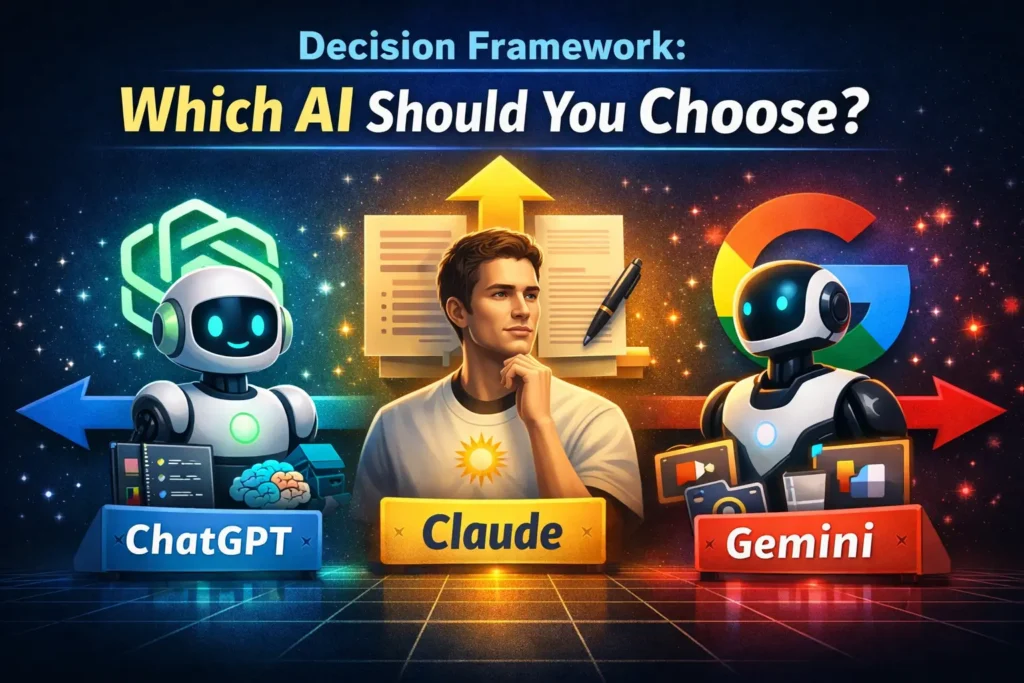
Decision Framework: Which AI Should You Choose?
Matching AIs to specific needs:
Choose ChatGPT If:
You Need:
- Versatile all-purpose assistant
- Memory across conversations
- Custom GPTs for specialized tasks
- Best free tier model
- Strong brand recognition and support
- Mixed workflows (writing, analysis, research, coding) in one tool
You Are:
- Individual professional
- Power user managing diverse tasks
- Someone who values conversational memory
- User comfortable with manual context setting
Primary Use Cases:
- General productivity
- Brainstorming and ideation
- Marketing copy and headlines
- Quick coding solutions
- Everyday questions and research
Bottom Line: ChatGPT remains best general-purpose AI for most users. Start here unless you have specific needs better served by alternatives.
Choose Claude If:
You Need:
- Highest quality writing output
- Best coding accuracy and performance
- Long-form content processing (200K-500K tokens)
- Lowest hallucination rate
- Complex reasoning and analysis
- Ethical AI with strong guardrails
You Are:
- Developer or software engineer
- Professional writer or content creator
- Researcher requiring factual accuracy
- Knowledge worker doing sustained long-form work
- Team prioritizing quality over speed
Primary Use Cases:
- Software development and debugging
- Blog posts and thought leadership
- Technical documentation
- Research analysis
- Creative writing
- Code review
Bottom Line: Claude wins when quality matters most. Premium justified for developers and professional writers.
Choose Gemini If:
You Need:
- Google Workspace integration
- Fastest response times
- Largest context window (1M tokens)
- Multimodal capabilities (image, video, audio)
- Best free tier for students
- Native productivity tool access
You Are:
- Heavy Google Workspace user
- Student or educator
- Multimodal content creator
- User requiring video/image generation
- Team already in Google ecosystem
Primary Use Cases:
- Google Workspace productivity
- Research with large documents
- Image and video creation
- Android/Firebase development
- Multimodal analysis
- Fast content generation
Bottom Line: Gemini makes sense if you live in Google ecosystem or need multimodal features. Integration value justifies choice for Workspace users.
Multi-AI Strategy
Reality: Many power users subscribe to multiple AIs strategically.
Common Combinations:
Developer Stack: Claude Pro ($20) for coding + ChatGPT Plus ($20) for general use = $40/month
Content Creator: Claude Pro ($20) for writing + Gemini for research/multimodal = $40/month
Budget Conscious: Use all three free tiers strategically, or try group buy services (AIonX at $30/month for all three)
The Pragmatic Approach: Use different models for different tasks. One AI for customer service, another for content, third for code.
Learn about how to use AI for content marketing with multi-AI workflows.
Common Mistakes When Choosing AI Assistants
Avoid expensive errors:
Mistake 1: Choosing Based on Brand Recognition Alone
The Error: Subscribing to ChatGPT because it’s most well-known without testing Claude or Gemini.
Why It Fails: Brand awareness doesn’t equal best fit. Blind tests show Claude dominates writing, Gemini wins multimodal, ChatGPT excels at strategy—yet most users never compare.
The Fix: Try all three free tiers for one week each with your actual workflows before committing to paid plans.
Mistake 2: Paying for Features You Don’t Use
The Error: Upgrading to Pro/Premium tiers without hitting free or standard tier limits.
Why It’s Wasteful: ChatGPT Pro ($200/month) provides unlimited access—but if you’re not hitting Plus rate limits, you’re paying 10× for capacity you don’t need.
The Fix: Track usage for 2-3 weeks. Upgrade only when consistently hitting rate limits or needing specific premium features.
Mistake 3: Ignoring Ecosystem Integration
The Error: Choosing AI without considering existing tool usage.
Why It Fails: If your workflow lives in Google Workspace, ChatGPT requires manual context while Gemini pulls from Docs/Gmail automatically, saving hours weekly.
The Fix: Map where you spend most time (Google, Microsoft, standalone). Choose AI with native integration.
Mistake 4: Not Testing for Specific Use Cases
The Error: Assuming all AIs handle your primary task equally well.
Why It Fails: ChatGPT might win at brainstorming but Claude produces dramatically better final drafts for technical content. Gemini crushes multimodal but trails text-only quality.
The Fix: Test your top 3 actual use cases (coding, writing, research) across all three AIs before deciding.
Mistake 5: Switching Too Frequently
The Error: Changing AI subscriptions monthly chasing marginal improvements.
Why It Fails: Each AI learns your preferences over time (especially ChatGPT with Memory). Constant switching prevents effective learning and workflow establishment.
The Fix: Choose one AI, use it consistently for 90 days, then evaluate if switching makes sense based on clear gaps.
Mistake 6: Expecting Perfection
The Error: Treating AI outputs as publish-ready without human review.
Why It Fails: All three AIs hallucinate, miss nuance, and lack human judgment. Even Claude’s low hallucination rate isn’t zero.
The Fix: Use AI for first drafts and heavy lifting. Always apply human editing for accuracy, voice, and final polish.
Mistake 7: Not Leveraging Unique Features
The Error: Using ChatGPT, Claude, or Gemini like generic chatbots without exploring specialized features.
Why It Misses Value: ChatGPT’s Custom GPTs, Claude’s Artifacts, Gemini’s Workspace integration provide 10× value when used properly versus basic chat.
The Fix: Invest 2 hours learning unique features of your chosen AI. ROI is substantial.
The Future of AI Assistants (2026-2027)
Where technology is heading:
Model Convergence: GPT-5, Claude 5, Gemini 4 will narrow capability gaps. Competition drives rapid improvement across all providers.
Agentic AI: All three moving toward autonomous task completion—booking, buying, scheduling—without constant human prompting.
Multimodal Everything: Text-only AIs becoming rare. Vision, voice, and video understanding standard across platforms.
Deeper Integration: AI embedded directly into operating systems, browsers, productivity tools rather than standalone apps.
Personal Models: Fine-tuned models learning individual preferences, communication styles, and domain expertise.
Regulatory Frameworks: EU AI Act (2026), emerging US regulations shaping enterprise AI deployment and privacy practices.
Price Pressure: Competition likely keeps consumer pricing at $20/month while adding features. Premium tiers may increase.
The Constant: No single “best AI” emerges. Choice remains use-case dependent with multi-AI strategies becoming standard for power users.
Conclusion: There Is No Universal “Best AI”—Only Best for Your Needs
The 2026 AI assistant landscape offers three excellent options, each dominating different use cases. ChatGPT leads in versatility and adoption with 200 million weekly users. Claude wins quality competitions for writing and coding, achieving 80.9% on developer benchmarks versus ChatGPT’s 70%. Gemini provides fastest performance and deepest Google ecosystem integration with the largest 1 million token context window.
Key Takeaways:
- Blind testing reveals Claude won 4/8 rounds (writing tasks), Gemini won 3/8 (consistency), ChatGPT won 1/8 (strategic thinking)
- When Claude won writing rounds, it dominated by 35-54 point margins
- 53% of developers use Claude for coding due to 80.9% SWE-bench Verified score
- ChatGPT commands 200 million weekly users but brand recognition doesn’t equal capability superiority
- All three AIs offer excellent value at ~$20/month with similar pricing
- Gemini provides best free tier, ChatGPT best free model access, Claude most limited free version
- Premium tiers ($100-250/month) justified only for power users consistently hitting rate limits
- Google Workspace users save hours with Gemini’s native integration
- Developers report 30-40% less editing time on Claude outputs
- Multi-AI strategies becoming standard for power users ($40-60/month for complementary tools)
- No single “best AI”—choice depends on primary use case and existing workflow
What To Do Now:
This Week: Try all three free tiers with your actual work. Test top 3 use cases (writing, coding, research) across each platform.
This Month: Choose one AI based on testing results. Subscribe to paid tier ($20/month). Use consistently without switching to establish workflow.
This Quarter: Evaluate if primary AI meets needs or if gaps justify adding second AI for specific tasks (coding, multimodal, integration).
The Bottom Line:
Stop choosing AI based on brand recognition or marketing hype. ChatGPT’s popularity doesn’t make it best for your needs. Claude’s writing quality justifies $20/month for content creators and developers. Gemini’s Google integration saves Workspace users hours weekly. Most users benefit from trying all three before committing.
The winning strategy isn’t finding “the best AI”—it’s matching capabilities to actual needs through real-world testing. Start with ChatGPT for versatility. Switch to Claude if quality matters more. Choose Gemini if you live in Google ecosystem.
For comprehensive AI guidance, read our related guides on how to use AI for content marketing and AI marketing predictions.
The best AI assistant is the one that actually fits your workflow. Test to find yours.