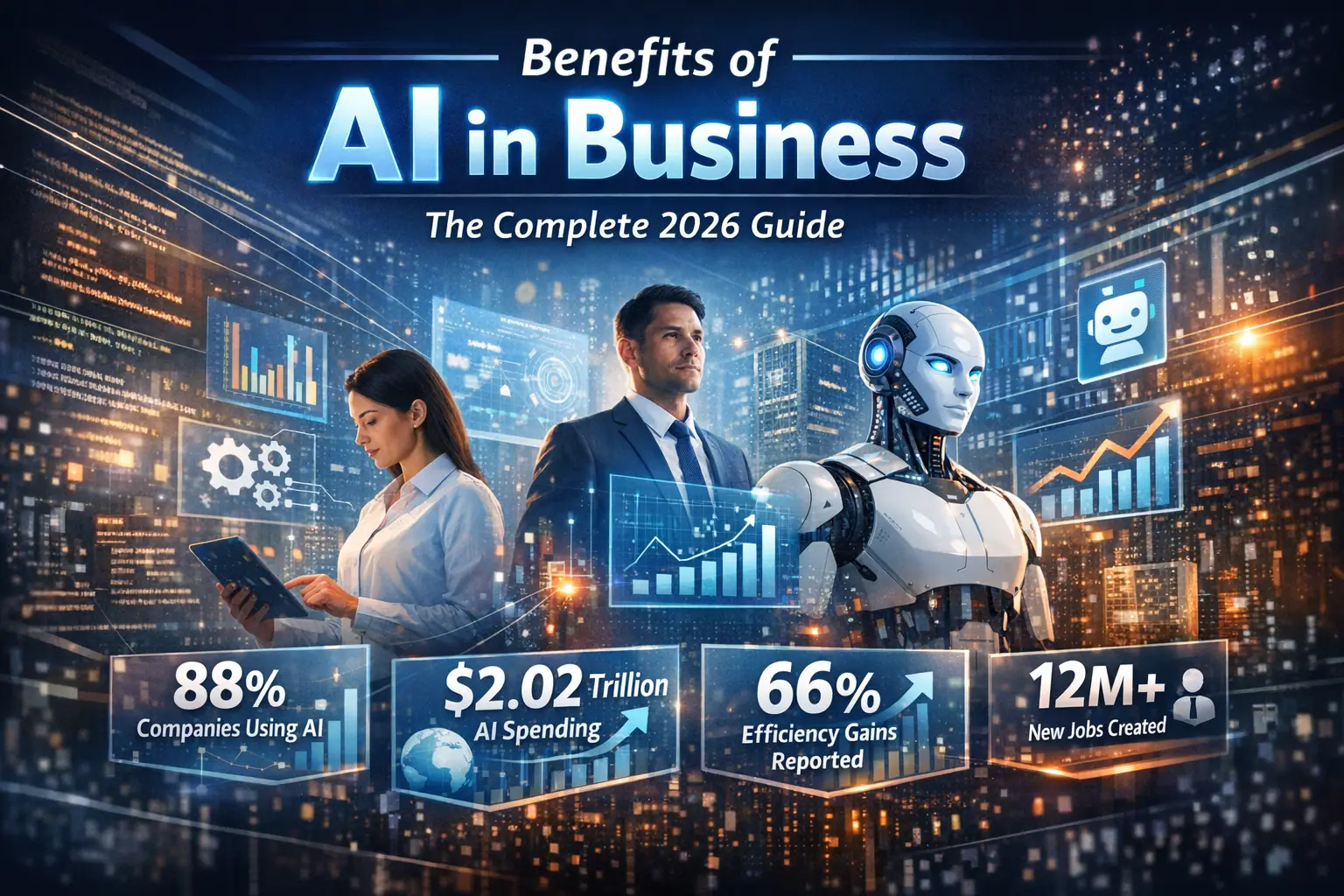
Artificial intelligence is no longer experimental technology. In February 2026, AI has become essential business infrastructure—like email, phones, or computers. The numbers tell a remarkable story: 88% of companies now use AI in at least one business function, up from 78% just last year.
But here is what matters more than adoption rates: companies using AI report measurable improvements in productivity, efficiency, customer satisfaction, and revenue. The question is not whether AI benefits business—the data proves it does. The question is how to capture these benefits in your specific situation.
This comprehensive guide explores the proven benefits of AI in business, backed by the latest research from Deloitte, PwC, McKinsey, and dozens of other sources. Whether you run a small business or lead enterprise strategy, you will understand exactly how AI delivers value and what it takes to achieve similar results.
The State of AI in Business: February 2026 Snapshot
Before diving into benefits, let’s establish where we are:
Adoption Metrics:
- 88% of companies use AI in at least one business function
- 72% of organizations use Gen AI in one or more functions
- 77% of companies either use or explore AI actively
- 83% of companies say AI is a top priority in business plans
- Worker access to AI rose 50% in 2025
Investment Trends:
- Total worldwide AI spending will surpass $2.02 trillion in 2026
- 67% of organizations expect to invest more in AI over next three years
- Global AI market growing at 38% annually
Business Impact:
- 66% of organizations report productivity and efficiency gains
- 64% say AI enables their innovation
- Only 39% report EBIT (earnings) impact at enterprise level yet
- 74% hope to grow revenue through AI (only 20% do so currently)
According to Deloitte’s 2026 State of AI in the Enterprise report (surveying 3,235 senior leaders from August-September 2025): “Organizations today stand at the untapped edge of AI’s potential. Success hinges on the ability to move boldly from ambition to activation.”
Understanding how AI is changing marketing shows similar patterns: rapid adoption, clear efficiency gains, but revenue impact still emerging.
Top 12 Benefits of AI in Business (Backed by 2026 Data)
Let’s examine each major benefit with current evidence:
1. Increased Productivity and Efficiency
This is the most consistently reported benefit across all research.
The Data:
- 66% of organizations report productivity and efficiency gains from AI
- 90% of employees using AI report significant time savings
- Workers save an average of 3.5+ hours weekly on administrative tasks
- High performers see even greater gains than low performers
How It Works: AI handles repetitive, time-consuming tasks that humans once did manually:
- Data entry and processing
- Document review and summarization
- Report generation
- Email drafting and responses
- Meeting note-taking and action item tracking
- Scheduling and calendar management
Real Example: A financial services company deployed agentic workflows to automatically capture meeting actions from video conferences, draft communications reminding participants of next steps, and track follow-through—eliminating hours of manual work weekly.
Why This Matters: When employees spend less time on administrative tasks, they focus more on strategic work that drives business value. This shift from execution to thinking transforms roles across organizations.
2. Cost Reduction and Operational Savings
AI reduces costs in multiple ways beyond labor efficiency.
The Data:
- Companies report cost benefits from AI use cases, especially in software engineering (top benefit), manufacturing, and IT
- Manufacturing sector projected to gain $3.8 trillion from AI by 2035
- Claims processing times cut by up to 70% in insurance with AI
Cost Reduction Areas:
- Lower labor costs for repetitive tasks
- Reduced error rates and rework
- Decreased customer service expenses
- Optimized inventory and supply chain costs
- Energy efficiency improvements
- Faster time-to-market reduces development costs
Real Example: Insurance companies using AI for fraud detection and claims processing report 70% faster processing while reducing fraudulent claims significantly—both cutting costs and improving customer satisfaction.
Learn about business growth strategies for long-term success to understand how cost savings fund other growth initiatives.
3. Enhanced Customer Experience and Satisfaction
AI improves how businesses serve customers across every touchpoint.
The Data:
- Nearly 2/3 of business owners think AI will improve customer relationships
- Majority of organizations report improved customer satisfaction from AI
- 98% of marketers currently use or plan to use generative AI within 18 months
- 65% of senior executives plan to use AI to increase customer retention and loyalty
Customer Experience Improvements:
- 24/7 customer support through AI chatbots
- Personalized recommendations and content
- Faster response times to inquiries
- Predictive support before problems occur
- Seamless omnichannel experiences
- Natural language interactions
Real Example: Retailers using AI analyze customer behavior to provide personalized product recommendations, resulting in higher conversion rates and customer lifetime value. AI-powered chatbots handle routine questions instantly while escalating complex issues to humans.
4. Data-Driven Decision Making
AI transforms how businesses make decisions by analyzing vast amounts of data humans could never process.
The Data:
- 64% of organizations say AI enables their innovation
- AI applications in data analysis provide real-time insights
- Predictive analytics help forecast demand, trends, and risks
Decision-Making Benefits:
- Real-time business intelligence dashboards
- Predictive analytics for market trends
- Risk assessment and mitigation
- Customer behavior insights
- Competitive intelligence
- Resource allocation optimization
Real Example: Manufacturing companies use AI to analyze sensor data from equipment, predicting maintenance needs before failures occur. This predictive maintenance reduces downtime by identifying issues weeks in advance.
5. Improved Innovation and Product Development
AI accelerates innovation cycles and enables new capabilities.
The Data:
- Revenue increases from AI most commonly reported in product and service development
- 64% say AI enables their innovation
- 34% of organizations use AI to create new products and services or reinvent core processes
Innovation Areas:
- Rapid prototyping and testing
- Discovery of new product features
- Market gap identification
- Faster R&D cycles
- New business model exploration
- AI-powered products themselves
Real Example: Pharmaceutical companies use AI to analyze molecular structures and predict drug effectiveness, reducing drug development timelines from 10+ years to potentially 5-7 years while improving success rates.
Understanding AI trends that are changing industries shows innovation happening across sectors.
6. Revenue Growth Opportunities
While lagging other benefits, revenue impact is emerging.
The Data:
- 20% of organizations already see revenue growth from AI
- 74% hope to achieve revenue growth through future AI initiatives
- Revenue increases most commonly reported in marketing and sales, strategy and corporate finance, and product development
- High performers more likely to set growth as an AI objective
Revenue Growth Drivers:
- New AI-powered products and services
- Improved lead scoring and conversion
- Personalized marketing at scale
- Dynamic pricing optimization
- Cross-selling and upselling
- Market expansion through automation
Real Example: E-commerce companies use AI for dynamic pricing, adjusting prices in real-time based on demand, inventory, competitor pricing, and customer behavior—optimizing revenue without manual price management.
7. Competitive Advantage and Market Differentiation
AI creates sustainable competitive advantages when implemented strategically.
The Data:
- Nearly half of organizations report competitive differentiation from AI
- 81% of business leaders say AI agents will be integrated into strategy within 12-18 months
- High performers 3x more likely to use AI for transformative business change
Competitive Advantages:
- Faster market response times
- Better customer insights than competitors
- Lower operational costs enabling better pricing
- Innovative products and services
- Superior customer experiences
- Data-driven strategy execution
Real Example: Companies using AI for market intelligence track competitor pricing, product launches, and customer sentiment in real-time, enabling rapid strategic adjustments that manual analysis could never provide.
8. Enhanced Risk Management and Compliance
AI improves how businesses identify and mitigate risks.
The Data:
- 65% of financial institutions use AI for fraud detection
- Agentic AI seen as high potential for cybersecurity use cases
- AI automates up to 45% of cybersecurity tasks
Risk Management Applications:
- Fraud detection and prevention
- Cybersecurity threat identification
- Regulatory compliance monitoring
- Financial risk assessment
- Supply chain risk analysis
- Quality control and defect detection
Real Example: Banks use AI to analyze transaction patterns in real-time, identifying potentially fraudulent activity within milliseconds and blocking suspicious transactions before they complete—protecting both the bank and customers.
9. Workforce Transformation and Augmentation
Contrary to fears, AI creates net new jobs while transforming existing roles.
The Data:
- AI projected to displace 85 million roles but create 97 million new ones by 2026 (net gain of 12 million)
- 50% of employees want more AI training
- 84% of marketers feel AI makes their jobs more strategic
- 43% expect no change in workforce size, 32% expect decreases, 13% expect increases
Workforce Benefits:
- Employees freed from repetitive tasks
- More strategic, creative work opportunities
- Enhanced decision-making capabilities
- New job categories and career paths
- Skill development and learning
- Better work-life balance through efficiency
Real Example: Customer service teams using AI chatbots for routine questions allow human agents to focus on complex problem-solving and relationship building—more satisfying work that requires uniquely human skills.
Learn about what jobs will AI replace and which are safe for detailed analysis of workforce changes.
10. Marketing and Sales Effectiveness
Marketing and sales see particularly strong AI benefits.
The Data:
- 75% of marketers experiment with or fully implement AI
- High-performing marketers nearly 3x more likely to have fully implemented AI
- 98% of marketers use or plan to use generative AI within 18 months
- 65% of senior executives use AI to boost customer retention
Marketing Benefits:
- Personalized content at scale
- Improved lead scoring accuracy
- Automated campaign optimization
- Better customer segmentation
- Predictive analytics for targeting
- Content generation and adaptation
Sales Benefits:
- Intelligent lead prioritization
- Automated outreach sequences
- Conversation intelligence from calls
- Predictive deal closure analysis
- Real-time coaching during calls
- Proposal and quote generation
Real Example: Sales teams using conversation intelligence AI analyze every sales call, identifying what messaging works, which objections appear most, and coaching opportunities—improving close rates systematically.
Our guide on marketing for business growth explores how AI enables modern marketing strategies.
11. Supply Chain and Operations Optimization
AI dramatically improves operational efficiency across supply chains.
The Data:
- Agentic AI seen as high potential for supply chain management
- Manufacturing among sectors seeing greatest AI cost benefits
- Real-time optimization reduces inventory costs and improves delivery times
Supply Chain Benefits:
- Demand forecasting accuracy
- Inventory optimization
- Route and logistics planning
- Supplier relationship management
- Quality control automation
- Warehouse operations efficiency
Real Example: Logistics companies use AI to optimize delivery routes in real-time based on traffic, weather, delivery windows, and vehicle capacity—reducing fuel costs by 10-15% while improving on-time delivery rates.
12. Small Business Empowerment
AI levels the playing field, giving small businesses enterprise capabilities.
The Data:
- 89% of small businesses use AI for daily tasks
- 57% use AI to automate marketing and customer outreach
- 40-42% have formal AI plans or initial deployments
Small Business Benefits:
- Access to advanced analytics previously unaffordable
- Automation of administrative work
- Professional marketing at low cost
- 24/7 customer service
- Competitive customer experiences
- Efficient operations without large teams
Real Example: Small retailers use AI-powered tools for inventory management, personalized email marketing, customer service chatbots, and social media content generation—capabilities that once required dedicated staff or agencies.
Real-World AI Use Cases by Department
Let’s examine specific applications across business functions:
Marketing Department
Content Creation: AI generates blog posts, social media content, email copy, and product descriptions
SEO and SEM: AI optimizes keywords, analyzes competitors, and improves ad performance
Customer Insights: AI analyzes behavior patterns to segment audiences and predict preferences
Campaign Management: AI tests variations, optimizes timing, and allocates budget automatically
Sales Department
Lead Scoring: AI predicts which leads most likely to convert based on behavior and firmographics
Sales Forecasting: AI analyzes pipeline to predict revenue with greater accuracy
Email Automation: AI personalizes outreach at scale based on prospect behavior
Call Analysis: AI transcribes calls, identifies key moments, and suggests follow-up actions
Customer Service Department
Chatbots: AI handles routine inquiries 24/7 across website, email, and messaging platforms
Ticket Routing: AI directs complex issues to appropriate specialists automatically
Knowledge Base: AI suggests relevant articles and generates answers from documentation
Sentiment Analysis: AI detects frustrated customers for priority handling
Human Resources Department
Recruiting: AI screens resumes, schedules interviews, and assesses candidate fit
Onboarding: AI guides new hires through processes and answers common questions
Employee Engagement: AI analyzes feedback to identify satisfaction issues early
Learning & Development: AI recommends personalized training based on roles and goals
Finance and Accounting
Invoice Processing: AI extracts data from invoices and matches them to purchase orders
Expense Management: AI categorizes expenses and flags policy violations
Financial Forecasting: AI predicts cash flow and identifies trends
Fraud Detection: AI spots unusual transactions and patterns indicating fraud
IT and Operations
Help Desk: AI chatbots resolve common technical issues without human intervention
Cybersecurity: AI monitors networks for threats and responds to incidents automatically
System Monitoring: AI predicts failures before they occur and triggers maintenance
Code Development: AI assists developers with code suggestions and bug detection
Understanding how AI is reshaping development provides deeper insight into IT transformation.
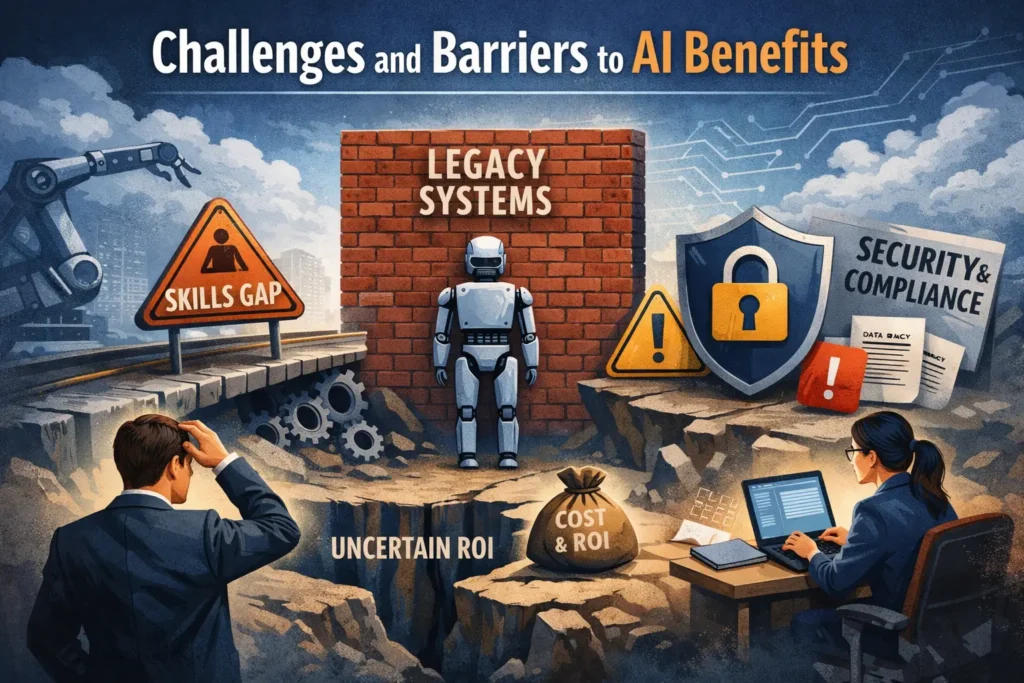
Challenges and Barriers to AI Benefits
Despite clear benefits, organizations face obstacles:
Skills Gap and Expertise (42% cite as top challenge)
The Problem: Shortage of skilled AI talent including data scientists and machine learning engineers
The Solution:
- Invest in training existing employees
- Partner with AI vendors offering implementation support
- Start with no-code/low-code AI tools
- Build cross-functional AI teams
- Hire AI consultants for initial projects
Integration with Existing Systems (30% cite as barrier)
The Problem: Legacy systems do not easily connect with modern AI tools
The Solution:
- Prioritize AI tools with robust APIs
- Implement middleware for system connections
- Consider phased modernization approach
- Use AI platforms with pre-built integrations
- Plan integration architecture from the start
Compliance and Security Concerns (83% cite as biggest AI threat)
The Problem: AI introduces new risks around data privacy, bias, and uncontrolled usage
The Solution:
- Establish clear AI governance policies
- Implement AI ethics guidelines
- Regularly audit AI systems for bias
- Ensure data privacy compliance
- Train employees on responsible AI use
Cost and ROI Uncertainty
The Problem: Upfront investment required with unclear return timeline
The Solution:
- Start with high-ROI use cases
- Measure impact with clear metrics
- Pilot projects before full deployment
- Focus on problems that cost significant time or money
- Track both quantitative and qualitative benefits
Lack of Leadership Buy-in (Only 10% lack this)
The Problem: Some executives remain skeptical about AI value
The Solution:
- Present data-driven business cases
- Start with low-risk pilot projects
- Share success stories from competitors
- Quantify potential benefits specifically
- Demonstrate quick wins
Only 1% of businesses believe they have reached AI maturity—meaning nearly everyone still has room to improve their AI implementation.
Best Practices for Maximizing AI Benefits
Based on research into high-performing organizations, here is how to succeed:
1. Set Clear Objectives Beyond Efficiency
While 80% of companies set efficiency as an AI objective, high performers also set growth and innovation goals. Do not just aim to work faster—aim to work differently.
2. Adopt Top-Down Strategy, Not Bottom-Up Chaos
PwC’s 2026 predictions emphasize: “Senior leadership picks the spots for focused AI investments, looking for key workflows where payoffs can be big.”
Crowdsourced AI initiatives rarely lead to transformation. Executive-led strategy ensures alignment with business priorities.
3. Redesign Workflows, Don’t Just Add AI
Half of AI high performers intend to transform their businesses through workflow redesign. Adding AI to existing processes provides modest gains. Reimagining processes around AI capabilities delivers dramatic improvement.
4. Create Centralized AI Capabilities
PwC recommends an “AI studio” model: centralized hub with reusable tech components, frameworks for assessing use cases, sandbox for testing, deployment protocols, and skilled people. This prevents duplicated effort and ensures best practices.
5. Measure What Matters
Track both leading and lagging indicators:
- Leading: Use case adoption, employee satisfaction, process efficiency
- Lagging: Revenue impact, cost savings, customer satisfaction scores
As PwC notes: “Each dollar spent should fuel measurable outcomes that accelerate business value.”
6. Invest in Change Management
Technology is only part of AI success. People and processes matter equally:
- Train employees on AI tool usage
- Communicate benefits clearly
- Address fears about job security
- Celebrate early wins publicly
- Gather feedback and iterate
7. Start Small, Scale Fast
Do not try to transform everything at once:
- Identify one high-impact, low-risk use case
- Implement with clear success metrics
- Measure results rigorously
- Share learnings across organization
- Scale to additional use cases
- Build momentum through visible wins
Learn about branding strategies for modern businesses to understand how AI fits into broader strategy.
The Future of AI Benefits in Business
Where are AI benefits heading? Key trends for 2026-2028:
Agentic AI Goes Mainstream
By 2028, 33% of enterprise software will include agentic AI, up from less than 1% in 2024. By 2028, roughly 15% of day-to-day business decisions could be made by agentic AI.
What This Means: AI moves from analysis to action, making decisions and executing workflows with minimal human oversight.
Voice AI Becomes Standard
Voice assistants projected to become cornerstone of digital interaction. Voice technology integrating into professional settings across industries.
AI-Native Product Development
New products will be designed AI-first rather than adding AI features later. This enables capabilities impossible with traditional approaches.
Democratization of AI Tools
AI tools becoming accessible to non-technical users through no-code interfaces. Small businesses gaining capabilities previously requiring data science teams.
Sovereign AI Emerges
Countries and companies deploying AI under their own laws, infrastructure, and data. This addresses data sovereignty and compliance concerns.
Conclusion: AI Benefits Are Real, But Require Strategy
The evidence is overwhelming: AI delivers significant business benefits across productivity, costs, customer experience, innovation, and competitive advantage. The numbers from February 2026 prove it:
Key Takeaways:
- 88% of companies now use AI in at least one function
- 66% report clear productivity and efficiency gains
- 64% say AI enables their innovation
- AI creates net 12 million new jobs despite disruption
- $2.02 trillion in AI spending globally in 2026
- High performers use AI for transformation, not just optimization
- Small businesses benefit as much as enterprises
- Challenges include skills gaps, integration, and governance
What This Means for Your Business:
AI is not optional anymore. The question is not whether to adopt AI, but how quickly you can implement it strategically. Companies moving boldly from ambition to activation will capture competitive advantages that late movers cannot match.
Start with high-impact use cases, measure results rigorously, redesign workflows around AI capabilities, and invest in both technology and people. The benefits are proven—the execution determines who captures them.
The AI revolution is not coming—it is here. The only question is whether your business will be shaped by it or left behind by it.