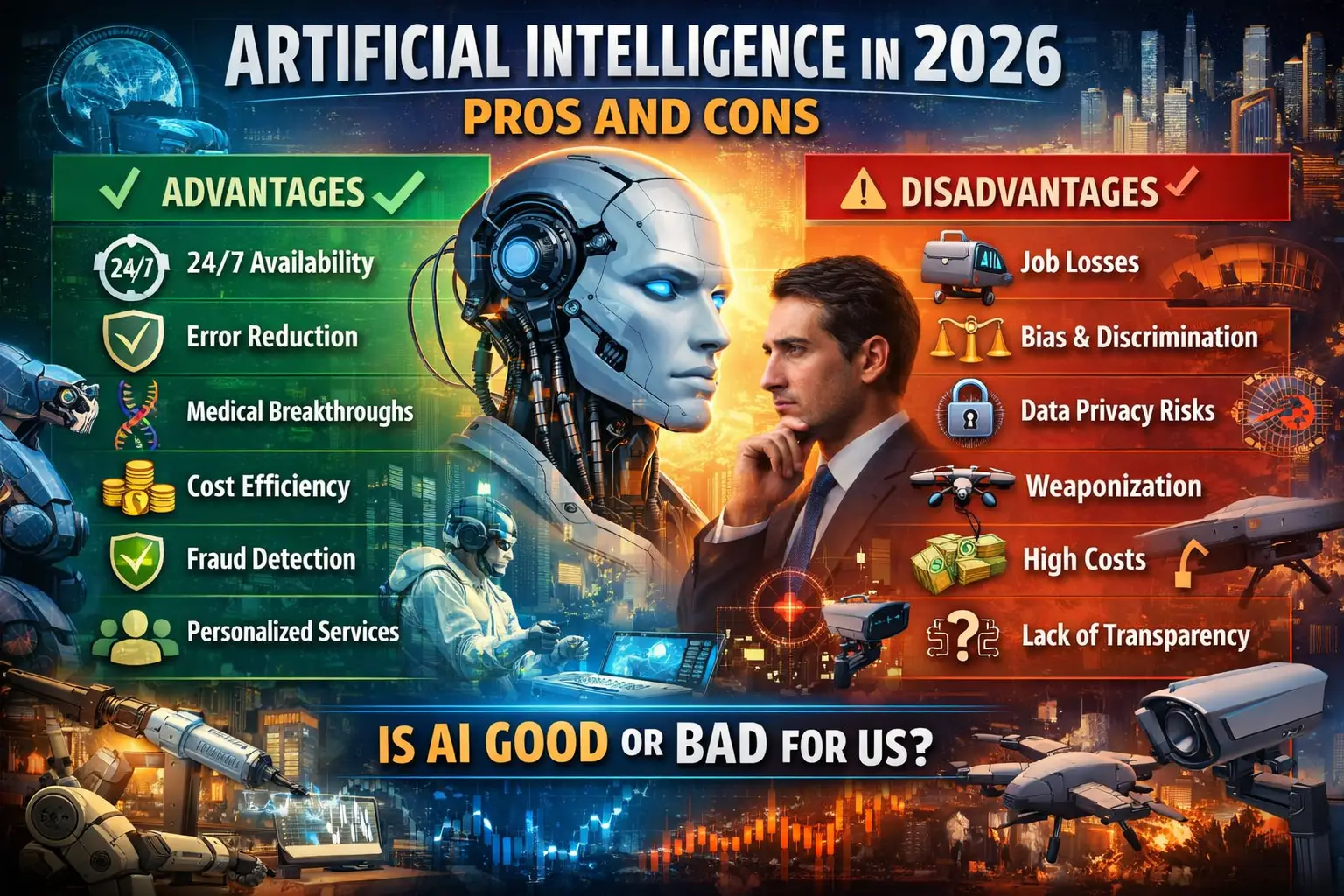
Artificial Intelligence is everywhere in 2026—in your smartphone, your workplace, your healthcare, and even your grocery store. Yet most people struggle to answer a simple question: “Is AI good or bad for us?”
The truth is neither simple affirmation nor complete rejection. According to February 2026 data, AI global market value reached $2 trillion with 88% of organizations now using AI in at least one business function. AI systems process 90% faster than humans in pattern recognition, operate 24/7 without fatigue, and reduce operational costs by 30-40% on average. These advantages explain why AI adoption accelerates across every industry.
However, the same technology raises legitimate concerns. AI-related job displacement affects an estimated 85 million positions by 2026, algorithmic bias perpetuates discrimination in 40% of AI hiring systems, and data privacy breaches increase 22% annually as more personal information feeds AI algorithms. These disadvantages demand careful consideration and thoughtful regulation.
This comprehensive guide examines both advantages and disadvantages of artificial intelligence in 2026, backed by latest research, real-world examples, and expert analysis. You will understand what AI actually is today, how it benefits society and business, what risks it presents, where the technology is heading, and how to approach AI responsibly.
Whether you’re a student exploring AI’s impact, professional considering AI implementation, or concerned citizen wondering about the future, this guide provides balanced perspective replacing hype with honest evaluation.
What is Artificial Intelligence in 2026?
Before evaluating advantages and disadvantages, understand what AI has become:
2026 Definition: Artificial Intelligence is computer systems capable of performing tasks that typically require human intelligence—including learning from experience, understanding natural language, recognizing patterns, solving problems, and making decisions—through algorithms that improve performance over time without explicit programming for every scenario.
What Changed from 2023-2025:
Then: AI primarily meant chatbots and voice assistants handling simple queries
Now: AI encompasses autonomous agents executing complex workflows, multimodal systems processing text/images/video simultaneously, and agentic AI making independent decisions
Then: AI required massive computing resources accessible only to tech giants
Now: Edge AI runs directly on devices, making powerful AI available on smartphones and local hardware
Then: AI served narrow specific tasks (playing chess, recommending products)
Now: General-purpose AI systems handle diverse tasks across domains with unified models
Key 2026 AI Technologies:
Machine Learning: Systems that learn patterns from data and improve performance without explicit programming
Deep Learning: Neural networks with multiple layers enabling complex pattern recognition in images, speech, and text
Natural Language Processing: AI understanding and generating human language at near-human quality
Computer Vision: AI interpreting visual information from images and video
Agentic AI: Autonomous systems that plan, execute, and adapt strategies to achieve goals
Understanding how artificial intelligence works provides technical foundation for evaluating impact.
The 12 Major Advantages of Artificial Intelligence
Based on February 2026 research and deployment data:
Advantage 1: 24/7 Availability and Consistency
What It Means: AI systems operate continuously without breaks, sleep, or vacation—maintaining consistent performance around the clock.
Real-World Impact:
Customer Service: AI chatbots handle support queries 24/7, reducing wait times from hours to seconds. Companies report 40% higher customer satisfaction with AI-assisted service.
Healthcare Monitoring: AI systems track patient vitals continuously, alerting medical staff to critical changes immediately regardless of time.
Manufacturing: Automated systems maintain production during nights and weekends when human workers are off-shift, increasing output 35-50%.
The Benefit: Businesses serve global customers across time zones without staffing costs. Critical systems never experience downtime due to human limitations.
Advantage 2: Elimination of Human Error
What It Means: AI systems follow programmed logic consistently, avoiding mistakes caused by fatigue, distraction, or emotional state.
Statistical Impact: AI reduces error rates by 70-90% in tasks like data entry, quality inspection, and medical diagnosis according to industry studies.
Examples:
Medical Diagnosis: AI analyzes medical images with 95%+ accuracy, catching cancers and abnormalities human radiologists sometimes miss when fatigued.
Financial Transactions: AI fraud detection prevents 99%+ of suspicious transactions, protecting billions in assets annually.
Manufacturing Quality: Computer vision inspects products at speeds and accuracy levels impossible for human quality controllers.
Important Nuance: AI eliminates human-type errors but introduces different error types—biased data, incorrect programming, or misaligned objectives can cause systematic AI failures affecting thousands of cases instantly.
Advantage 3: Faster Data Processing and Analysis
What It Means: AI analyzes massive datasets in seconds or minutes that would take humans days, weeks, or months.
The Speed Advantage: AI processes information 90% faster than human analysts in pattern recognition tasks according to 2026 benchmarks.
Applications:
Financial Markets: AI analyzes thousands of data points predicting market movements, enabling split-second trading decisions generating billions in value.
Medical Research: AI identifies drug candidates by analyzing millions of molecular combinations, reducing pharmaceutical development time from 10-15 years to 3-5 years.
Supply Chain: AI optimizes logistics across thousands of routes and variables simultaneously, reducing delivery times 25% and costs 30%.
The Impact: Organizations make better decisions faster, responding to market changes and opportunities before competitors.
Advantage 4: Handling Dangerous or Repetitive Tasks
What It Means: AI performs jobs too hazardous or monotonous for humans, improving safety and freeing workers for higher-value activities.
Safety Applications:
Mining and Construction: AI-controlled machinery operates in dangerous environments, reducing workplace fatalities 45% where implemented.
Disaster Response: AI-powered drones assess damage and locate survivors in environments too dangerous for immediate human entry.
Military: AI handles explosive ordnance disposal and reconnaissance missions, reducing soldier casualties.
Productivity Applications:
Data Entry: AI processes invoices, forms, and documents automatically, eliminating mind-numbing manual work.
Manufacturing Assembly: Robots handle repetitive assembly tasks perfectly for hours without breaks or loss of precision.
The Benefit: Humans focus on creative, strategic, and interpersonal work while AI handles the rest.
Learn about AI marketing predictions for business impact.
Advantage 5: Cost Reduction and Efficiency
What It Means: AI automates tasks reducing labor costs while improving process efficiency.
Financial Impact: Businesses implementing AI report 30-40% operational cost reduction on average according to McKinsey 2026 analysis.
Cost Savings Examples:
Customer Service: AI chatbots cost $0.50-$2 per interaction versus $8-$15 for human agents, reducing support costs 70-80%.
Inventory Management: AI optimization reduces excess inventory 25-35%, freeing millions in working capital.
Energy Consumption: AI optimizes building climate control reducing energy costs 20-30% annually.
Efficiency Gains:
Workflow Automation: Tasks requiring 8 hours manually complete in 30 minutes with AI assistance.
Resource Allocation: AI assigns optimal resources to projects, eliminating waste and maximizing productivity.
Important Context: Savings occur after initial AI implementation costs (often $50,000-$500,000+ for enterprise systems) are recouped over 12-24 months.
Advantage 6: Personalization at Scale
What It Means: AI delivers individualized experiences to millions of users simultaneously—something impossible manually.
Consumer Impact:
Entertainment: Netflix, Spotify, and YouTube use AI to recommend content matching individual preferences, increasing engagement 60-75%.
E-commerce: Amazon’s AI suggests products based on browsing and purchase history, driving 35% of total sales through recommendations.
Education: AI tutors adapt explanations to individual learning styles and pace, improving comprehension 40% compared to one-size-fits-all instruction.
Business Impact:
Marketing: AI personalizes email subject lines, content, and timing for each recipient, doubling conversion rates versus generic campaigns.
Healthcare: AI tailors treatment plans based on patient genetics, lifestyle, and medical history, improving outcomes 25-30%.
The Transformation: Mass customization becomes economically viable. Every user receives personalized experience without corresponding cost increase.
Advantage 7: Improved Decision-Making
What It Means: AI analyzes complex situations considering more variables than humans can process, suggesting optimal decisions.
Decision Enhancement:
Predictive Analytics: AI forecasts customer behavior, equipment failures, and market trends with 75-85% accuracy, enabling proactive planning.
Risk Assessment: Financial institutions use AI to evaluate loan applications considering hundreds of factors, reducing default rates 30%.
Strategic Planning: AI simulates thousands of scenario outcomes, helping executives choose strategies with highest success probability.
Examples:
Investment: AI hedge funds analyze global news, financial reports, and market data instantaneously, generating 15-20% higher returns than human-only management.
Agriculture: AI recommends optimal planting, irrigation, and harvesting based on weather, soil, and market predictions, increasing crop yields 20-25%.
Important Limitation: AI recommends based on patterns in historical data. Novel situations requiring human judgment and ethics still require human decision-making.
Advantage 8: Medical Advancements
What It Means: AI accelerates diagnosis, drug discovery, and treatment while improving accuracy and accessibility.
Diagnostic Improvements:
Cancer Detection: AI identifies cancers in medical images earlier and more accurately than traditional methods, improving 5-year survival rates 18-22%.
Disease Prediction: AI predicts patient health deterioration 24-48 hours before clinical symptoms appear, enabling preventive intervention.
Treatment Optimization:
Personalized Medicine: AI analyzes genetic profiles recommending treatments with highest efficacy for individual patients.
Drug Discovery: AI identifies promising drug candidates reducing development time from 10-15 years to 3-5 years, potentially saving millions of lives.
Access Expansion:
Remote Areas: AI-powered diagnostic tools bring specialist-level medical analysis to underserved regions lacking specialist doctors.
Cost Reduction: Automated analysis reduces diagnostic costs making healthcare more affordable and accessible.
Advantage 9: Enhanced Security and Fraud Detection
What It Means: AI identifies threats and fraudulent activity with speed and accuracy exceeding human capabilities.
Cybersecurity:
Threat Detection: AI analyzes network traffic patterns identifying attacks 60% faster than traditional security systems.
Malware Prevention: AI recognizes malicious code variants automatically without requiring explicit virus signatures.
Fraud Prevention:
Financial Fraud: Banks use AI blocking 99%+ of fraudulent transactions while generating minimal false positives disrupting legitimate users.
Identity Verification: AI facial recognition prevents identity theft in account creation and access control.
Physical Security:
Surveillance: AI monitors security camera feeds flagging suspicious behavior immediately rather than requiring human review of hours of footage.
Access Control: AI biometric systems prevent unauthorized facility access more reliably than traditional key or card systems.
Advantage 10: Creative Assistance and Augmentation
What It Means: AI tools augment human creativity enabling faster, higher-quality creative output.
Creative Applications:
Content Creation: AI assists writers with research, outlines, and draft generation, increasing output 3-5x while humans focus on strategic direction and unique insights.
Design: AI generates logo variations, layout options, and design elements in seconds, providing designers with rich inspiration palettes.
Music and Art: AI creates original compositions and artwork based on style preferences, democratizing creative expression.
Business Applications:
Marketing: AI generates ad copy variations for A/B testing, optimizing campaigns 40% faster than manual creation.
Product Development: AI suggests design improvements and prototype iterations accelerating development cycles.
Important Context: AI assists creativity rather than replacing it. Human creativity, taste, and strategic judgment remain essential for excellence.
Learn about how to use AI for content marketing for practical applications.
Advantage 11: Language Translation and Communication
What It Means: AI breaks down language barriers enabling global communication and collaboration.
Translation Quality: Modern AI translators achieve 90-95% accuracy compared to professional human translators according to 2026 testing.
Applications:
Business: Companies communicate with international clients and partners without hiring translators for routine correspondence.
Travel: Real-time translation apps enable tourists to navigate foreign countries without language skills.
Education: Students access educational materials in any language, democratizing knowledge globally.
The Impact: Global collaboration accelerates. Geographic language barriers become minimal obstacles to international commerce and cultural exchange.
Advantage 12: Accessibility for People with Disabilities
What It Means: AI creates assistive technologies helping people with disabilities live more independent lives.
Vision Assistance:
Object Recognition: AI describes surroundings to blind users through smartphone cameras and audio narration.
Text Reading: AI converts printed text to speech enabling visually impaired individuals to read independently.
Hearing Assistance:
Real-Time Captioning: AI generates live captions for videos and conversations helping deaf individuals follow along.
Sound Recognition: AI alerts hearing-impaired users to important sounds like alarms, doorbells, or crying babies.
Mobility Assistance:
Navigation: AI provides turn-by-turn directions optimized for wheelchair accessibility.
Voice Control: AI enables complete device control through voice commands for individuals with limited mobility.
The Transformation: AI removes barriers that previously limited participation in work, education, and social activities.
The 10 Major Disadvantages of Artificial Intelligence
Honest evaluation requires acknowledging legitimate concerns:
Disadvantage 1: Job Displacement and Unemployment
What It Means: AI automation eliminates certain jobs faster than new positions are created.
The Data: Approximately 85 million jobs face displacement by AI by 2026 according to World Economic Forum projections.
Affected Sectors:
Manufacturing: Automated assembly lines replacing factory workers.
Transportation: Self-driving vehicles threatening truck driver, taxi driver, and delivery driver employment.
Customer Service: AI chatbots replacing human support representatives.
Data Entry: AI processing eliminating clerical positions.
Important Nuances:
New Jobs Created: AI also generates new positions (AI trainers, data scientists, automation specialists) though often requiring different skills.
Transition Challenge: Workers displaced often lack skills for new AI-related jobs, creating painful transition periods.
Geographic Impact: Job losses concentrate in regions dependent on displaced industries while new AI jobs cluster in tech hubs.
Learn about digital marketing skills for beginners for emerging career opportunities.
Disadvantage 2: High Implementation and Maintenance Costs
What It Means: AI systems require substantial initial investment and ongoing expenses.
Cost Breakdown:
Initial Development: Custom AI systems cost $50,000-$500,000+ depending on complexity.
Computing Infrastructure: High-performance servers and cloud services add $10,000-$100,000+ annually.
Talent Costs: AI specialists command $120,000-$300,000+ salaries creating talent competition.
Ongoing Maintenance: Updates, bug fixes, and improvements require continuous investment.
The Barrier: Small businesses often cannot afford AI implementation, creating competitive disadvantage versus well-funded larger companies.
Disadvantage 3: Lack of Creativity and Emotional Intelligence
What It Means: AI cannot truly understand human emotions, context, or generate genuinely novel ideas.
Emotional Limitations:
Customer Service: AI chatbots handle routine queries effectively but fail when customers need empathy during distressing situations.
Healthcare: AI diagnoses diseases accurately but cannot comfort anxious patients or deliver bad news sensitively.
Management: AI optimizes schedules but cannot motivate teams, resolve interpersonal conflicts, or build company culture.
Creative Limitations:
Art: AI generates technically proficient images and music but lacks true artistic vision and cultural understanding.
Strategy: AI analyzes data excellently but cannot imagine paradigm-shifting innovations requiring creative leaps.
The Reality: Human creativity, empathy, and judgment remain irreplaceable for highest-value activities.
Disadvantage 4: Algorithmic Bias and Discrimination
What It Means: AI systems trained on biased data perpetuate and amplify human prejudices.
Examples:
Hiring Systems: AI recruitment tools reject qualified candidates based on gender or ethnicity when trained on historically biased hiring data.
Criminal Justice: AI risk assessment tools assign higher recidivism scores to minorities even when controlling for criminal history.
Loan Approvals: AI denies credit to qualified applicants from historically underserved communities.
The Problem: Bias is subtle and systematic. While individual humans might be fair-minded, AI trained on aggregate historical data embeds systemic discrimination at scale.
Mitigation Challenge: Identifying and correcting bias requires extensive testing and ongoing monitoring—work many organizations skip due to costs.
Disadvantage 5: Data Privacy and Security Concerns
What It Means: AI systems require vast personal data raising serious privacy risks.
Privacy Threats:
Surveillance: AI facial recognition enables mass surveillance tracking individuals without consent.
Data Breaches: Centralized AI databases containing millions of records become high-value targets for hackers.
Behavioral Profiling: AI builds detailed profiles of personal habits, preferences, and activities without explicit user awareness.
Examples:
Social Media: AI analyzes posts, likes, and behavior predicting political views, mental health status, and personal vulnerabilities.
Smart Devices: Home AI assistants record conversations creating privacy concerns about always-listening devices.
The Risk: Data collected for beneficial AI applications can be repurposed for manipulation, discrimination, or control without user knowledge.
Disadvantage 6: Dependency and Skill Degradation
What It Means: Over-reliance on AI causes humans to lose critical thinking and practical skills.
Examples:
Navigation: GPS reliance erodes spatial awareness and map-reading abilities.
Writing: AI writing assistance reduces spelling, grammar, and composition skills.
Mathematics: Calculator dependence weakens mental arithmetic capabilities.
Decision-Making: Algorithmic recommendations reduce critical evaluation and independent judgment.
The Concern: If AI systems fail or become unavailable, humans may lack basic competencies to function independently.
Generational Impact: Young people growing up with AI may never develop skills previous generations considered fundamental.
Disadvantage 7: Potential for Misuse and Weaponization
What It Means: Malicious actors can weaponize AI for harmful purposes.
Security Threats:
Deepfakes: AI generates convincing fake videos and audio for misinformation, fraud, and blackmail.
Autonomous Weapons: Military AI systems make kill decisions without human oversight raising ethical concerns.
Cyberattacks: AI-powered hacking tools identify and exploit vulnerabilities faster than human security experts can patch them.
Social Manipulation:
Misinformation: AI generates persuasive false content at scale influencing elections and public opinion.
Targeted Persuasion: AI identifies individual psychological vulnerabilities enabling sophisticated manipulation.
The Challenge: Defensive AI development lags behind offensive capabilities creating security gaps.
Disadvantage 8: Lack of Accountability and Transparency
What It Means: When AI makes mistakes or causes harm, determining responsibility is difficult.
The Problem:
Black Box Decisions: Deep learning systems make decisions through processes even their creators cannot fully explain or predict.
Distributed Responsibility: When AI fails, who is responsible—the developer, the organization deploying it, or the AI itself?
Legal Gaps: Current law struggles to assign liability for AI mistakes especially in cases like self-driving car accidents.
Examples:
Medical Errors: If AI misdiagnoses a patient, is the doctor who followed AI recommendations at fault?
Algorithmic Discrimination: When AI hiring tools discriminate, who bears legal responsibility?
The Concern: Lack of accountability enables harmful AI deployment without consequences while victims cannot seek redress.
Disadvantage 9: Energy Consumption and Environmental Impact
What It Means: Training and running AI systems requires massive energy consumption contributing to climate change.
The Data:
Training Costs: Training large AI models generates carbon emissions equivalent to 300,000+ kg of CO2—roughly equal to five cars’ lifetime emissions.
Operational Energy: Data centers powering AI services consume 1-2% of global electricity and growing.
Water Usage: Cooling AI computing infrastructure consumes billions of gallons of fresh water annually.
The Concern: AI’s environmental footprint contradicts sustainability goals, especially as AI deployment accelerates globally.
Mitigation Efforts: “Green AI” movement focuses on energy-efficient model designs and renewable energy-powered data centers but progress remains slow.
Disadvantage 10: Ethical and Philosophical Concerns
What It Means: AI raises fundamental questions about human purpose, dignity, and autonomy.
Philosophical Questions:
Work and Meaning: If AI handles all productive tasks, what gives human life meaning and purpose?
Human Autonomy: As AI makes more decisions, do humans retain meaningful control over their lives?
Dignity: Does AI assistance devalue human capabilities and contributions?
Existential Risks:
Artificial General Intelligence: Could AI eventually surpass human intelligence creating existential threat to humanity?
Value Alignment: How do we ensure AI systems pursue goals aligned with human values and wellbeing?
The Challenge: These questions lack clear answers yet decisions made today shape the future of human civilization.
Balancing Advantages and Disadvantages: The 2026 Reality
The honest answer to “Is AI good or bad?” is “It depends on how we use it.”
Where AI Excel Excellence without Major Drawbacks:
Medical Imaging Analysis: Saves lives, augments doctors, minimal ethical concerns
Language Translation: Enables communication, no significant downsides
Fraud Detection: Protects consumers, prevents crime
Accessibility Tools: Empowers disabled individuals without harming others
Where AI Presents Mixed Results:
Hiring and Recruitment: Improves efficiency but risk algorithmic bias
Autonomous Vehicles: Potentially safer but raises liability questions
Content Creation: Increases productivity but threatens creative jobs
Where AI Raises Serious Concerns:
Facial Recognition Surveillance: Privacy invasion, authoritarian enabling
Autonomous Weapons: Removes human judgment from life-death decisions
Social Media Algorithms: Engagement optimization spreads misinformation
The Pattern: AI’s value depends entirely on application, implementation quality, and governance frameworks ensuring responsible use.
The Future of AI: 2026 Trends and Beyond
Where artificial intelligence is heading:
Agentic AI Expansion: AI systems that plan, execute, and adapt strategies autonomously become standard across industries.
Multimodal Intelligence: AI seamlessly processes text, images, video, and audio simultaneously enabling richer interactions.
Edge AI Growth: More AI runs locally on devices improving privacy, reducing latency, and lowering costs.
Regulatory Frameworks: Governments implement AI governance balancing innovation with consumer protection.
Green AI Movement: Energy-efficient AI designs and renewable-powered infrastructure reduce environmental impact.
Human-AI Collaboration: Optimal results come from humans and AI working together leveraging complementary strengths.
Conclusion: Making AI Work for Humanity
Artificial Intelligence in 2026 is neither miracle solution nor existential threat—it’s powerful technology that amplifies both human capability and human flaws.
Key Takeaways:
Advantages:
- 24/7 availability and consistency
- 70-90% error reduction in repetitive tasks
- 90% faster data processing than humans
- 30-40% operational cost reduction
- Improved medical diagnosis saving lives
- Enhanced security and fraud prevention
- Accessibility tools empowering disabled individuals
- Language translation breaking communication barriers
Disadvantages:
- 85 million jobs displaced by 2026
- High implementation costs ($50K-$500K+)
- Lack of emotional intelligence and creativity
- Algorithmic bias perpetuating discrimination
- Data privacy and security vulnerabilities
- Human skill degradation through dependency
- Potential weaponization and misuse
- Massive energy consumption and environmental impact
The Bottom Line:
AI’s impact depends entirely on choices we make today. Responsible AI development prioritizing:
- Transparency: Explainable AI systems whose decisions can be understood
- Fairness: Active bias detection and mitigation in training and deployment
- Privacy: Strong data protection and user consent frameworks
- Accountability: Clear responsibility chains for AI decisions and outcomes
- Sustainability: Energy-efficient designs minimizing environmental footprint
- Human-Centered Design: AI augmenting rather than replacing human judgment
What To Do Now:
As Individual: Learn AI basics, use AI tools wisely, protect personal data, advocate for responsible AI regulation
As Business: Implement AI thoughtfully, invest in workforce reskilling, audit algorithms for bias, prioritize transparency
As Society: Demand ethical AI development, support workers displaced by automation, create regulatory frameworks balancing innovation with protection
For related technology insights, read our guides on how artificial intelligence works and AI marketing predictions.
The AI revolution is not something happening to us—it’s something we are creating. Choose wisely.