![What Is Marketing_ [Simple Definition, Purpose, & Types] - Complete 2026 Guide](https://dailyidealblogs.com/wp-content/uploads/2026/02/What-Is-Marketing_-Simple-Definition-Purpose-Types-Complete-2026-Guide-1024x683.webp)
Every business needs customers. But how do those customers find you? How do they know you exist? Why do they choose you over competitors? The answer to all these questions is marketing.
Yet according to American Marketing Association research, most people cannot define marketing beyond “advertising” or “selling stuff.” They miss the 90% of marketing that happens before anyone sees an ad or makes a purchase.
In February 2026, marketing is more complex and more critical than ever. Consumers encounter approximately 1,200 advertising stimuli daily according to Dinmo’s January 2026 research. AI is rewriting customer journeys before people even search Google. The marketing playbook from two years ago is obsolete today.
This comprehensive guide explains exactly what marketing is, why it matters, the different types businesses use, and how marketing works in the AI-powered landscape of 2026. Whether you are starting a business, building a career, or just trying to understand this fundamental business function, you will get clear answers backed by current data and real examples.
What Is Marketing? The Simple Definition
Marketing is the process of creating, communicating, delivering, and exchanging offerings that have value for customers, clients, partners, and society.
Even Simpler: Marketing means understanding what people need, creating solutions they want, and making sure they know those solutions exist.
This official definition comes from the American Marketing Association and according to Asana’s January 18, 2026 guide, “offers a lot of room for the world of marketing to grow as our technology expands.”
Think of marketing like this: If you bake the world’s best cookies but nobody knows about them, you will not sell any. Marketing is everything you do to make sure people:
- Know your cookies exist
- Understand why they are special
- Want to buy them
- Can find them easily
- Feel good about the purchase
- Tell their friends
Marketing includes market research, product development, pricing strategy, distribution, advertising, sales, and customer service. It is not just one thing—it is an integrated system.
Understanding how to build a strong marketing plan starts with grasping what marketing fundamentally accomplishes.
The Purpose of Marketing
Marketing serves several critical purposes for businesses:
1. Create Awareness
Before anyone buys from you, they need to know you exist. Marketing builds recognition and familiarity.
2. Generate Demand
Marketing identifies customer needs and creates desire for solutions. It shows people problems they have and how products solve them.
3. Educate Customers
People rarely buy things they do not understand. Marketing teaches customers about products, how they work, and why they matter.
4. Build Relationships
Marketing creates connections between brands and customers that last beyond single transactions. As Pierre Herubel noted in his January 22, 2026 analysis, the best marketing builds foundations including “clear ICP, strong offers, brand narrative.”
5. Drive Sales
Ultimately, marketing moves people from awareness to consideration to purchase. It shortens sales cycles and increases conversion rates.
6. Differentiate from Competitors
In crowded markets, marketing explains why customers should choose you instead of alternatives. According to Dinmo’s 2026 research: “A company without a well-defined and adapted marketing strategy may struggle to stand out.”
7. Create Value
Effective marketing benefits everyone: customers get solutions to problems, businesses generate revenue, and society gains useful products and services.
The Evolution of Marketing Through 2026
Marketing has changed dramatically, especially in the last few years:
Traditional Marketing (Pre-2000s):
- Print ads, billboards, TV commercials
- One-way communication
- Mass market messaging
- Limited measurement
Digital Marketing (2000s-2020s):
- Websites, email, social media
- Two-way conversations
- Targeted audiences
- Detailed analytics
AI-Powered Marketing (2024-2026):
- Personalization at scale
- Predictive customer insights
- Automated campaign optimization
- AI agents making purchases
According to Google’s February 2026 marketing predictions: “2026 is the year we break the speed barrier in marketing. We must reorganize for a unified, real-time reality where creative and optimization happen at the same velocity as consumer behavior.”
The fundamental question has not changed: “How do we connect products with people who need them?” But the answers evolve continuously.
Learn more about how AI is changing marketing in our comprehensive guide.
The Marketing Mix: The 4 Ps Framework
Marketing strategy traditionally organizes around four key elements known as the 4 Ps. According to Salesforce’s 2026 Marketing Strategy Guide, these remain fundamental:
Product
What: The good or service you offer
Key Questions:
- What problem does it solve?
- What features does it include?
- How is it designed and packaged?
- Does it meet customer needs?
- Will it cultivate loyalty?
2026 Consideration: Products increasingly incorporate AI features. According to recent research, AI agents are becoming part of the product experience itself, not just marketing tools.
Price
What: How much customers pay
Key Questions:
- What should it cost?
- Does price reflect value?
- Is it affordable for target customers?
- Does it ensure profitability?
- How does it compare to competitors?
- What payment options exist?
2026 Consideration: Dynamic pricing using AI adjusts in real-time based on demand, inventory, and customer behavior.
Place
What: Where and how customers access your product
Key Questions:
- Where will products be sold?
- Can target customers find it easily?
- What distribution channels work best?
- Is it available online and offline?
- Does delivery meet expectations?
2026 Consideration: According to MarTech Series’ February 2026 analysis, 70% of Americans expect advertising tailored to their precise location. “Place” now means hyper-local, neighborhood-level distribution.
Promotion
What: How you communicate value to customers
Key Questions:
- What message resonates?
- Which channels reach the audience?
- What content formats work?
- How often should we communicate?
- What calls-to-action drive response?
2026 Consideration: Google’s predictions note that “AI platforms are the new ground for brand discovery.” Promotion now includes optimizing for AI recommendation engines, not just search engines.
Types of Marketing: 19+ Strategies for 2026
Marketing encompasses many specialized approaches. Here are the major types according to Asana’s January 18, 2026 comprehensive guide:
1. Digital Marketing
Definition: All marketing that happens online
Includes:
- Website optimization
- Email campaigns
- Social media
- Online advertising
- Content marketing
- SEO
- Mobile marketing
Why It Matters in 2026: According to Clientify’s October 2025 analysis, digital marketing is “the most widespread today” and includes “everything that happens in the online world.”
The trick according to experts: “Not to fall into the trap of ‘being everywhere’, better to choose few channels and exploit them well.”
2. Content Marketing
Definition: Creating valuable content to attract and engage audiences
Forms:
- Blog posts and articles
- Videos and podcasts
- Infographics and visual content
- E-books and white papers
- Webinars and online courses
- Case studies and testimonials
Why It Matters in 2026: According to C&I Studios’ February 2026 analysis: “Content is the delivery mechanism through which brand meaning is expressed and reinforced. However, not all content contributes to brand equity. Random output creates noise. Strategic content builds recognition.”
3. Social Media Marketing
Definition: Using social platforms to build relationships and drive business
Platforms:
- Facebook and Instagram
- LinkedIn (especially B2B)
- Twitter/X
- TikTok and YouTube
- Pinterest and Snapchat
Why It Matters in 2026: Authenticity is critical. Google’s 2026 predictions emphasize: “Prioritize micro-communities, employee influencers, and in-person experiences over mass reach.”
4. Search Engine Marketing (SEM)
Definition: Using paid advertising on search engines to increase visibility
Includes:
- Pay-per-click (PPC) ads
- Google Ads campaigns
- Shopping ads
- Display advertising
Why It Matters in 2026: According to Google’s predictions, marketers must now optimize for “zero-click” reality where AI provides answers without users clicking through to websites.
5. Search Engine Optimization (SEO)
Definition: Optimizing content to rank higher in organic search results
Components:
- Keyword research and targeting
- Technical website optimization
- Quality content creation
- Link building
- Local SEO
Why It Matters in 2026: Traditional SEO must now include AI visibility. As discussed in our entity-based SEO guide, being cited by ChatGPT and other AI tools is now critical.
6. Email Marketing
Definition: Direct communication with customers and prospects via email
Types:
- Promotional emails
- Newsletter content
- Automated sequences
- Personalized recommendations
- Transactional messages
Why It Matters in 2026: Email remains one of the highest ROI marketing channels. Modern email marketing uses AI to personalize content, optimize send times, and predict engagement.
7. Inbound Marketing
Definition: Attracting customers with valuable content rather than interrupting them
Strategy: According to Clientify’s research: “Inbound is about attracting customers with valuable content: blogs, ebooks, webinars, newsletters… instead of chasing them, you make them come to you. It is slow, but very profitable in the long run.”
Components:
- Educational content
- SEO optimization
- Lead magnets
- Marketing automation
- Lead nurturing
8. Brand Marketing
Definition: Building long-term recognition and reputation
According to Asana’s 2026 guide: “Brand marketing is a long-term form of marketing in which the goal is to become recognizable and establish a good reputation. Brand marketing encompasses many different facets, from visual branding to tone and voice.”
Focus Areas:
- Visual identity and design
- Messaging and positioning
- Company values and culture
- Customer experience
- Thought leadership
Why It Matters in 2026: C&I Studios’ February analysis emphasizes: “Brand marketing is the long term process of shaping how a company is perceived before a buying decision is made.”
Learn about branding strategies for modern businesses for deeper insights.
9. B2B Marketing
Definition: Marketing to other businesses rather than individual consumers
Characteristics:
- Longer sales cycles
- Multiple decision-makers
- Relationship-focused
- Educational content
- Account-based approaches
Best Strategies for 2026: According to Improvado’s research, “The best B2B marketing strategies for 2026 prioritize personalized account-based marketing (ABM), utilizing AI-powered analytics for precise client targeting, and producing insightful, educational content to establish credibility.”
10. B2C Marketing
Definition: Marketing directly to individual consumers
Characteristics:
- Shorter sales cycles
- Emotional decision-making
- Broader audiences
- Brand loyalty focus
- Impulse purchase optimization
Examples:
- Retail advertising
- Consumer product marketing
- Restaurant promotions
- Entertainment marketing
11. Influencer Marketing
Definition: Partnering with influential people to reach their audiences
Why It Matters in 2026: Google’s predictions note: “Creators are your new creative directors. YouTube creators are rewriting the rules of engagement; stop treating them like just another media buy.”
12. Video Marketing
Definition: Using video content to engage audiences
Formats:
- Product demonstrations
- Customer testimonials
- Educational tutorials
- Behind-the-scenes content
- Live streaming
Why It Matters in 2026: Video continues dominating content consumption, particularly short-form video on TikTok, Instagram Reels, and YouTube Shorts.
13. Mobile Marketing
Definition: Reaching customers on smartphones and tablets
Tactics:
- Mobile-optimized websites
- SMS marketing
- App-based marketing
- Location-based targeting
- QR codes
14. Affiliate Marketing
Definition: Partners promote products and earn commissions on sales
How It Works:
- Affiliates share unique links
- Customers click and purchase
- Affiliates earn percentage
- Business gains new customers
15. Guerrilla Marketing
Definition: Unconventional, creative tactics that generate buzz
Examples:
- Flash mobs
- Street art
- Viral stunts
- Unexpected brand experiences
16. Event Marketing
Definition: Using events to build relationships and showcase offerings
Types:
- Trade shows and conferences
- Product launches
- Webinars and virtual events
- Networking events
- Sponsorships
Why It Matters in 2026: Google’s predictions emphasize “in-person experiences” as a key priority, countering digital fatigue.
17. Experiential Marketing
Definition: Creating immersive brand experiences
Goal: Engage customers through memorable, interactive encounters rather than passive advertising.
18. Cause Marketing
Definition: Aligning with social or environmental causes
According to Asana: “Cause marketing is a strategy in which a company chooses to back a certain cause as a way of strengthening their brand’s core values.”
19. Strategic Marketing
Definition: Long-term planning aligning marketing with business objectives
According to Improvado’s January 2026 guide: “Strategic marketing is the systematic process through which organizations analyze market opportunities, identify target audiences, develop competitive positioning, and create long-term marketing strategies that support overall business objectives.”
Key Components:
- Market research and analysis
- Customer segmentation
- Competitive advantage development
- Marketing plan creation
- Resource allocation
Explore marketing for business growth to understand how strategic marketing drives results.
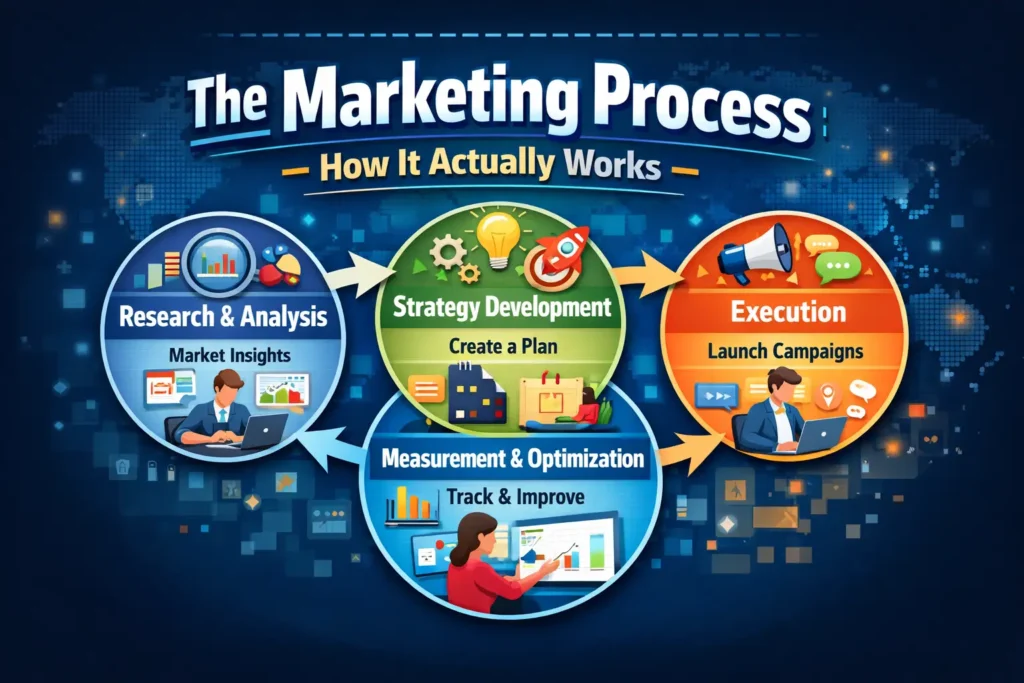
The Marketing Process: How It Actually Works
Marketing follows a systematic process. Here are the essential steps:
Step 1: Research and Analysis
Understand your market, customers, and competition through:
- Market analysis
- Customer surveys and interviews
- Competitor research
- Industry trend monitoring
- Data analytics
Learn how to conduct thorough competitive analysis to inform strategy.
Step 2: Strategy Development
Create a plan based on research:
- Set clear objectives (SMART goals)
- Define target audience
- Establish positioning
- Determine budget
- Select channels and tactics
According to Vertical Response’s November 30, 2025 guide: “Define SMART goals directly tied to concrete business results. Instead of aiming for generic increases in website traffic, set specific targets like a 25% increase in qualified leads.”
Step 3: Execution
Implement the strategy through:
- Content creation
- Campaign launches
- Advertising deployment
- Relationship building
- Multi-channel coordination
Step 4: Measurement and Optimization
Track performance and improve:
- Monitor KPIs
- Analyze results
- A/B testing
- Adjust tactics
- Scale what works
According to Vertical Response: “Agile planning with quarterly reviews and continuous A/B testing will enable brands to adapt quickly to platform changes and market shifts.”
Step 5: Continuous Improvement
Marketing is never “done”:
- Review data regularly
- Update strategies
- Test new approaches
- Learn from failures
- Adapt to changes
2026 Marketing Trends Reshaping the Industry
Marketing evolves rapidly. Here are the most important trends right now:
AI-Powered Personalization
According to Vertical Response’s November 2025 analysis: “AI-powered personalization and automation will dominate marketing strategies in 2026, requiring marketers to integrate generative AI tools across customer journey stages.”
Impact:
- Hyper-personalized content
- Predictive customer insights
- Automated campaign optimization
- AI-generated creative assets
Agentic AI Shopping
Google’s February 2026 predictions highlight: “Consumer AI will move beyond ‘explain this to me’ to become an indispensable agent, actively advising and executing purchases.”
What This Means:
- AI assistants make purchase decisions
- Brands must optimize for AI recommendations
- Traditional customer journeys disrupted
- New discovery pathways emerge
Zero-Click Optimization
More searches end without clicks as AI provides direct answers.
Strategy Shift:
- Optimize for featured snippets
- Build authority AI systems trust
- Focus on entity-based SEO
- Create comprehensive content
Hyper-Local Targeting
According to MarTech Series’ February 2026 report: “70% of Americans now expect advertising tailored not just to their city, but to their precise location at any given moment.”
Approach:
- Neighborhood-level campaigns
- Location-specific offers
- Real-time geo-targeting
- Store-level customization
Brand + Performance Integration
Google’s predictions emphasize: “Retire ‘brand or performance.’ In 2026, it’s about brand and performance. If you aren’t building a full-funnel engine where brand fuels sales and sales build brand, you’re driving with the hand brake on.”
Authenticity Over Reach
According to Pierre Herubel’s January 22, 2026 analysis and Google’s predictions, micro-communities, employee influencers, and genuine connections matter more than mass reach.
Focus Areas:
- Micro-community engagement
- Employee advocacy
- User-generated content
- Real customer stories
Multi-Channel Integration
Vertical Response notes: “Multi-channel integration combining retail media networks, creator partnerships, and micro-communities will be essential for reaching modern consumers.”
Common Marketing Mistakes to Avoid
Based on 2026 research and expert analysis:
Mistake 1: No Clear Strategy
Dinmo’s January 2026 research warns: “A common mistake is the lack of a clear marketing strategy, leading to disconnected actions across multiple channels.”
Solution: Develop coherent strategy before tactics.
Mistake 2: Chasing Every New Tactic
Pierre Herubel’s January 2026 analysis notes businesses face “shiny object syndrome” with constant new tools and AI updates.
Solution: Build marketing foundations first, then selectively adopt innovations.
Mistake 3: Ignoring Data
Marketing without measurement wastes resources.
Solution: Establish KPIs from the start and review regularly.
Mistake 4: Focusing Only on Acquisition
Vertical Response emphasizes revenue-driven goals including “customer retention rate” and “lifetime value.”
Solution: Balance acquisition with retention and expansion.
Mistake 5: Mass Messaging
Generic messages to everyone reach no one effectively.
Solution: Segment audiences and personalize messaging.
Mistake 6: Platform Proliferation
Trying to be everywhere dilutes impact.
Solution: As Clientify advises: “Choose few channels and exploit them well.”
Mistake 7: Short-Term Thinking
Marketing requires patience. Inbound marketing is “slow, but very profitable in the long run” according to Clientify’s research.
Solution: Balance quick wins with long-term brand building.
Conclusion: Marketing Is Essential, Not Optional
Marketing is the bridge between businesses and customers. It identifies needs, creates solutions, communicates value, builds relationships, and drives growth.
Key Takeaways:
- Marketing creates, communicates, delivers, and exchanges value
- It includes research, strategy, execution, and optimization
- The 4 Ps (Product, Price, Place, Promotion) provide foundational framework
- 19+ types of marketing serve different purposes and audiences
- 2026 trends emphasize AI, personalization, authenticity, and integration
- Consumers encounter 1,200 daily advertising stimuli
- 70% expect hyper-local, relevant messaging
- AI agents are becoming shopping advisors and decision-makers
- Strategic marketing aligns with business objectives for long-term growth
What This Means for You:
Whether you are building a business, developing a career, or making purchasing decisions, understanding marketing helps you:
- See through manipulative tactics
- Appreciate effective communication
- Make informed decisions
- Build better businesses
- Create meaningful connections
Marketing is not about tricks or deception. It is about understanding human needs and connecting solutions to people who benefit from them. When done ethically and effectively, everyone wins.
The marketing landscape changes constantly, but the fundamental purpose remains: create value for customers while building sustainable businesses.
Marketing is not everything in business—but without it, everything else struggles.